AI agent vs traditional chatbot: when should you upgrade?
DineshAI, Automation & Technology Strategist
12 min read
The real difference between an AI agent and a traditional chatbot, and the specific signals that mean it's time to upgrade.
The real difference between an AI agent and a traditional chatbot is not how smart the replies sound. It is whether the system can look something up, take an action, and hand off intelligently, or whether it is just matching your message against a decision tree someone built in advance. Most businesses asking "should we upgrade to AI" are actually asking a narrower, more answerable question: has our chatbot's decision tree run out of branches for what customers actually ask.
That reframe matters because a lot of "AI chatbot" marketing sells natural-language phrasing wrapped around the same rigid tree underneath. The upgrade that actually changes outcomes is retrieval and reasoning, a system that can search real content and make a judgment call, not a chatbot that merely sounds more conversational while doing the same fixed-path routing.
The 30-second verdict
#
Traditional chatbot
AI agent
How it decides what to say
Matches input against pre-built rules or intents
Retrieves relevant information and reasons over it
Handles unexpected phrasing
Poorly, falls back to "I didn't understand"
Well, understands intent even with new wording
Answers from live data
Only if a rule was built for that exact case
Yes, via tool calls to real systems
Setup effort
Lower, map out flows and canned responses
Higher, needs a knowledge base and integration work
Maintenance as scope grows
Expensive, every new case needs a new rule
Cheaper, mostly knowledge base updates
Best fit
Narrow, highly predictable interactions
Broader support volume, varied phrasing, live data needs
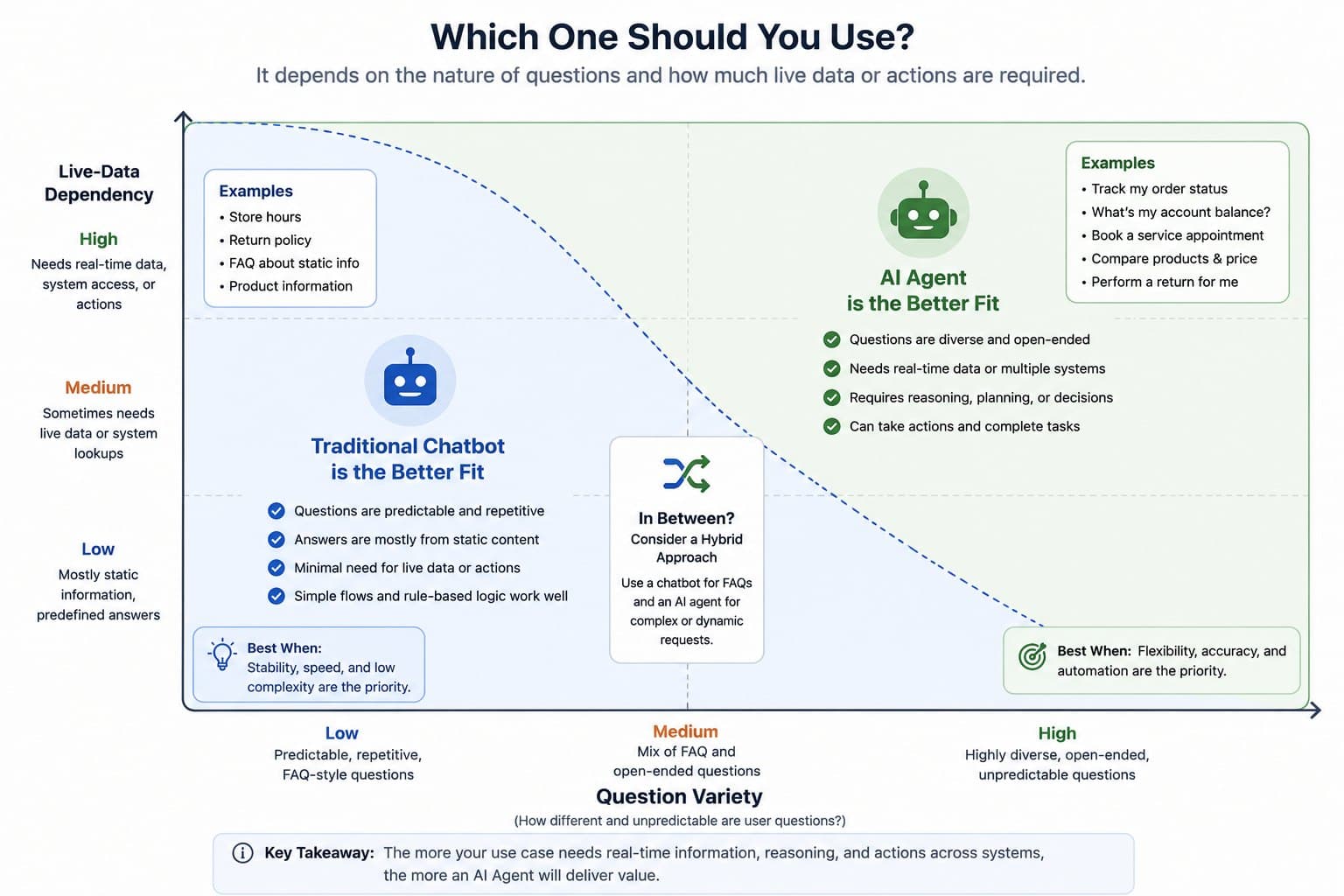
I do not treat this as "AI agent always wins." A traditional chatbot handling three fixed flows (check order status, track a return, get store hours) with no ambiguity in how customers phrase things is often the right, cheaper choice. The agent earns its cost when the question set is broad or the phrasing is unpredictable, not by default.
What each one actually is
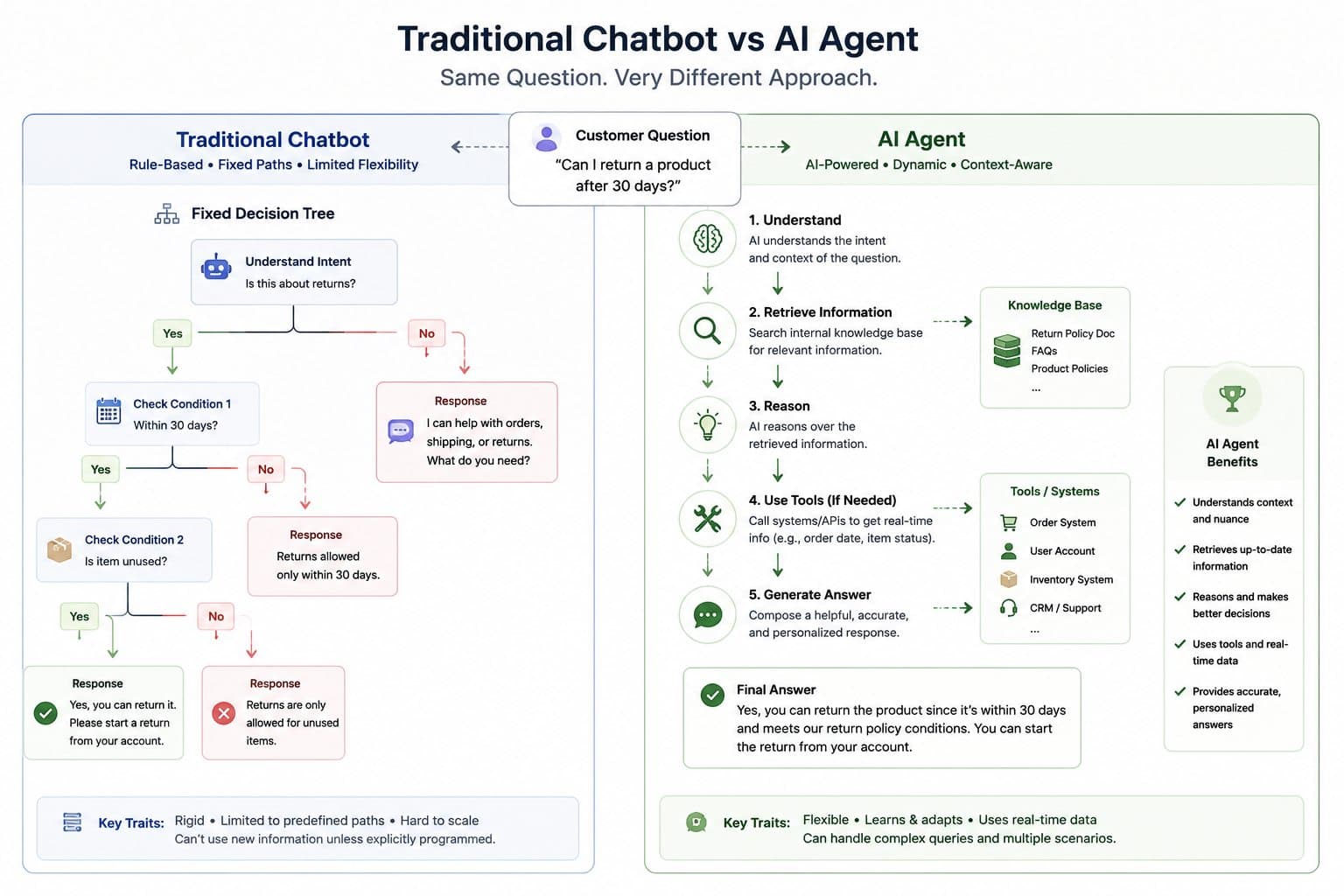
A traditional chatbot runs on rules: intents, decision trees, or keyword matching built by a person in advance. "If the message contains 'refund', show the refund flow." It works exactly as well as the rules someone anticipated, and it fails hard, an "I don't understand that" loop, the moment a customer phrases something outside the anticipated paths. I have inherited chatbot builds where the rule set had grown to hundreds of branches trying to cover edge cases, and the maintenance cost of that sprawl exceeded what a properly scoped AI agent would have cost from the start.
An AI agent uses a language model with retrieval (RAG) and, usually, the ability to call external tools or APIs. Instead of matching against pre-written rules, it searches a knowledge base for relevant content and reasons over what it finds to construct an answer, or decides to call a tool (check an order, look up an account) when the question needs live data. It handles novel phrasing because it is reasoning over meaning, not pattern-matching against a fixed list.
The line between the two is not always sharp. Some vendors sell rule-based systems with LLM-generated phrasing layered on top, which sounds more natural but still fails on the same edge cases a pure rule engine would. The real test is not how it talks, it is whether it can answer a question nobody explicitly anticipated.
Head-to-head
Handling unexpected questions
A traditional chatbot's failure mode is binary: the rule exists, or the conversation dead-ends. A customer asking "can I swap sizes instead of returning" when the rules only cover "return" and "exchange" as separate, rigidly defined flows will likely hit a wall. An AI agent working from a properly indexed policy document can synthesize an answer from related content even if that exact phrasing was never anticipated, because it retrieves the relevant policy and reasons over it rather than requiring an exact match.
Cost of maintenance as scope grows
This is where the two diverge hardest over time. Every new customer phrasing pattern in a rule-based system means someone opening the flow builder and adding another branch, and that cost compounds as the rule tree grows tangled and hard to debug. An AI agent's maintenance is mostly updating the knowledge base, editing a policy document and re-running the index, which is a fundamentally cheaper operation because the reasoning layer does not need to be rebuilt for every new question pattern.
Accuracy on live, changing data
A rule-based chatbot answering "what's my order status" needs a rule wired directly to that specific API call, built and tested in advance. An AI agent with tool-calling can be given access to the same order-lookup capability and reason about when to use it based on the conversation, without a developer having to anticipate and hardcode every phrasing that might trigger that lookup.
Setup cost and speed to launch
Here the traditional chatbot wins outright. Mapping three or four fixed flows and canned responses is genuinely faster and cheaper than building a knowledge base, chunking and indexing content, and testing retrieval quality. If the use case is narrow and well-defined, a rule-based bot ships in days at a fraction of the cost, and building an AI agent for that same narrow scope is over-engineering.
Transparency and predictability
A rule-based chatbot's behavior is fully predictable, it will only ever say what was explicitly written, which matters in regulated or high-liability contexts where an unpredictable response is a real risk. An AI agent's reasoning is less than fully deterministic even with good guardrails, and that unpredictability is a real cost, not a footnote, for use cases where a wrong or off-script answer has legal or safety weight.
Decision framework
Stay with a traditional chatbot if:
The question set is genuinely narrow, three to five well-defined flows cover nearly everything
Customer phrasing is predictable (order status, store hours, simple FAQs)
The interaction has legal or safety weight where a fully predictable, scripted response matters more than flexibility
Budget and timeline favor a fast, low-cost build over broader coverage
Upgrade to an AI agent if:
Support tickets show wide variation in how the same question gets phrased
The rule tree has grown past the point where anyone can confidently predict what it will say for a new phrasing
The bot needs to answer from a large or frequently changing knowledge base (policies, product catalog, documentation)
Live system lookups (order status, account state, inventory) are a meaningful share of the volume
Maintenance cost of adding new rules has become a recurring, growing line item
Real cost comparison
#
Traditional chatbot
AI agent
Initial build
25,000 to 80,000 INR ($300 to $1,000)
1,50,000 to 3,50,000 INR ($1,800 to $4,200) for a Standard-tier build
Monthly running cost
Low, platform fee only, no model usage
Model API usage, typically low hundreds of dollars monthly at moderate volume
Cost to add new coverage
Recurring, grows with rule complexity
Mostly knowledge base updates, flatter over time
Break-even point
Cheaper for the life of the product if scope stays genuinely narrow
Cheaper cumulatively once scope or phrasing variety grows past what a rule tree can cleanly handle
The hybrid approach nobody mentions
The choice is not always all-or-nothing. A pattern I use often: keep rule-based, fully predictable responses for the handful of high-stakes or legally sensitive flows (refund policy specifics, account cancellation, anything with contractual language), and let an AI agent handle the broader, lower-stakes volume where flexibility genuinely helps. The rule-based paths stay auditable and exact where that matters most, and the agent absorbs everything else instead of forcing every interaction through one architecture.
This also gives a lower-risk upgrade path. Instead of replacing an entire chatbot at once, add AI-agent handling for the categories of questions currently hitting the fallback response most often, and leave the flows that already work well as rules alone. Measure the fallback rate on just that added scope before deciding whether to extend it further.
Frequently asked questions
The conversation flows and canned copy generally do not carry over directly, but the underlying content, policies, FAQs, product data, absolutely does. That existing content becomes the knowledge base for the new system, so the upgrade is not starting from zero even though the chatbot logic itself gets rebuilt.
The bottom line
"AI agent vs chatbot" is really "how narrow and predictable is your actual question set, and is that still true today." A traditional chatbot is the right, cheaper tool for a genuinely narrow scope, and staying with it is not a compromise when the scope genuinely fits. The upgrade earns its cost specifically when phrasing variety, live data needs, or rule-tree maintenance have outgrown what a fixed decision tree can handle, and that is a decision worth checking against real conversation data, not against how the technology is marketed.
If you're deciding whether your current chatbot has hit that ceiling, Flowagenz can look at your actual fallback rate and conversation data before recommending a rebuild, not after. Happy to walk through it on a short call.