Your team already knows where the manual work piles up: the same lookup, the same reply, the same copy-paste between five tools. We build the retrieval system or agent that removes that one bottleneck, not a generic chatbot dropped onto your homepage.
AI systems that actually run your business
The problem, reframed
Most AI pilots stall for one reason. They got built as a demo, not as a system with a real data source, an evaluation loop, and an owner who can maintain it once the consultant leaves.
That is not a failure of AI. It is a scoping problem. The fix is not more hype, it is picking one workflow, grounding it in your actual data, and shipping something your team uses on day one.
What we build
01
RAG chatbots grounded in your own documents.
Retrieval built on Postgres with pgvector or a managed vector store, chunking tuned to the content type (a support ticket chunks differently than a product spec), and a retrieval evaluation pass before launch, so the bot does not answer with plausible-sounding wrong information.
02
AI agents wired into your existing stack.
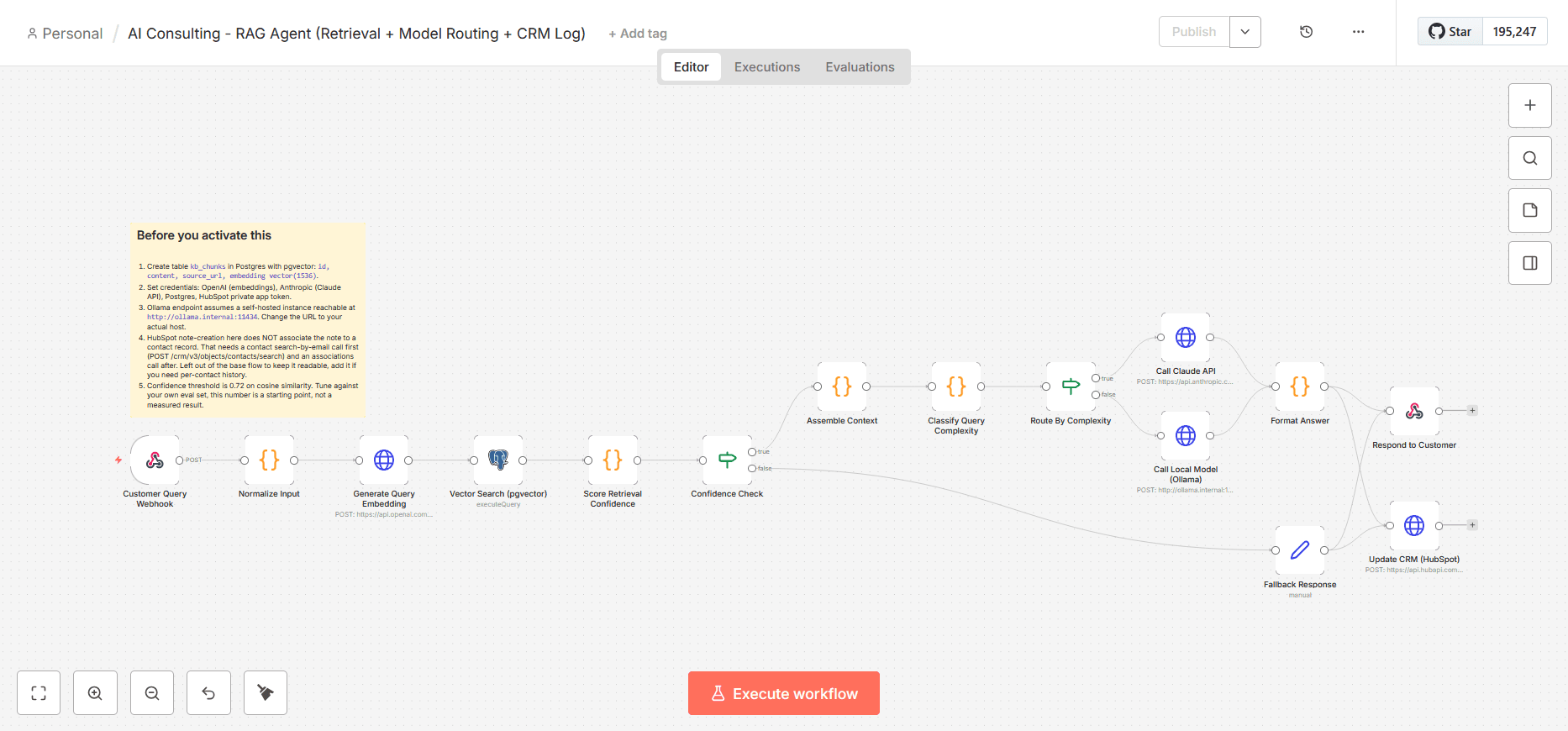
n8n orchestrating the actual API calls, not a black-box "agent platform" you cannot inspect. Your CRM, your inventory system, your support queue, connected through webhooks and REST calls you can open and edit yourself.
03
LLM routing that matches the model to the job.
Claude for multi-step reasoning and long documents, a smaller or open-weight model through Ollama or vLLM for high-volume, low-stakes calls, so the token bill does not scale linearly with usage.
04
Prompt and evaluation harnesses.
A structured test set with known correct answers, run against every prompt or model change, so "the bot got worse" is a diffable regression, not a feeling.
Built on a modern, future-proof stack
I default to Anthropic's Claude API for anything involving multi-step reasoning or long context, and reach for a cheaper model only where the task is narrow enough that the quality gap will not show. Underneath, n8n handles orchestration, so the logic lives in a workflow you can open and edit, not buried inside a vendor's proprietary builder.
Storage runs on Postgres with pgvector when the data fits, or a dedicated vector store like Pinecone or Weaviate when it does not. We ship the front end as a headless Next.js interface when the system needs its own dashboard, not just an API endpoint.
Who this is for
01
Businesses running five or more disconnected tools, where the same data still gets copied by hand between them.
02
Agencies that want white-label AI capability to offer clients without hiring an in-house ML team.
03
Startups that need a working AI feature shipping inside the product, not a slide deck for investors.
04
Teams who hit the ceiling of a no-code AI builder on custom logic or data volume and need something built to spec.
If your situation involves real integration depth, several systems that need to talk to each other, and a workflow specific enough that a generic tool cannot handle it, this is built for that. It is not built for "add a chatbot to my landing page."
Why Flowagenz
Full code and infrastructure ownership on handover. No vendor lock-in, no locked account, full access to the workflows, the prompts, and the hosting credentials once the project closes.
We are based in Salem, Tamil Nadu, which means Western-grade engineering without a US or UK agency's overhead built into the rate. Working hours overlap with US, UK, and Australian teams, and communication runs async by default so nothing waits on one meeting slot a week.
Every system ships with an evaluation set, not just a demo. That means you can tell, objectively, when a prompt change or model swap makes the system better or worse, instead of guessing from a handful of test messages.
Process
How it works
01
01
Scoping call.
We map your actual workflow and the specific decision point the AI should own, not the vaguest version of "AI for the business."
02
02
Data and access audit.
What documents, APIs, or databases the system needs to read, and just as important, what it should never touch.
03
03
Build.
Roughly 2 to 4 weeks for a single-workflow RAG or agent system, depending on integration count and how much the source data needs cleaning first.
04
04
Evaluation and handover.
We review the test set results together, then transfer full code, prompts, and credentials.
FAQ
Frequently Asked Questions
Everything you need to know about our process and digital systems.
Scope drives the number. A single RAG chatbot answering from an existing knowledge base costs less than a multi-integration agent system with its own evaluation harness. We scope against your actual workflow on a call rather than quoting a generic starting price that has nothing to do with what you need.
Related articles
Ready to build something great?
Bring the one workflow that eats the most hours every week. We will tell you honestly whether AI is the right fix for it before we quote anything.