AI voice agent: in-house vs SaaS, the real 2026 cost breakdown
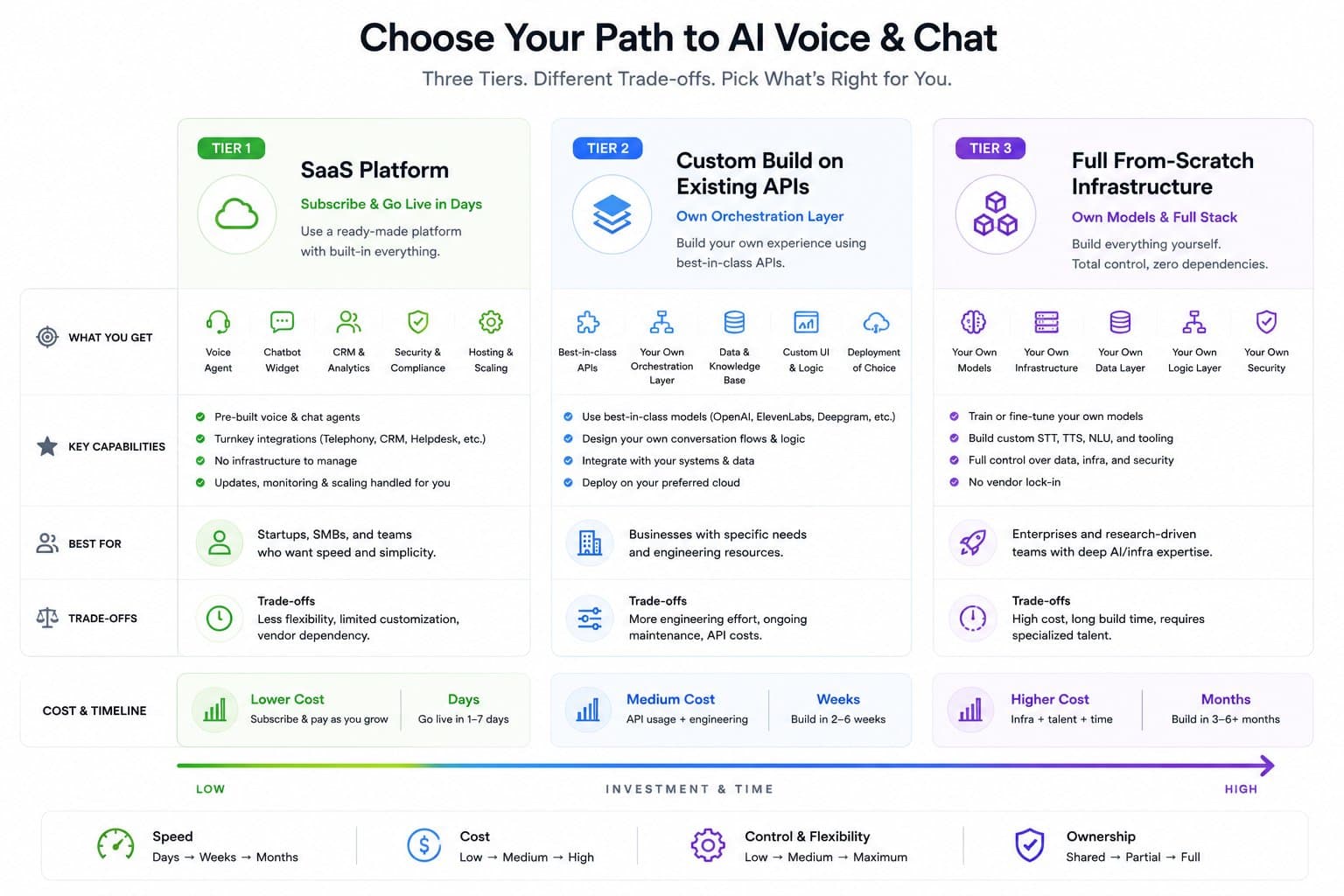
"In-house" is doing a lot of silent work in most build-vs-buy voice agent comparisons, and it's the reason the cost figures floating around 2026 content look wildly inconsistent, some quoting $3,000, others quoting $2 million, for what reads like the same decision. It isn't the same decision. "In-house" spans three genuinely different projects: building your own voice AI stack from scratch, models, infrastructure, everything, which only makes financial sense at massive scale; building a custom orchestration and integration layer on top of existing speech and language APIs, which is what most businesses actually mean when they say "custom build"; and simply subscribing to a managed platform like Vapi, Retell, or Bland. Conflating these three is why so much of this content contradicts itself.
This post separates them, with real 2026 pricing for each, so the comparison you're actually making is clear before you commit budget to it.
For the overwhelming majority of businesses reading a "build vs buy" voice agent comparison, the real decision is between the first two columns. The third column, true from-scratch infrastructure, is a decision reserved for a small number of companies operating at a scale most businesses will never reach.
Tier 1: SaaS platforms (Vapi, Retell, Bland, and similar)
This is subscribing to a managed voice AI platform that handles the orchestration, speech-to-text, language model routing, and text-to-speech pipeline for you, typically billed per minute. Advertised rates cluster in the $0.05 to $0.35 per minute range, but that headline number reliably hides real additional costs: bring-your-own-key models mean you pay your LLM provider separately on top of the platform fee, premium voices cost more, telephony and compliance add-ons stack further, and the true all-in cost commonly lands at two to four times the advertised base rate once everything is included.
At real volume this adds up fast: one detailed teardown found a platform advertising a $0.05 per minute fee actually costing $10,000 to $13,200 a month once speech-to-text, the language model, text-to-speech, and telephony were all added in, for a volume where the platform fee alone would have suggested $2,000. This is the single most common surprise in SaaS voice agent budgeting, and it's worth modeling explicitly before signing rather than after the first real invoice.
Compliance is a real, separate cost dimension here too. HIPAA-relevant add-ons can run $2,000 a month on top of base platform fees, and PII guardrails add further per-minute cost. For any healthcare or regulated use case, get the compliance line items in writing before comparing platforms on their headline per-minute rate.
Tier 2: custom build on existing APIs
This is what most businesses actually mean when they say "we're building this in-house," and it's a fundamentally different project from Tier 3. You're not training models or running your own speech infrastructure, you're building your own orchestration layer, prompts, business logic, integrations, on top of existing best-in-class APIs for speech-to-text (Deepgram is a common choice), language models (Groq, OpenAI, Anthropic), and text-to-speech (ElevenLabs, Fish Audio, and similar).
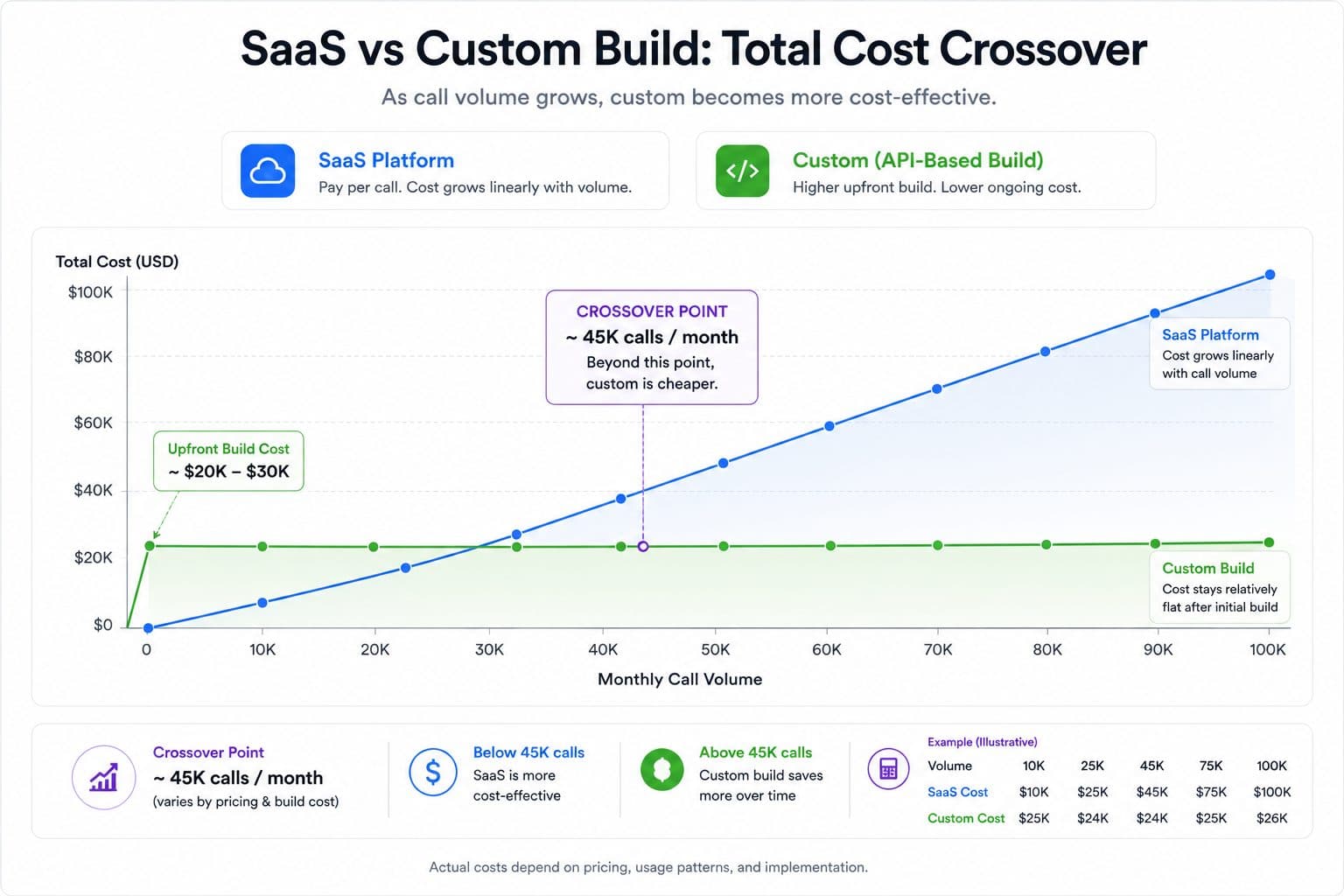
Realistic cost here runs $3,000 to $12,000 for a small or mid-sized business build, and $20,000 to $120,000 at enterprise scale, driven mostly by integration depth and compliance requirements rather than by the core conversation logic itself. What you get for that cost, compared to a SaaS platform, is a genuinely owned asset: the logic, the prompts, the integrations, and the data all belong to you rather than living inside a vendor's platform you pay per minute to use forever. Past a certain call volume and integration depth, this tier also becomes cheaper to run month to month than a per-minute SaaS platform, since you're paying your API providers directly rather than a platform's markup on top of them.
The trade-off is real engineering ownership: you're responsible for latency tuning across your own pipeline, handling API provider outages or rate limits, and ongoing maintenance as underlying model APIs change, work a SaaS platform absorbs on your behalf as part of its fee.
Tier 3: full from-scratch infrastructure
This is a different category of investment entirely: building or fine-tuning your own models, running your own speech infrastructure, owning every layer rather than calling out to existing APIs. Realistic cost is $250,000 to $2,000,000 in year one, with a four to nine month timeline before it's live. This only makes financial sense above roughly 500,000 minutes of voice traffic a month, a volume the vast majority of businesses, including most mid-sized companies, will never approach. Reaching for this tier below that volume is solving a problem you don't have yet, at a cost most businesses have no path to recovering.
When each tier actually wins
SaaS platforms win when: call volume is moderate, speed to launch matters more than long-term per-minute cost, and you don't have engineering capacity to own an integration layer. Below roughly 200 to 400 calls a month, even a low-cost SaaS platform paired with human backup tends to beat any custom investment on pure cost, since platform minimums and setup overhead don't get recovered at low volume.
Custom builds on existing APIs win when: you need integrations or business logic a generic platform can't accommodate well, call volume is high enough that per-minute platform fees start exceeding what direct API costs plus a fixed engineering cost would run, or owning the logic and data outright is a real business requirement, not just a preference. This is also the natural fit for an agency or product team building a repeatable voice agent offering across multiple clients or use cases, where the orchestration layer becomes a reusable asset rather than a one-off cost.
Full from-scratch infrastructure wins when: you're operating at genuinely massive scale, above roughly 500,000 minutes a month, where the fixed cost of owning the entire stack finally amortizes below what any per-minute pricing, platform or API, would cost at that volume.
The bottom line
Most "in-house vs SaaS" voice agent content quietly compares different things under the same label, which is why the cost figures look so inconsistent. Clarify which project you're actually evaluating first: a SaaS subscription, a custom orchestration layer built on existing APIs, or full infrastructure ownership, since these have real cost gaps of one to two orders of magnitude between them. For the large majority of businesses, the real decision is the first two, and it comes down to your actual call volume and how much you value owning the logic versus renting it by the minute.
If you're trying to figure out whether a SaaS platform or a custom build fits your actual call volume and requirements, Flowagenz builds voice agents on both models and can model the real numbers against your specific case. Happy to walk through it on a short call.
Let's create something together
Get in touch with us today.