AI voice agent vs chatbot: when voice actually converts better
The AI voice agent market sits at roughly $5.5 billion in 2026, growing at about 35 percent a year, while the text chatbot market is larger overall, $10 to $12 billion, but growing slower at around 23 percent. Voice is catching up fast, and a wave of vendor content has followed with bold claims: voice agents converting three to four times better than chatbots for lead qualification and booking. Those numbers deserve a skeptical read before they inform a real budget decision, they come almost entirely from companies selling voice AI platforms, not from independent research.
The honest version sits underneath the hype: voice and chatbots aren't competing for the same job in most businesses, they're suited to different interaction types, and the real decision is about matching the channel to how your customers actually want to reach you, not picking whichever technology has the more impressive headline stat.
I default to auditing actual inbound channel volume before recommending either one. A service business where most inbound is phone calls, and where a meaningful share of those calls go unanswered, has a genuinely strong case for a voice agent regardless of what any single conversion stat claims. A digital-first business where customers overwhelmingly reach out through a website or app has the opposite case, just as strongly.
That specific figure appears across several 2026 industry posts, and tracing it back, it consistently cites the same one or two vendor sources, companies selling voice AI platforms, rather than independent, methodologically transparent research. That doesn't make it false, vendors closest to a technology often do have real usage data, but it does mean the number reflects specific use cases (lead qualification, appointment booking) under specific conditions, not a universal multiplier that applies to any business swapping a chatbot for a voice agent.
A more defensible, still vendor-sourced but more specific claim: voice agents reportedly achieve 60 to 75 percent task completion on outbound qualification calls versus 20 to 35 percent for chatbot deflection in comparable B2B workflows. Even taking that at face value, it's describing outbound qualification specifically, not every use case a chatbot handles well, FAQ deflection, order status lookups, and simple self-service tasks aren't the comparison being made in that stat, and chatbots remain strong, cost-effective performers in exactly those categories.
Setting conversion claims aside, there's one difference that's genuinely, mechanically true and doesn't depend on whose research you trust: voice has a hard real-time latency requirement that text simply doesn't. Human conversational turn-taking expects a response within a few hundred milliseconds. Current benchmarks put competitive voice AI platforms in the 400 to 500 millisecond range, and above roughly 700 milliseconds, users start rating the interaction as uncomfortable or robotic, regardless of how good the underlying model's actual answer is. The most advanced platforms are pushing toward sub-200 millisecond latency specifically because that's the threshold where a conversation starts feeling indistinguishable from talking to a person.
This matters practically: a voice agent's speech-to-text, language model, and text-to-speech pipeline all have to complete within that tight window for every single turn of the conversation, a technical constraint chatbots simply don't face, since a two or three second response delay in a chat widget is barely noticed. This is a real, structural reason voice agent quality varies more visibly between vendors and setups than chatbot quality does, latency budget is unforgiving, and a slow retrieval step or an overloaded model provider shows up immediately as an awkward pause a caller actually feels.
Where each one has a genuinely strong, well-supported case
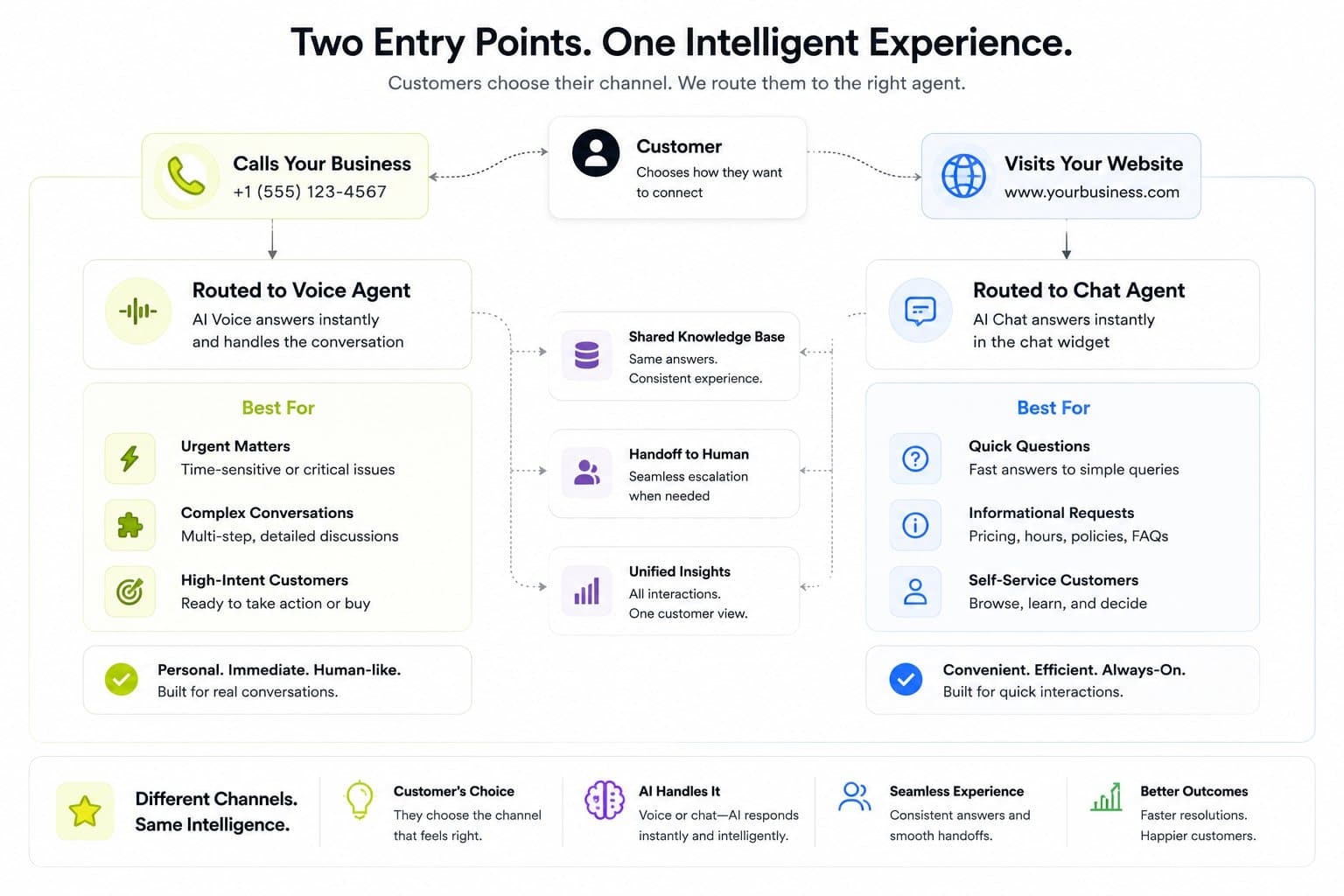
Voice agents win clearly for:
Missed-call recovery. A business where phone calls regularly go unanswered, after hours, during peak times, is leaving measurable revenue on the table every time a call rings out, and this is close to the cleanest, most measurable ROI case for a voice agent, independent of any conversion-rate debate.
Phone-first service industries. Dental offices, HVAC, legal intake, real estate, the businesses where the phone genuinely is where transactions happen, not a secondary channel.
High-stakes or emotionally weighted interactions. Voice agents can pick up on tone and adjust pacing in a way text fundamentally can't, which matters more for something like a churn-prevention call than a routine FAQ.
Chatbots win clearly for:
High-volume, low-complexity queries. Order status, store hours, simple policy questions, the categories where a fast, async text response actually serves the customer better than a phone call would.
Digital-first businesses. If the large majority of customer interaction already happens through a website, app, or messaging platform, that's where the automation should live too.
Cost efficiency at scale. Per-resolved-interaction, chatbots remain the cheaper option for handling large volumes of routine, low-stakes questions.
A practical way to decide, without relying on any single stat
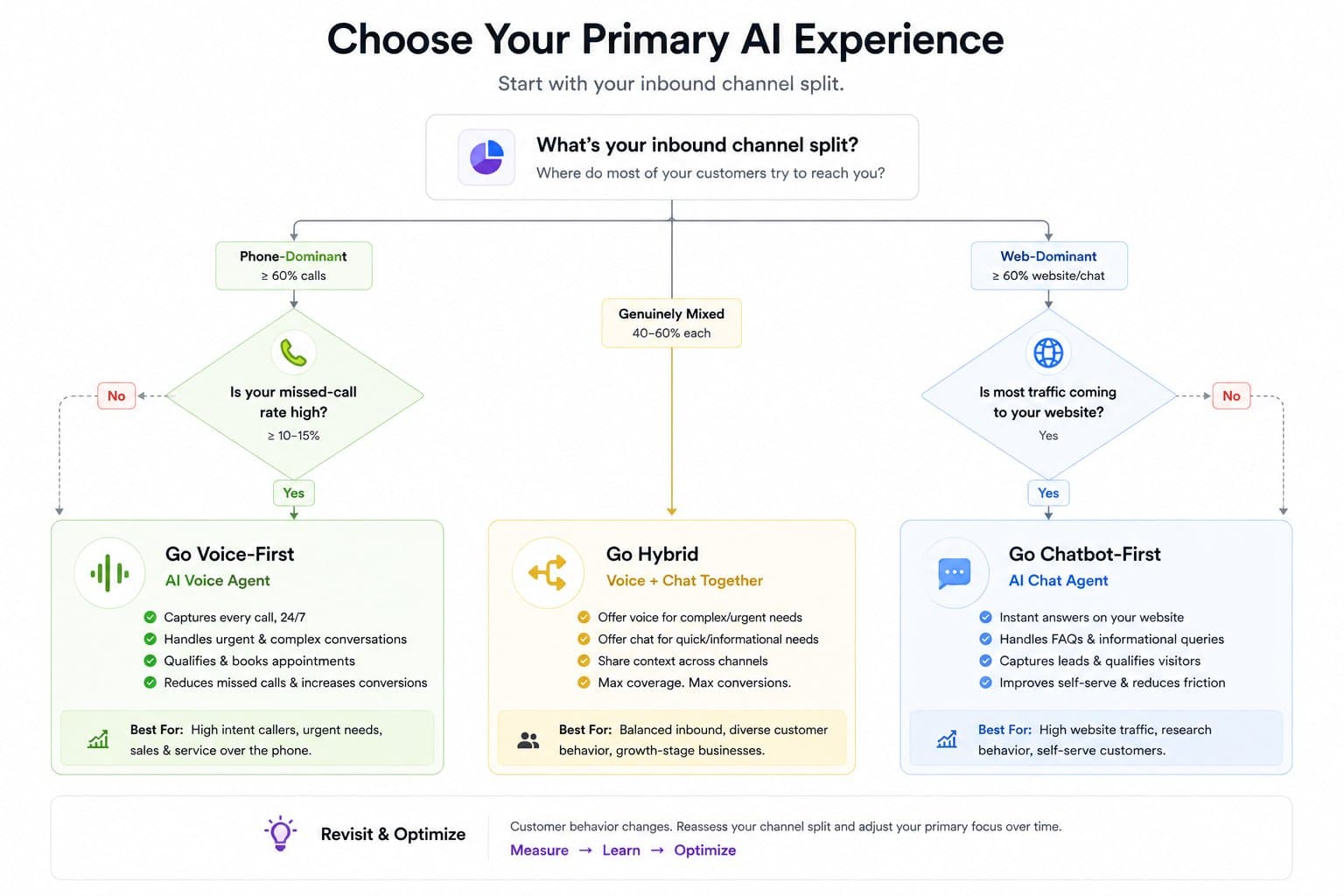
Rather than picking a side based on a conversion percentage from a vendor blog, audit your own actual inbound channel data before deciding:
Check the real channel split over the last 90 days. If more than roughly 60 percent of inbound contact comes through the phone, that's a real signal toward voice, regardless of what a generic industry benchmark says. If it's mostly web or app-based, chatbot is the stronger starting point.
Check your missed-call rate specifically. A missed-call rate above roughly 20 percent is a strong, independently measurable case for a voice agent, since that's lost revenue you can quantify directly from your own data, not from someone else's case study.
Consider a hybrid approach from the start. The strongest customer experiences in 2026 increasingly run both, sharing the same knowledge base and CRM, with each channel handling what it's actually suited for, rather than treating this as an exclusive choice.
Check regulatory exposure before committing to voice specifically. Two-party consent laws, TCPA rules, and HIPAA (for healthcare) all have real implications for automated calling that don't apply the same way to chat, verify this before purchase, not after a compliance issue surfaces.
What actually determines whether a voice agent hits that latency bar
Since latency is the real, non-negotiable technical constraint voice agents face, it's worth understanding what actually determines it. A voice agent's pipeline runs three stages for every single conversational turn: speech-to-text (converting the caller's audio into text), the language model generating a response, and text-to-speech (converting that response back into audio). Each stage adds real, measurable milliseconds, and the total has to stay under that few-hundred-millisecond threshold for the conversation to feel natural.
This is why voice agent quality varies more visibly between implementations than chatbot quality does: a slower speech-to-text provider, a language model call that hits a busy provider, or a text-to-speech step that isn't optimized for streaming output all show up immediately as an awkward pause a real caller notices and reacts to. A chatbot with the same underlying inefficiency just takes an extra second or two to show a typing indicator, barely felt by comparison. Evaluating a voice AI vendor or platform choice means asking specifically about each stage's latency contribution, not just the advertised end-to-end number, since that number can hide which stage is actually the bottleneck under real load.
The bottom line
Voice agents have a real, structural advantage for phone-first, high-intent, or emotionally weighted interactions, and a real, unforgiving technical bar, sub-few-hundred-millisecond latency, that chatbots never had to clear. Chatbots remain the more cost-effective, better-suited choice for high-volume, low-complexity, digital-first interactions. The specific conversion-multiplier numbers circulating in 2026 largely trace back to vendors selling voice platforms, worth treating as a hypothesis to test against your own data, not a settled fact to build a budget around. Audit your actual channel mix and missed-call rate before choosing, that tells you more than any single industry stat will.
If you're deciding between voice and chat for your business, or whether a hybrid setup makes more sense, Flowagenz builds both and can assess your actual channel data before recommending an approach. Happy to walk through your specific numbers on a short call.
Let's create something together
Get in touch with us today.