The framework landscape looks nothing like it did even eighteen months ago, and most comparison posts still written today are recycled from 2024. LangChain shipped its 1.0 release in October 2025 and split its agent orchestration into a separate library, LangGraph. Model providers absorbed a lot of what frameworks used to justify their existence: native function calling, structured JSON outputs, and provider-side agent SDKs now ship out of the box from OpenAI and Anthropic directly. And a real, documented wave of production teams spent early 2026 quietly ripping frameworks out of their stack and replacing them with raw SDK calls.
This post is built from current developer discourse, engineering blog postmortems, npm download data, and practitioner comparisons published through mid-2026, not from what each framework's own marketing page claims. Where a claim below is genuinely contested or the data is thin, that's flagged rather than smoothed over.
The honest framing for 2026 isn't "which framework is best," it's "how much orchestration does your use case actually need, and in which language." A simple support chatbot answering from a knowledge base needs a fraction of what these frameworks are built for.
What's actually changed since the last time you read a comparison post
LangChain matured, then a real exit wave started. The 1.0 release addressed a lot of the stability complaints that had built up over the framework's early years, breaking changes, unclear agent patterns, inconsistent APIs. But by early 2026, engineering teams were publishing detailed postmortems about removing LangChain from production, and the reason wasn't that the software got worse, it's that the abstraction stopped paying for itself. OpenAI, Anthropic, and Google all now ship native function calling, structured outputs, and their own agent SDKs, which used to be exactly what LangChain provided.
LangGraph is the part that actually matters for agents now. LangChain the core library handles a large share of common use cases well, document loading, RAG chains, simple tool calls. But the official recommendation for anything stateful, branching, or long-running is LangGraph, a separate library with its own mental model built around nodes, edges, and explicit state. If you're doing real agent work with LangChain today, you're likely writing LangGraph code whether the docs frame it that way or not.
The adoption gap between raw tooling and framework abstraction has widened, not narrowed. As of npm data from early June 2026, the Vercel ai package pulls roughly 14.2 million weekly downloads against roughly 2.4 million for langchain. That gap reflects a broader shift toward lighter, more direct tooling in the TypeScript ecosystem specifically, not a verdict on LangChain's technical quality.
Vercel AI SDK is not a LangGraph competitor, despite how it's often framed. This is the point most comparison content gets wrong. The Vercel AI SDK is a streaming UI and model-calling toolkit, genuinely excellent for what it does, but it has no durable workflow engine, no first-class persistent memory, and no multi-agent orchestration of its own beyond a basic tool-calling loop. Teams building real agents in TypeScript are increasingly pairing it with something else (Inngest for durable execution, or newer TS-native frameworks like Mastra) rather than expecting the SDK alone to carry agent logic. If your use case is "chat UI in Next.js," the SDK alone is the right call. If your use case is "an agent that needs to survive a restart mid-task," it isn't, on its own.
What each one actually is
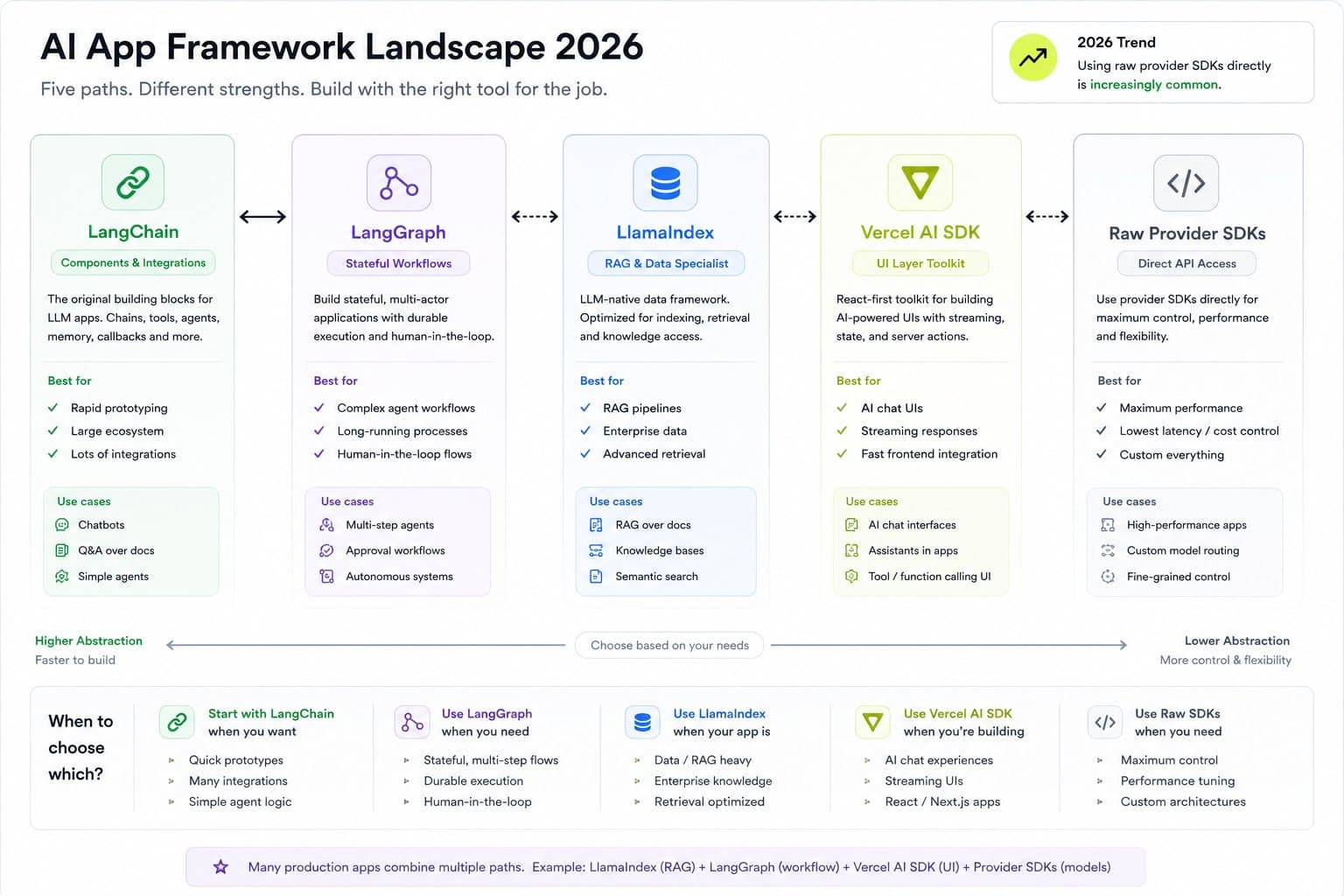
LangChain provides composable primitives, prompt templates, output parsers, memory modules, document loaders, and a large integration catalog covering hundreds of vector stores and model providers. LangChain Expression Language (LCEL), introduced a couple of years back, meaningfully improved how chains get composed compared to the earlier class-based construction. For RAG pipelines with a standard shape, load documents, chunk, embed, store, retrieve, generate, it remains a reasonable, well-trodden default, and the integrations catalog is still unmatched in breadth.
LangGraph models an agent's logic as an explicit graph: nodes, edges, conditional routing, and checkpointed state. This explicitness is exactly what pays off for genuinely complex control flow, branching based on tool results, retry logic on failure, human-in-the-loop pauses mid-conversation. For a simple, mostly linear workflow, LangGraph is more machinery than the task needs. Its TypeScript port exists and is real, but reporting from teams running both editions puts it 4 to 8 weeks behind the Python release on new features, a real cost for a TypeScript-first team that wants the newest capabilities the day they ship.
LlamaIndex was built specifically for connecting LLMs to external data, and that specialization shows. Its data connectors cover well over a hundred sources, and its default retrieval and indexing pipeline requires meaningfully less code to get a working RAG system than LangChain's more general-purpose approach. The trade-off is scope: its agent tooling is less mature than LangGraph's for complex, branching agent workflows, and the integration ecosystem outside of data connectors is narrower, though that gap has been closing.
Vercel AI SDK takes a different starting point entirely: UI-first AI, built around the assumption that the product is a web application where a user interacts through a chat interface or another streaming UI component. It has strong first-party support for a wide range of model providers, real edge-runtime compatibility, and cuts a genuinely large amount of boilerplate for streaming chat UIs in Next.js specifically. What it does not have, by design, is a durable workflow engine or built-in long-term memory, RAG in the SDK typically means integrating a LangChain or LlamaIndex adapter rather than a native pipeline.
Do you need a framework at all
For a genuinely simple use case, one model, one prompt, no multi-step reasoning, no memory, calling the provider's own SDK directly is a defensible, increasingly common choice in 2026 specifically because providers now ship natively what frameworks used to have to build: function calling, structured outputs, and their own agent primitives. The abstraction tax a framework charges buys less than it used to.
Decision framework
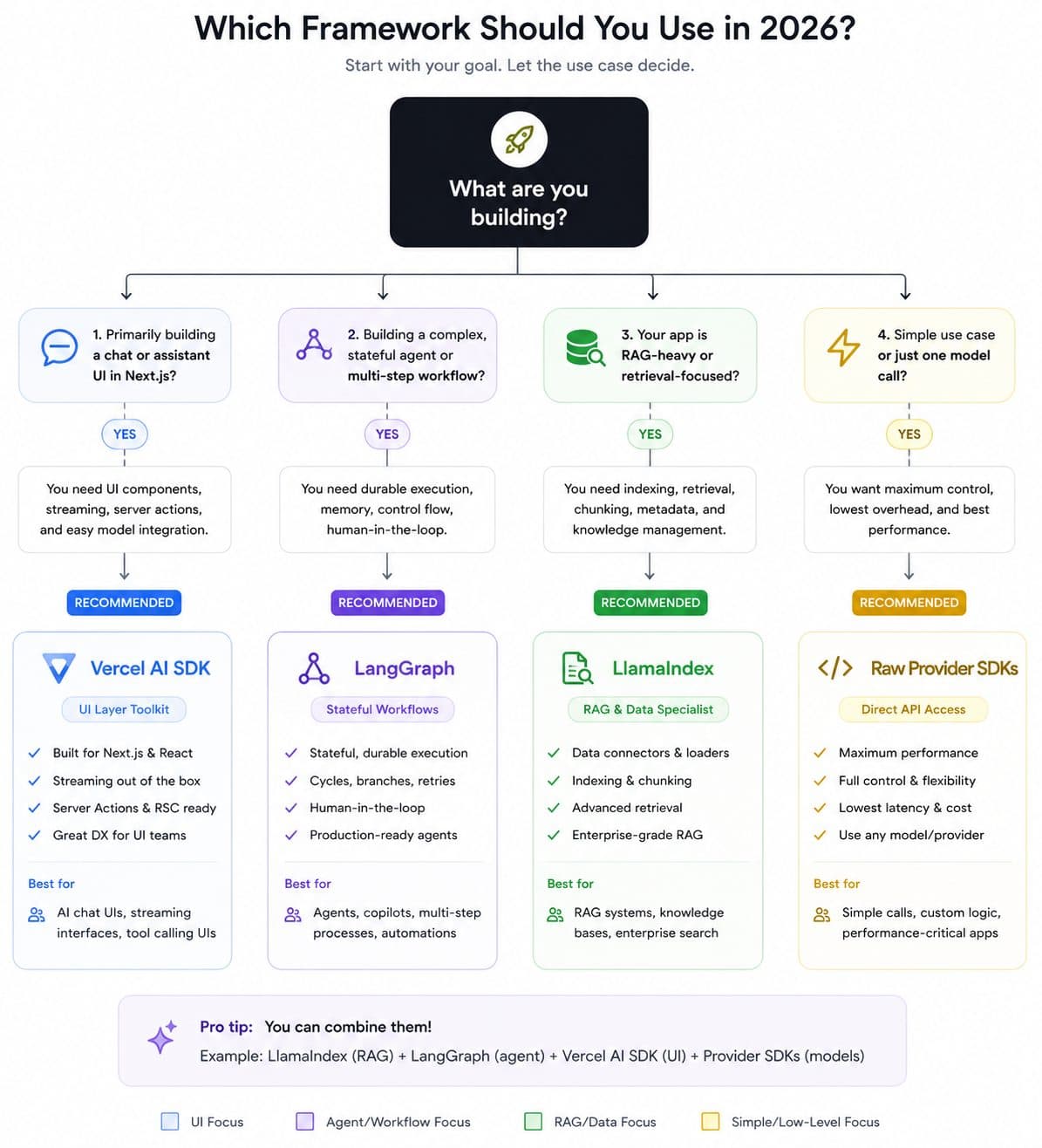
Pick LangChain if: you're prototyping fast, need broad provider and vector store coverage without writing custom adapters, and your workflow shape is fairly standard (RAG, simple tool use).
Pick LangGraph if: the agent genuinely needs branching, retries, human-in-the-loop pauses, or checkpointed state that survives a restart, and your team is comfortable in Python or willing to accept the TypeScript port's lag.
Pick LlamaIndex if: the core problem is retrieval quality over a large or varied document set, and agent complexity is secondary to getting RAG right with less manual pipeline assembly.
Pick Vercel AI SDK if: the product is a Next.js or React chat interface and you need production-grade streaming UI fast, paired with something else (LangGraph, Mastra, or a custom durable workflow layer) if the agent logic itself needs to be stateful or long-running.
Skip frameworks entirely if: the use case is a single-call or lightly branching interaction with one provider, where a raw SDK call is faster to build, easier to debug, and carries no ongoing framework-upgrade tax.
What we actually use, and why that's not the universal answer
Flowagenz builds RAG chatbots and voice agents on a stack that leans on LangChain and LangGraph patterns for the orchestration layer, paired with direct provider SDKs where a framework adds more overhead than value, which matches the current developer consensus above more than it reflects a fixed preference. That combination fits our typical client scope: moderate-complexity agents with retrieval, tool calls, and escalation logic. It is not the right call for every use case, a pure Next.js chat UI project would lean harder on the Vercel AI SDK, and a heavy document-retrieval project with light agent logic would lean harder on LlamaIndex. The point of this post is that the right answer depends on what's actually being built, not on defaulting to whatever a vendor or agency already knows.
The bottom line
There is no single best framework in 2026, there's a best fit for what you're actually building, in the language your team already works in. LangChain still earns its place for fast prototyping and standard RAG shapes. LangGraph is the real answer for complex, stateful agents, if you can live in Python or accept the TypeScript lag. LlamaIndex wins when retrieval quality is the core problem. The Vercel AI SDK wins the UI layer decisively but was never actually competing with the other three for orchestration, despite how it's often listed alongside them. And for a real, growing share of simple use cases, the provider's own SDK is genuinely enough on its own in 2026 in a way it wasn't in 2023.
If you're scoping which of these actually fits your chatbot or agent project, Flowagenz can walk through your specific requirements and recommend a stack based on what you're building, not on which framework we happen to already know. Happy to talk it through on a short call.