MCP, the Model Context Protocol, is an open standard that lets an AI model connect to external tools and data sources through one common interface instead of a custom-built connection for every single pairing. Anthropic introduced it in November 2024, and in a little under two years it has gone from a new idea to something OpenAI, Google, Microsoft, AWS, Salesforce, and Snowflake all now build against, governed since December 2025 by the Linux Foundation's Agentic AI Foundation rather than by Anthropic alone.
That's the headline. The more useful explanation is the specific problem it solves, why that problem was expensive before MCP existed, and what's genuinely still unresolved about it, security chief among them, before you build on it.
The problem it actually solves
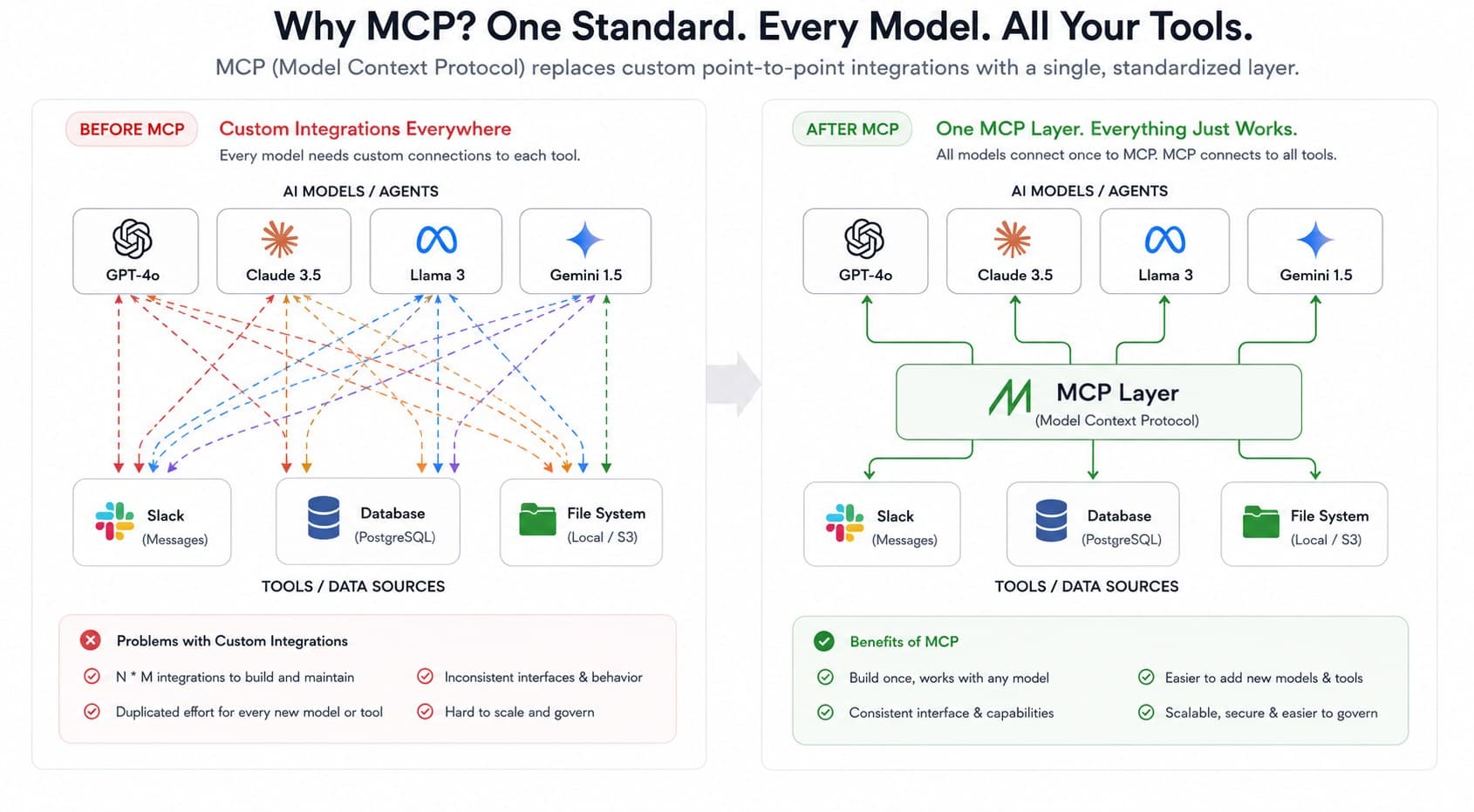
Before MCP, connecting an AI model to your company's Slack, your database, your internal ticketing system, and your filesystem meant writing four separate, model-specific integrations. Add a second AI provider to the mix, maybe you want to run the same setup on both Anthropic's and OpenAI's models, and you're not doubling the work, you're multiplying it: every model needs its own version of every connector. This is the N×M problem, N models times M tools equals N times M custom integrations, and it was the real, expensive bottleneck behind "connect AI to our systems" for most of 2023 and 2024.
MCP collapses that into N+M. Build one MCP server for a resource, your internal API, a database, Slack, and any MCP-compliant AI client can talk to it, regardless of which model is behind that client. Swap providers later, Anthropic to OpenAI, or run several at once, without rebuilding the integration layer underneath.
The USB-C analogy, and where it actually holds
MCP gets called "USB-C for AI" often enough that it's worth addressing directly, because the analogy is genuinely apt in one specific way and misleading in another. Like USB-C, MCP is a common physical-layer standard: one port shape that many different devices plug into, instead of a different cable for every device. That part holds.
Where it's incomplete: USB-C guarantees a physical connection works, it says much less about whether the device on the other end behaves safely once connected. MCP is the same. It standardizes how a model discovers and calls a tool, but it does not, on its own, guarantee that tool is trustworthy, correctly scoped, or safe to grant broad permissions to. That distinction matters more than the analogy usually gets credit for, and it's the source of most of MCP's real 2026 problems.
How it actually works
MCP runs on JSON-RPC 2.0 and defines a small number of core pieces:
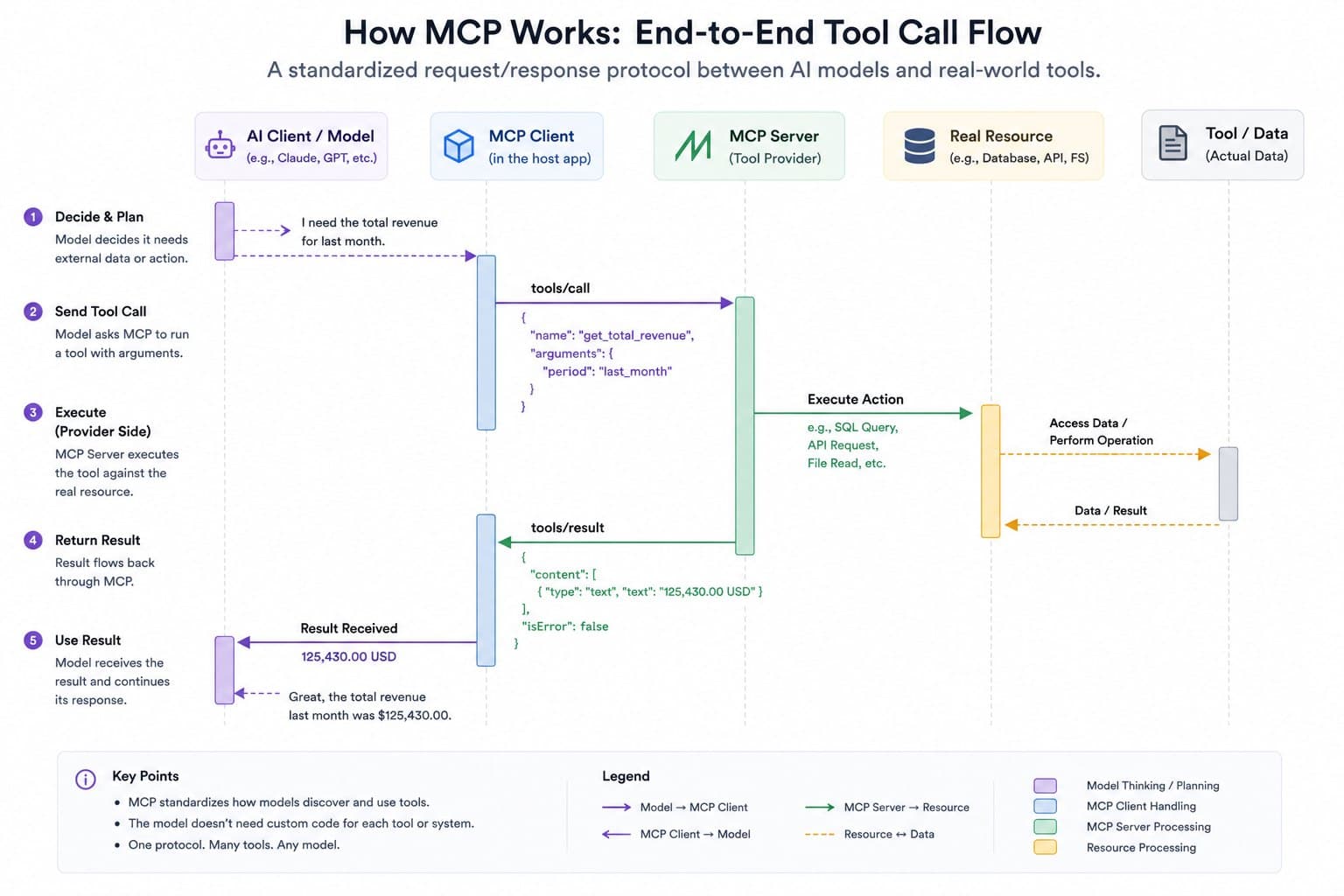
MCP servers expose a specific resource, tools it can call, data it can read, prompts it can offer, through the standard protocol.
MCP clients are the applications, an AI assistant, an IDE, a chat interface, that connect to one or more MCP servers on the model's behalf.
The connection is stateful and bidirectional, meaning the server can maintain context across a session and, in newer capabilities, initiate communication back to the client, not just respond to requests.
A model deciding to check a calendar, query a database, or read a file does so by calling a tool exposed through an MCP server, the same mechanical pattern regardless of which specific tool or server is on the other end. That consistency is what lets one AI client work across thousands of different MCP servers without custom code for each one.
Where MCP actually stands in mid-2026
Adoption is real, but the specific numbers you'll see vary a lot depending on the source, and some widely repeated figures don't hold up well under scrutiny. Monthly SDK download counts near 97 million and a registry of roughly 10,000 active public MCP servers are reasonably well corroborated across independent sources. Production adoption claims are messier: some reports cite 78 percent of enterprise AI teams running MCP-backed agents in production, while the most methodologically transparent survey available, a 2026 industry report surveying senior technical leaders, puts software-industry production adoption closer to 41 to 45 percent. Treat any single adoption statistic on MCP with some skepticism and look for the methodology behind it before repeating it as fact.
Governance moved from one vendor to an industry foundation. Anthropic donated MCP to the Linux Foundation's newly formed Agentic AI Foundation in December 2025, with AWS, Google, Microsoft, OpenAI, Bloomberg, Cloudflare, Block, Salesforce, and Snowflake all involved. That's a meaningful signal, competing companies rarely agree to build on a shared standard unless the alternative, everyone maintaining their own incompatible protocol, is worse for everyone.
Security incidents are real and worth knowing about before deploying MCP broadly. Early 2026 saw more than 30 CVEs filed against MCP implementations within a two-month span, and actual production incidents made headlines: a cross-tenant data leak at Asana, a path-traversal vulnerability at Smithery that exposed thousands of connected apps, and tool-poisoning attacks affecting open-source MCP servers, where a malicious or compromised server manipulates the model into taking unintended actions. None of this means MCP is unsafe to use, but it does mean the protocol's security model is still maturing, and treating an MCP server as automatically trustworthy because it uses a standard protocol is a mistake worth avoiding explicitly.
The specification itself is mid-overhaul. The largest revision since MCP's launch is landing through 2026: a stateless transport core meant to unlock serverless and high-scale deployments, an extension called MCP Apps for server-rendered UI components, a Tasks extension for long-running work, authorization aligned more closely with OAuth and OpenID Connect, and a formal deprecation policy so future changes don't break existing implementations without warning. The release candidate locked in May 2026, with the final specification set to publish July 28, 2026. If you're building on MCP now, budget for this transition rather than assuming today's implementation details are permanent.
What this means if you're actually building with it
Scope permissions narrowly. An MCP server should expose exactly what a model needs and nothing more. The tool-poisoning and cross-tenant incidents from early 2026 largely trace back to overly broad access granted to a server that then got exploited or misused.
Vet third-party MCP servers before connecting them. With roughly 10,000 public servers now available, quality and security posture vary enormously. A server from an established vendor is a different risk profile than an unaudited community project.
Don't treat "it uses MCP" as a security guarantee. The protocol standardizes the connection, not the trustworthiness of what's on the other end. That evaluation is still your responsibility.
Plan for the July 2026 spec transition if you're building new MCP servers now, particularly around authorization, since the alignment toward OAuth and OpenID Connect is a meaningful change from earlier authorization patterns.
Log and monitor tool calls, not just the final model output. Several of the 2026 incidents were caught late specifically because nobody was watching what tools the model was actually invoking in the moment, only reviewing the end result after something had already gone wrong.
Let's create something together
Get in touch with us today.
The bottom line
MCP solved a real, expensive problem, N models times M tools worth of custom integration work, by standardizing the connection layer between AI models and the tools they use. Adoption is genuinely significant, though specific statistics vary more than most coverage admits, and the protocol is backed by enough competing companies that it's reasonably safe to treat as the durable standard rather than a fad. What it hasn't solved, and what any serious deployment needs to account for directly, is the trust and security layer on top of that standardized connection. A common protocol for how a model talks to a tool says nothing about whether that tool deserves the access it's asking for, and that gap is exactly where the real engineering work still lives.
If you're building AI agents that need to connect to real business systems, Flowagenz designs the MCP or custom integration layer with permission scoping and security built in from the start, not bolted on after an incident. Happy to talk through your specific setup on a short call.