Small businesses with 10 to 100 employees went from 47 percent AI adoption to 68 percent in about a year, and the businesses actually seeing returns aren't the ones chasing every new tool. The typical AI-using small business runs a median of five AI tools now, an operational stack built around specific, narrow jobs rather than one all-purpose assistant trying to do everything.
The honest caveat first: Gartner projects that over 40 percent of agentic AI projects will be cancelled by the end of 2027, mostly from unclear scope and cost that got away from the team deploying it. The businesses getting real value picked one measurable job, deployed a focused agent against it, and expanded only once that first agent proved itself. This list is ordered around that principle, real, narrow, currently deployed use cases, not a wishlist of everything AI could theoretically do.
1. Customer service and support
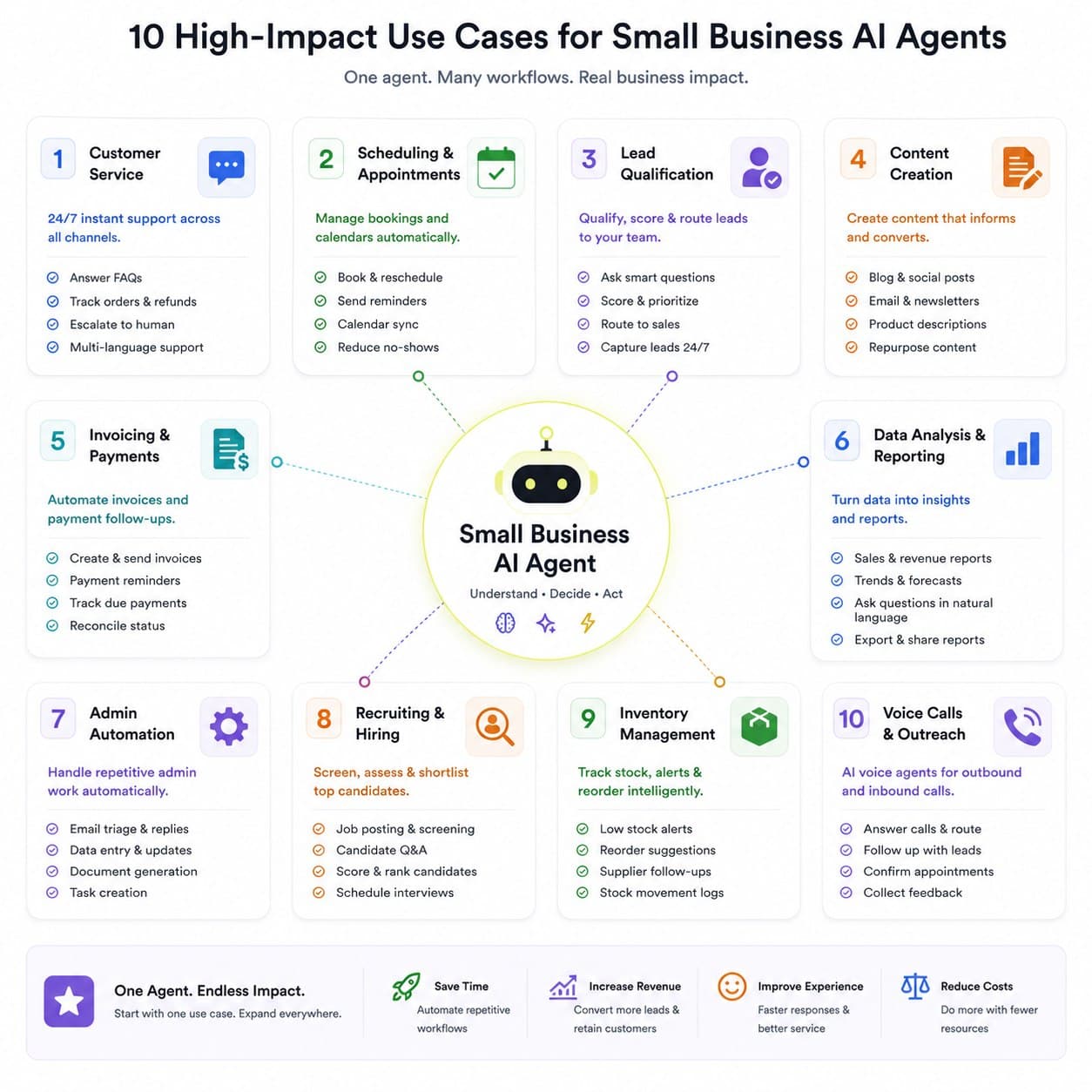
This is the most mature, most measured use case in the data. Agents handling refunds, escalations, and omnichannel support (chat, email, social messages) are saving small teams real hours monthly, and the cost math is stark: an AI-resolved standard support ticket runs roughly $0.46 against $4.18 for the same ticket handled by a person, a nine-times cost difference on routine, repeatable questions. The agent should absorb the repetitive volume and hand off anything genuinely uncertain to a person with full context, not attempt to replace judgment calls.
2. Missed call and voice agent recovery
Local service businesses, clinics, salons, contractors, lose real revenue to calls that ring out after hours or during busy periods. A voice agent answering, qualifying, and either booking or routing the call recovers that lost volume without adding headcount. This is one of the clearer, more immediately measurable wins because the baseline, calls that previously went to voicemail or got missed entirely, is easy to compare against.
3. Lead qualification and follow-up
Sales support is one of the most common agent use cases small businesses report deploying. An agent that reads an inbound lead, asks a few qualifying questions, and routes only genuinely qualified leads to a salesperson keeps the sales team's time on conversations that can actually close, instead of manually triaging every form submission.
4. Appointment scheduling
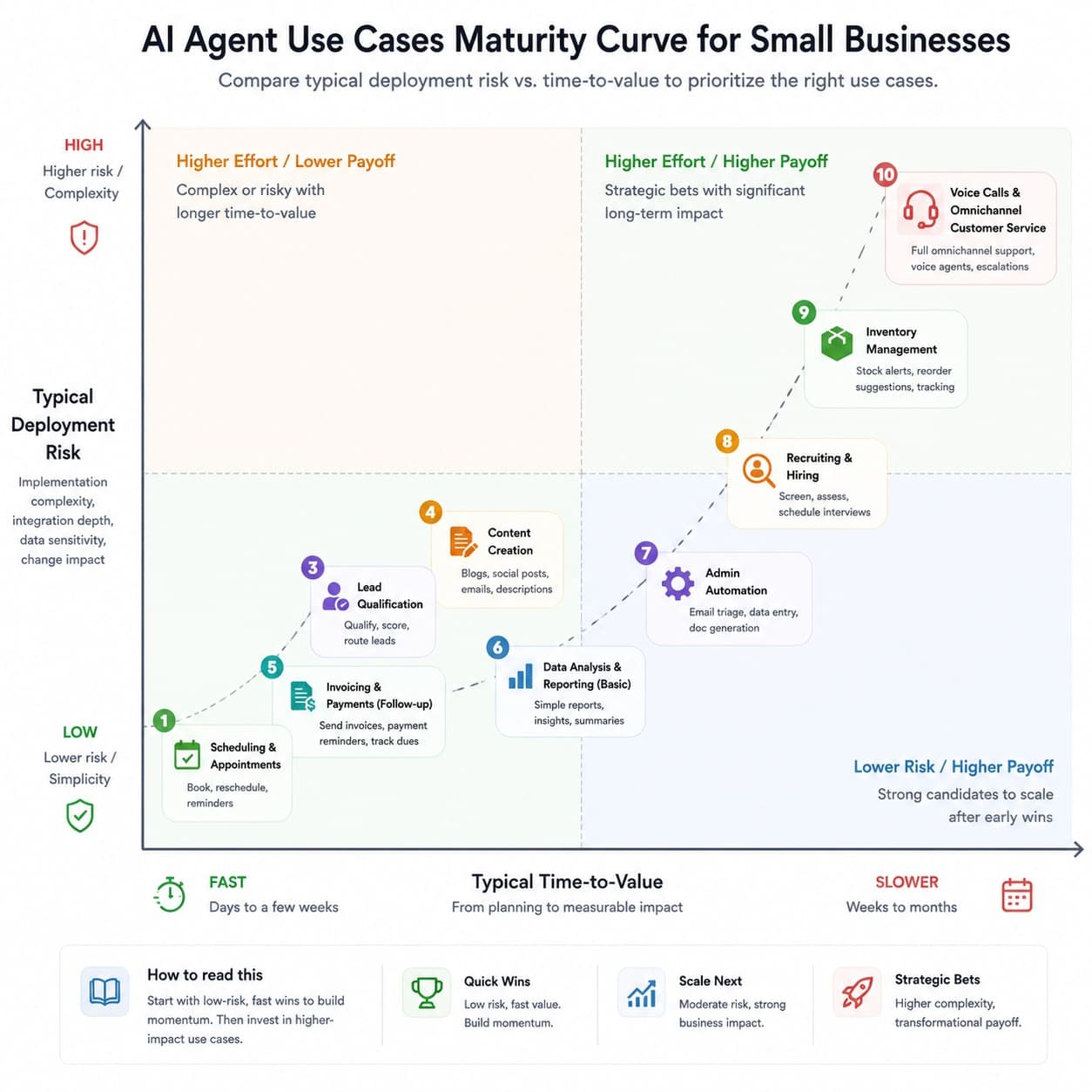
Booking and rescheduling is a narrow, well-bounded job that agents handle reliably: check availability, confirm a slot, send a reminder, handle a reschedule request, all without a back-and-forth chain of messages. This is a genuinely low-risk place to start for a business that hasn't deployed an agent before, since the failure mode (a booking error) is easy to catch and correct.
5. Invoice and payment follow-up
Financial management and forecasting is a named, common use case in current small business AI adoption. An agent that tracks overdue invoices and sends tone-matched reminders on a consistent schedule, gentle for a good customer, firmer for a repeat late payer, replaces a task most small business owners either do inconsistently themselves or don't do at all until cash flow forces the issue.
6. Marketing content drafting
Marketing remains where small businesses see the clearest, fastest return from AI, with AI-using businesses saving five to fifteen hours a week on content work specifically. An agent drafting social posts, email copy, and first-pass blog content doesn't replace a content strategist, but it removes the blank-page time that eats disproportionate hours relative to the value of that specific task.
7. Data analysis and reporting
Data analysis is one of the most widely reported small business AI use cases, and for good reason: pulling a sales trend, summarizing a month's numbers, or flagging an anomaly is exactly the kind of structured, repeatable task an agent handles well, freeing the owner or manager from manually building the same report every week or month.
8. Administrative automation
Processing forms, extracting data from documents, and routine data entry are named among the highest-impact, most commonly deployed agent categories beyond customer-facing use cases. This is unglamorous work, and that's exactly why it's a strong candidate: the task is well-defined, repetitive, and the current manual process is usually someone's least favorite part of their job.
9. Recruiting and screening support
For a small business hiring even occasionally, an agent doing first-pass resume screening against a defined set of criteria, then routing a shortlist to a human for the actual judgment call, saves real hours without removing the human decision from where it matters most: the interview and final hiring call.
10. Research and competitive monitoring
Ongoing market or competitor research, checking for a competitor's pricing change, a new market entrant, a relevant industry development, is exactly the kind of standing, recurring task that gets skipped when nobody has time for it. An agent that runs this on a schedule and surfaces only what actually changed turns a task that keeps getting deprioritized into one that just happens.
How to actually pick which one to start with
The businesses getting real value aren't the ones with the most agents, they're the ones that picked one narrow, measurable job first. Before choosing from this list:
Name the current cost in hours or money. "We spend roughly six hours a week chasing overdue invoices" is a scoping input. "Invoicing feels inefficient" is not.
Pick the use case with the clearest before-and-after measurement. Missed calls, overdue invoice follow-up, and support ticket volume are all easy to measure before and after. A vaguer use case like "improve marketing" is harder to prove out and harder to scope correctly.
Start with one agent, not a stack. The median five-tool AI stack small businesses run today was built one proven use case at a time, not deployed all at once. Expand from evidence, not from a list like this one.
Budget for the scoping conversation, not just the build. The 40-percent project cancellation rate Gartner is tracking traces mostly to unclear scope and cost that wasn't modeled upfront, not to the technology failing to work.
Check whether the industry pattern applies to you. Adoption lags hardest in construction, food service, skilled trades, and local services, largely because owners in those sectors report not seeing an applicable use case. If that describes your business, look for the version of these ten categories specific to your actual operations rather than assuming AI agents simply don't fit, missed-call recovery and appointment scheduling in particular translate well to almost any service-based business, regardless of industry.
Let's create something together
Get in touch with us today.
The bottom line
The small businesses seeing real returns from AI agents in 2026 picked one narrow, measurable job, customer service, scheduling, invoice follow-up, whatever had the clearest before-and-after, and built out from there. The failure pattern is the opposite: broad, vaguely scoped "AI transformation" projects that rack up cost without a clear win to point to. Start with the use case on this list that has the most obvious, countable cost today, prove it out, and let the results, not the hype cycle, decide what comes next.
If you're trying to figure out which of these fits your business first, Flowagenz scopes against your actual numbers, hours spent, calls missed, invoices overdue, before recommending a build. Happy to walk through it on a short call.