Every new enquiry is read, rated and routed to the right rep, with the reasoning stored on the CRM record where your team can check it. Flowagenz builds the n8n workflows behind it, and you own every part of it.
AI lead qualification that explains its score
The problem, reframed
Reps do not spend their time on the wrong leads because they are careless. They do it because a one-line enquiry such as "need quote for 3 offices, urgent" looks the same in the CRM as "just browsing prices", and nobody has time to read every one carefully.
Rule-based scoring only gets you part of the way. It counts what a lead did, such as opening an email or visiting a page, but it cannot read what the lead wrote. That free text is often the strongest signal you have, and today it goes unread.
AI qualification reads it. Done properly, it does not replace your reps' judgment. It gives them a ranked, explained queue so their first calls go to the people most likely to buy.
What we build
Flowagenz does not sell a CRM or a black-box scoring product. It builds a qualification step inside the pipeline you already run, writing to HubSpot, Zoho CRM, Pipedrive or any CRM with a REST API.
01
Structured qualification, not a free-form opinion
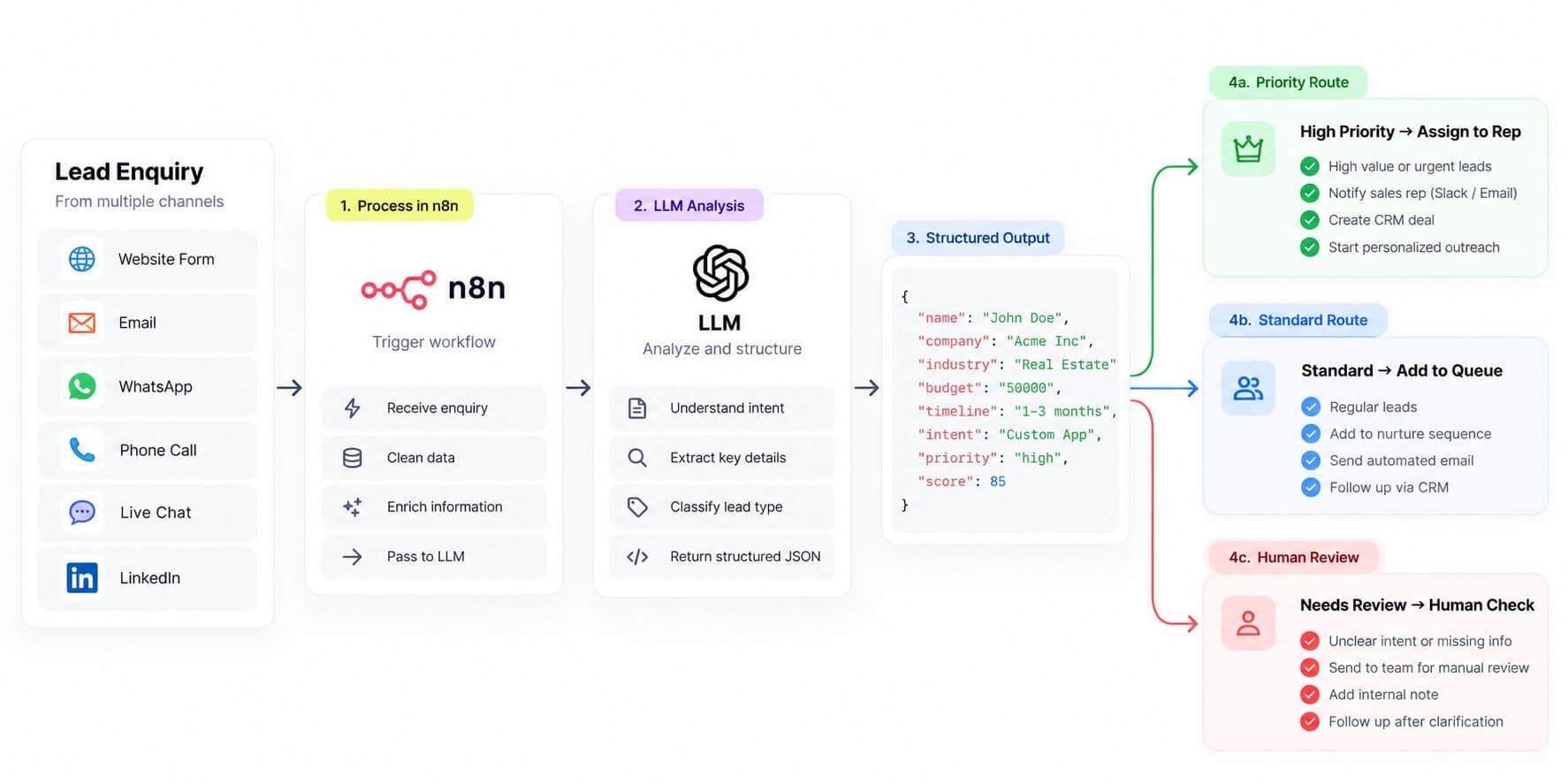
An LLM node in n8n reads the enquiry and returns JSON that follows a schema we agree on: budget band, service interest, urgency, location, language, and a spam or bot flag. A structured output parser rejects any response that does not match the schema, so the CRM only ever receives valid fields and never loose paragraphs.
02
Reasoning stored beside the score
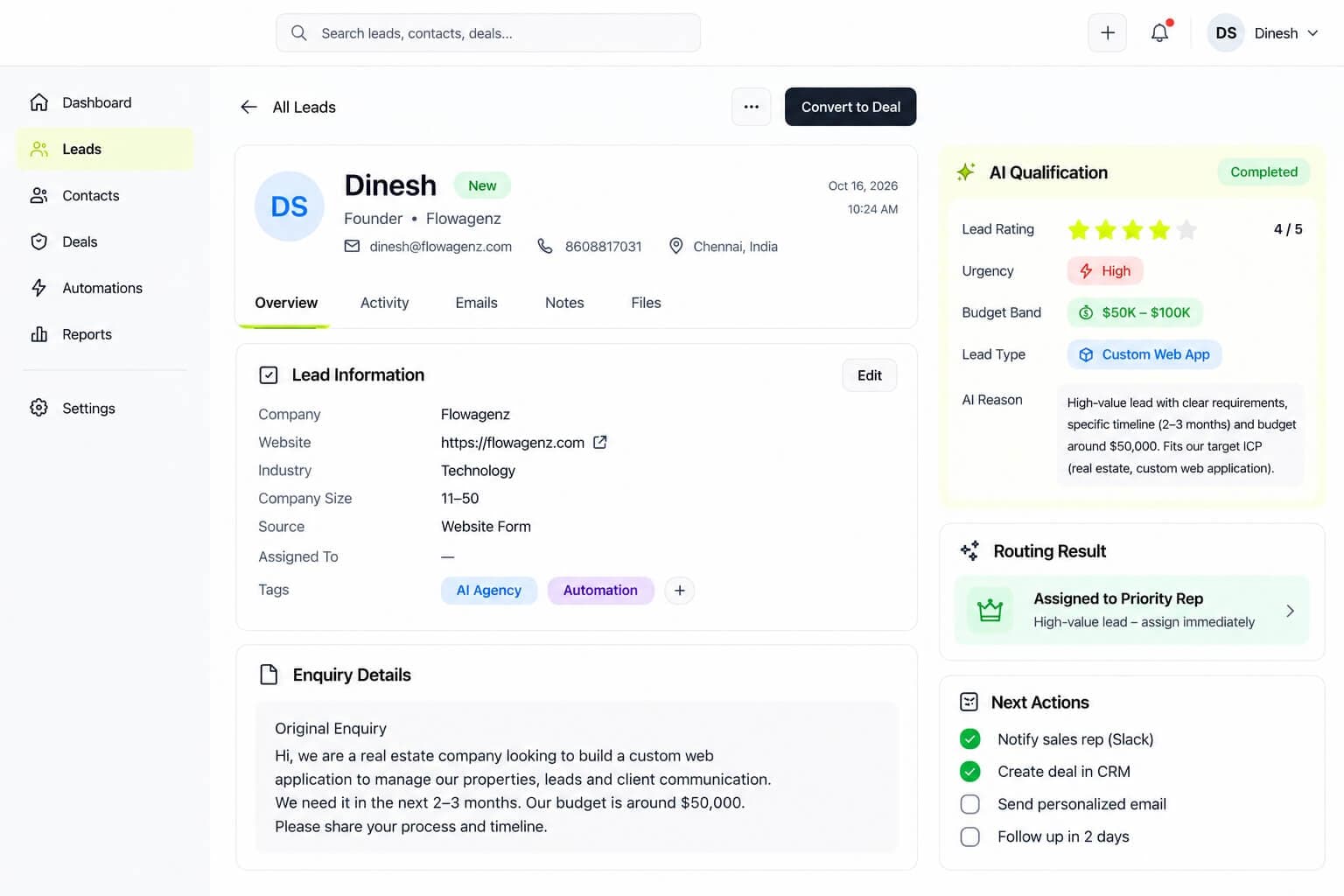
Each rating is written to a custom CRM property together with a short written reason and the original enquiry text. When a rep wonders why a lead is marked low, the answer is on the record. A score nobody can inspect is a score nobody trusts, and unused scoring is wasted spend.
03
Routing from the result
Priority leads go to a senior rep with an immediate alert and a short task window. Standard leads enter the normal round-robin. Anything the model is unsure about goes to a human review queue instead of being forced into a bucket. You set the thresholds, and they can change without rebuilding anything.
04
Multilingual enquiries
The model detects the language of the enquiry and qualifies it in that language. For teams receiving enquiries in English, Tamil or Hindi, a short English summary is attached to the record so any rep can read it.
05
Light enrichment
When an enquiry includes a company email domain, n8n can look up public company information and add it to the context the model sees. Enrichment is optional and only used where the data source is reliable for your market.
06
Spam and bot filtering
Obvious bot submissions and junk are flagged before they take a rep's time, with the flag visible in the CRM so false positives can be caught and corrected.
07
Backtesting before go-live
Before the workflow touches live leads, it is run against a set of your past leads whose outcomes you already know, ideally 50 to 100 of them. We compare what it would have said to what actually happened, adjust the prompt and thresholds, and you see the results before anything goes live. I do not promise an accuracy figure in advance, because it depends on how much signal your enquiries contain. The backtest tells you instead.
Built on a modern, future-proof stack
The workflow runs in n8n, either self-hosted (Docker, PostgreSQL, and Redis queue mode when volume needs it) or on n8n Cloud. The model behind it can come from OpenAI, Anthropic or Google, or from a self-hosted model where lead data cannot leave your servers. Provider choice is a setting, not a rebuild, so you can switch if pricing or policy changes.
Production use needs more than a prompt, so these are part of every build:
Version logging. Each rating records the prompt version and model used, so changes in results can be traced to a cause.
Fallback behaviour. If the model call fails or times out, the lead goes to a human queue with a clear marker. It is never dropped and never auto-rejected.
Cost control. Qualification runs once per lead with a capped input length, so cost per lead stays predictable and you can see it in the run log.
Monthly review. A short review of ratings against actual outcomes catches drift before it affects your pipeline.
Every build also includes an Error Trigger workflow that posts failures to Slack with a link to the run.
From there, it can grow into a RAG chatbot that qualifies visitors on your site before they submit a form, a voice AI agent that qualifies inbound callers, or a custom Next.js dashboard that shows rating against closed outcome.
Who this is for
Growing businesses doing roughly $500K to $10M in annual revenue with enough inbound volume that reps cannot read every enquiry, and a CRM already in place. If you receive a handful of leads a week, a person reading them will do better than a model.
High-enquiry SMBs: dozens or hundreds of leads a month with a wide quality spread.
Agencies: a white-label dev team to build qualification workflows for your clients under your brand.
Service businesses: contractors, clinics, real estate and education, where urgency and budget are written into the enquiry.
Teams with a pipeline already: lead capture running, and the next constraint is rep time.
Why Flowagenz
You own all of it.
Workflows are delivered as exported JSON, the prompt and schema are yours, model and CRM credentials are created in your own accounts, and hosting access is in your name. No vendor lock-in is a contract term.
One senior engineer, start to finish.
You speak to the person building the workflow. I give the engineering opinions, including when AI is the wrong tool for part of the job.
Safe by default.
Built and tested against a CRM sandbox and your historical leads first. Every workflow writes a run log of what it changed, so any automated write can be traced and reversed. Humans keep every decision that moves a deal stage.
Based in Salem, Tamil Nadu.
Western-grade execution at offshore rates. US East Coast mornings are my evening, UK mornings are my afternoon, and Australian afternoons are my morning. Day to day, work moves asynchronously with written updates.
How it works
01
01
Scoping call and data review.
Thirty minutes on how you define a good lead today, plus a look at a sample of past enquiries. You get a fixed quote after this call, in USD or INR.
02
02
Schema and routing design.
A written spec of the fields the model returns, the thresholds, and the routes, which you approve before the build starts.
03
03
Build and backtest.
Built against a sandbox and run on past leads, with the results shared at a review checkpoint.
04
04
Go-live in parallel.
The workflow rates live leads beside your current process, without changing routing, for a short period. Routing switches over once your team agrees the ratings hold up.
05
05
Handover.
Workflow exports, prompt and schema documentation, a recorded walkthrough, and 30 days of post-launch support.
Qualification added to an existing lead pipeline typically takes 2 to 3 weeks. Building the pipeline underneath it as well takes longer, and the scoping call gives you a firm date.
FAQ
Frequently Asked Questions
Everything you need to know about our process and digital systems.
It depends on scope, and I would rather quote properly than give a "starting at" figure that means nothing. The build price depends on your CRM, the number of fields, languages and routes, and whether the lead pipeline already exists. Running cost is the model usage per lead, which is small per enquiry and visible in the run log. You get a fixed build price after the scoping call, in USD or INR.
Book an AI lead qualification scoping call
Tell me which CRM you use and roughly how many enquiries you get a month. In 30 minutes I will tell you whether AI qualification fits your volume, what it would rate, and what it would take to build. No pitch deck, no obligation.