A CRM shaped around how your team actually sells, running on your infrastructure, with code you own and no per-seat licence fees. Flowagenz designs and builds it, and connects it to your forms, WhatsApp, billing and the rest of your stack through n8n.
Custom CRM build for teams outgrowing spreadsheets
The problem, reframed
Most businesses should buy a CRM. HubSpot, Zoho and Pipedrive solve the common cases well, and I will tell you so if that is your situation. Building makes sense in a narrower set of cases:
Your sales process has steps or data that no off-the-shelf pipeline models cleanly, such as site surveys, quote revisions, multi-party approvals or regulated record-keeping.
You are paying for many seats, and most of those users only need a small slice of the system.
You have tried two CRMs and ended up back in spreadsheets, because adapting the tool cost more than the tool was worth.
Your data has to live on infrastructure you control, for contractual or regulatory reasons.
If one of those describes you, a custom build can cost less over three years than the licences it replaces, and fit better from day one. If none do, the honest answer is to buy, and the scoping call will say so.
What we build
Flowagenz builds the CRM around your process, starting with a single pipeline and expanding once it earns its place.
01
A data model drawn from your real workflow
Before any code, we map how a lead becomes a customer in your business: the objects, the stages, the fields each stage needs, and who may see or change what. This workshop is the most valuable part of the project. A CRM built on a wrong data model is hard to fix later, and a right one makes everything after it simple.
02
Core CRM features
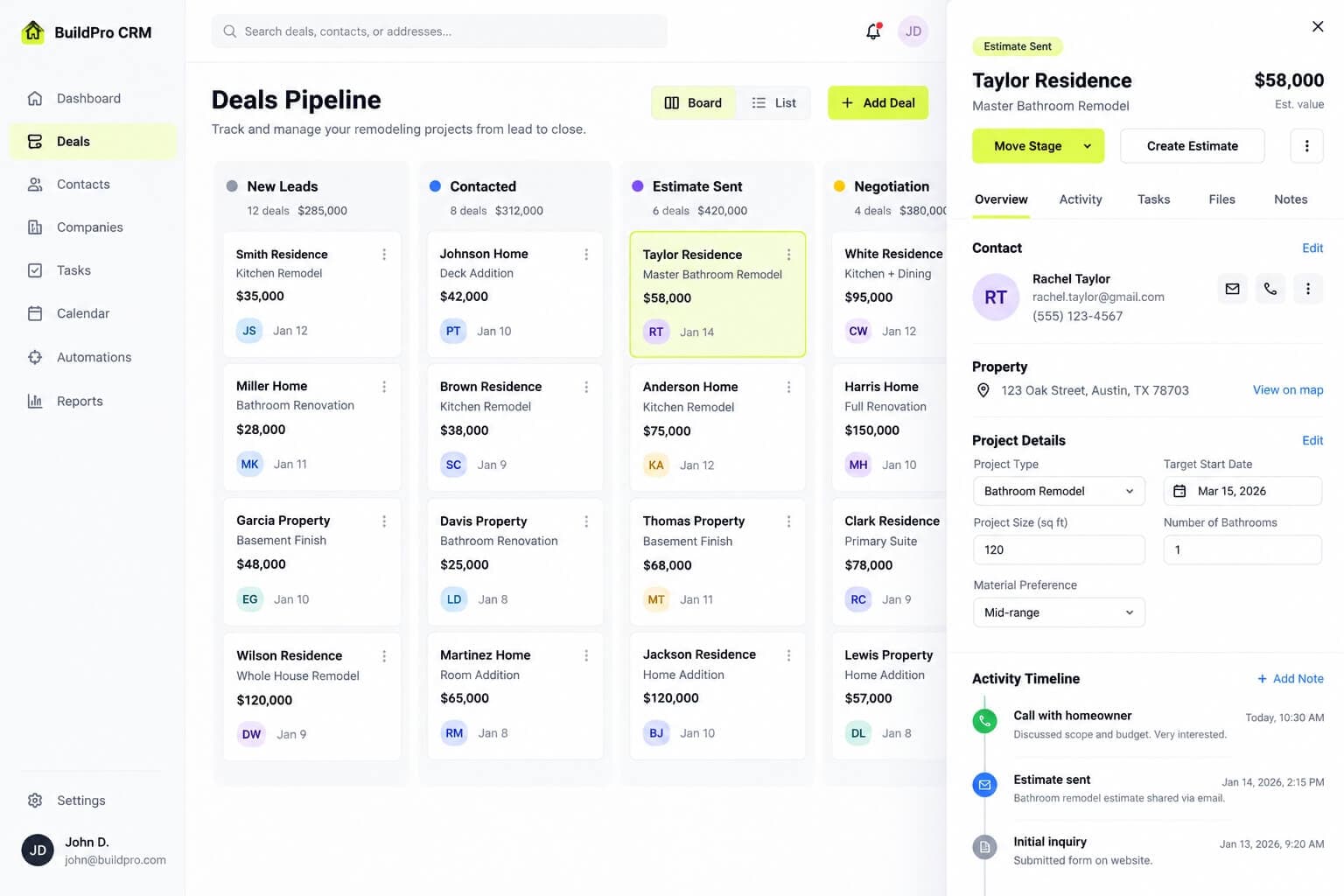
Contacts, companies, deals and pipelines, with an activity timeline on each record. Tasks and reminders, notes, file attachments, saved views and filters, and import and export in CSV with validation and duplicate checks. Custom fields are built in, not bolted on.
03
Roles, permissions and audit trail
Role-based access control, so each person sees what their job requires, with field-level restrictions where needed. Every change to a record is written to an audit log: who, what, when, and the previous value. Sign-in through Google or Microsoft accounts where you use them.
04
Integrations through n8n
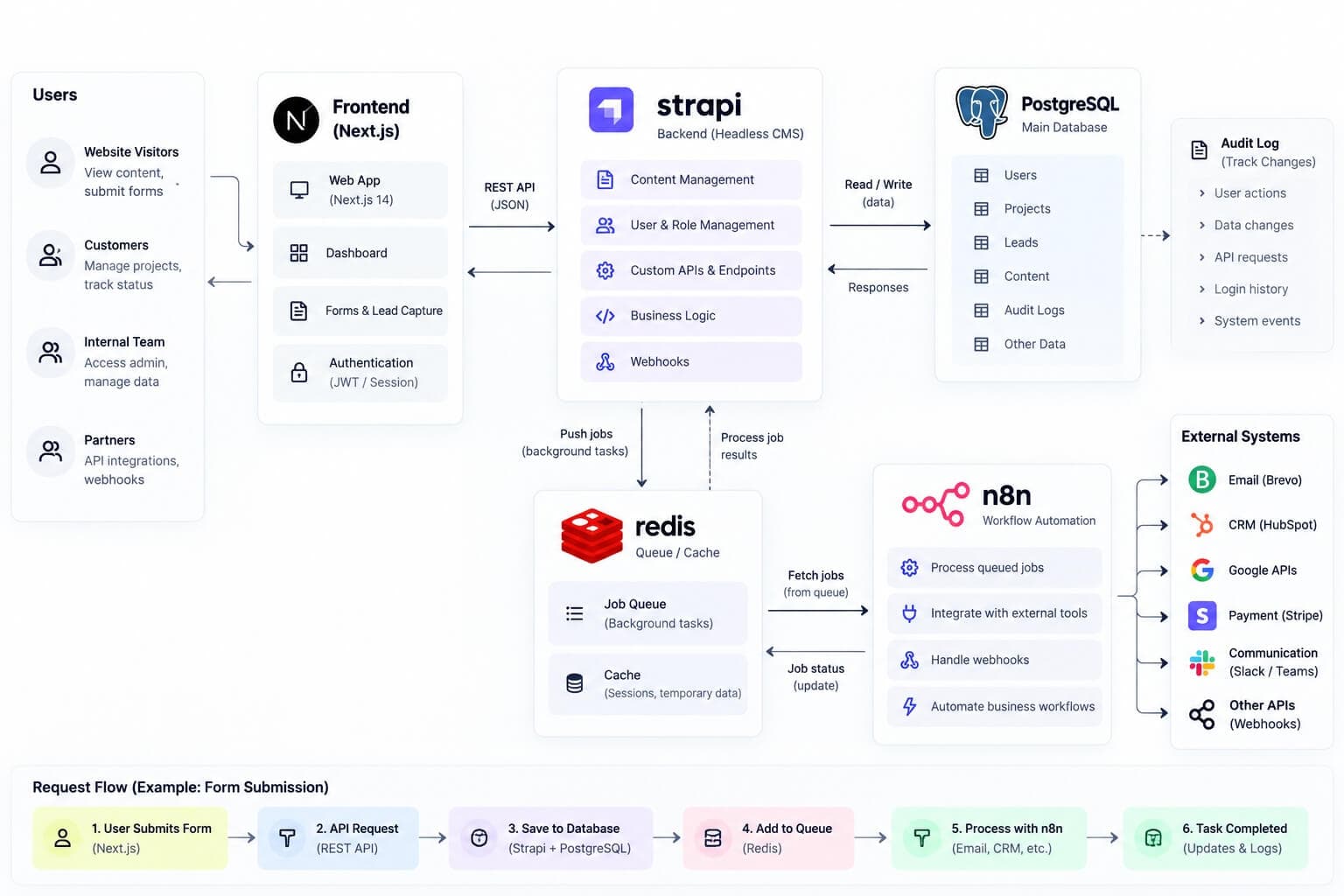
The CRM exposes a REST API and webhooks, and n8n connects it to everything around it: website forms, Meta and Google lead ads, WhatsApp Cloud API, email, accounting tools and calendars. Lead capture, deduplication, routing and follow-up sequences are built the same way as for any other CRM. Because you own both sides, nothing depends on a third party's API limits or pricing changes.
05
Reporting that answers your questions
Pipeline value by stage, conversion between stages, response time by rep, and source performance, built on SQL views over your own data. Anything a standard CRM report cannot show, we can query directly.
06
Optional AI features
AI lead qualification with reasoning stored on the record, call and email summaries, and a RAG chatbot that answers staff questions from your own documents. These are added only where they save real time.
Built on a modern, future-proof stack
The frontend is Next.js. The backend is Strapi or a custom API, depending on how much of your model is standard content-and-relations and how much is custom logic. Data lives in PostgreSQL, with Redis for queues and caching. This is a common, well-documented stack, which matters for you: any competent Next.js and Postgres developer can pick it up later, so you are never dependent on me to keep it running.
Operational basics are part of the build, not extras:
Hosting in your own account. Deployed to your cloud account or a VPS you control, with the credentials in your name.
Backups and restore tests. Automated database backups, and a restore actually tried before go-live. A backup you have never restored is a hope, not a backup.
Monitoring and error alerts. Failures post to Slack with enough detail to act on.
Security basics. HTTPS everywhere, secrets kept out of the code, dependency updates, and access scoped by role.
Who this is for
Growing businesses doing roughly $500K to $10M in annual revenue whose process does not fit a standard CRM, or whose seat costs have grown past what the tool is worth. Below that, buy a CRM and spend the difference on automation.
Process-heavy service businesses: contractors, installers, consultancies and clinics with multi-step jobs and approvals.
Agencies: a white-label dev team to build tailored CRMs and client portals under your brand.
Regulated or data-sensitive teams: those who need records on their own infrastructure with a full audit trail.
Spreadsheet-driven operations: teams whose real system is a shared sheet that has stopped scaling.
Why Flowagenz
You own all of it.
The full source code repository, database, infrastructure and documentation are transferred to you. No vendor lock-in is a contract term, and there is no licence fee to keep it running.
One senior engineer, start to finish.
You speak to the person designing and writing the system. I give the engineering opinions, including when a feature is not worth building.
Scoped to ship.
The first release covers one pipeline end to end, with the minimum that your team can use daily. Everything else waits for evidence that it is needed.
Based in Salem, Tamil Nadu.
Western-grade execution at offshore rates. US East Coast mornings are my evening, UK mornings are my afternoon, and Australian afternoons are my morning. Day to day, work moves asynchronously with written updates, so you are never waiting on a meeting to learn where things stand.
How it works
01
01
Scoping call and process mapping.
Thirty minutes on how you sell today, what you use, and what is not working. You get a recommendation to buy or build, and a fixed quote if building, in USD or INR.
02
02
Data model and design.
A written data model, screen sketches and permission matrix, which you approve before development starts.
03
03
Iterative build.
Weekly releases to a staging site you can use, so your team's feedback shapes the product as it grows.
04
04
Data migration and parallel run.
Existing data is imported and validated, and the system runs beside your current process until the numbers match.
05
05
Handover.
Source code, documentation, a recorded walkthrough, and 30 days of post-launch support, with an optional maintenance plan after that.
A first release covering one pipeline typically takes 6 to 10 weeks, depending on the number of objects, permissions and integrations. The scoping call gives you a firm plan.
FAQ
Frequently Asked Questions
Everything you need to know about our process and digital systems.
It depends on scope, and I would rather quote properly than give a "starting at" figure that means nothing. The build price depends on the number of objects and screens, roles and permissions, integrations, and data migration. The comparison that matters is a build cost plus hosting and maintenance against several years of per-seat licences plus the cost of workarounds. You get a fixed build price after the scoping call, in USD or INR, with that comparison laid out.
Book a custom CRM scoping call
Tell me how your sales process works and what is not working in your current setup. In 30 minutes I will tell you whether to buy or build, and what each path would cost. No pitch deck, no obligation.