Your site needs to move a nervous, time-pressed patient from search result to booked appointment, without a developer standing between you and every text edit afterward. I build healthcare websites and patient-facing portals with the compliance groundwork, scheduling logic, and accessibility work done properly the first time, not bolted on after a security review flags it.
Healthcare website development that patients can book from
The problem, reframed
Most medical and health-tech sites are built by whoever also does the practice's business cards. That gets you a homepage and a contact form, not a system that talks to your scheduling software, respects patient data handling, or scores above a 60 on PageSpeed on the phone your patients are actually using.
The fix isn't a bigger agency. It's a build where the data model, the third-party integrations (EHR, scheduling, insurance verification), and the accessibility layer are planned before the first page template gets touched, and refined and extended as your practice or platform grows rather than rebuilt every eighteen months.
What we build
Patient-facing marketing and information sites Multi-location practice sites with location-specific landing pages, provider bios pulled from a structured custom post type, and MedicalOrganization and MedicalWebPage schema markup so Google can surface your hours, specialties, and accepted insurance directly in search results.
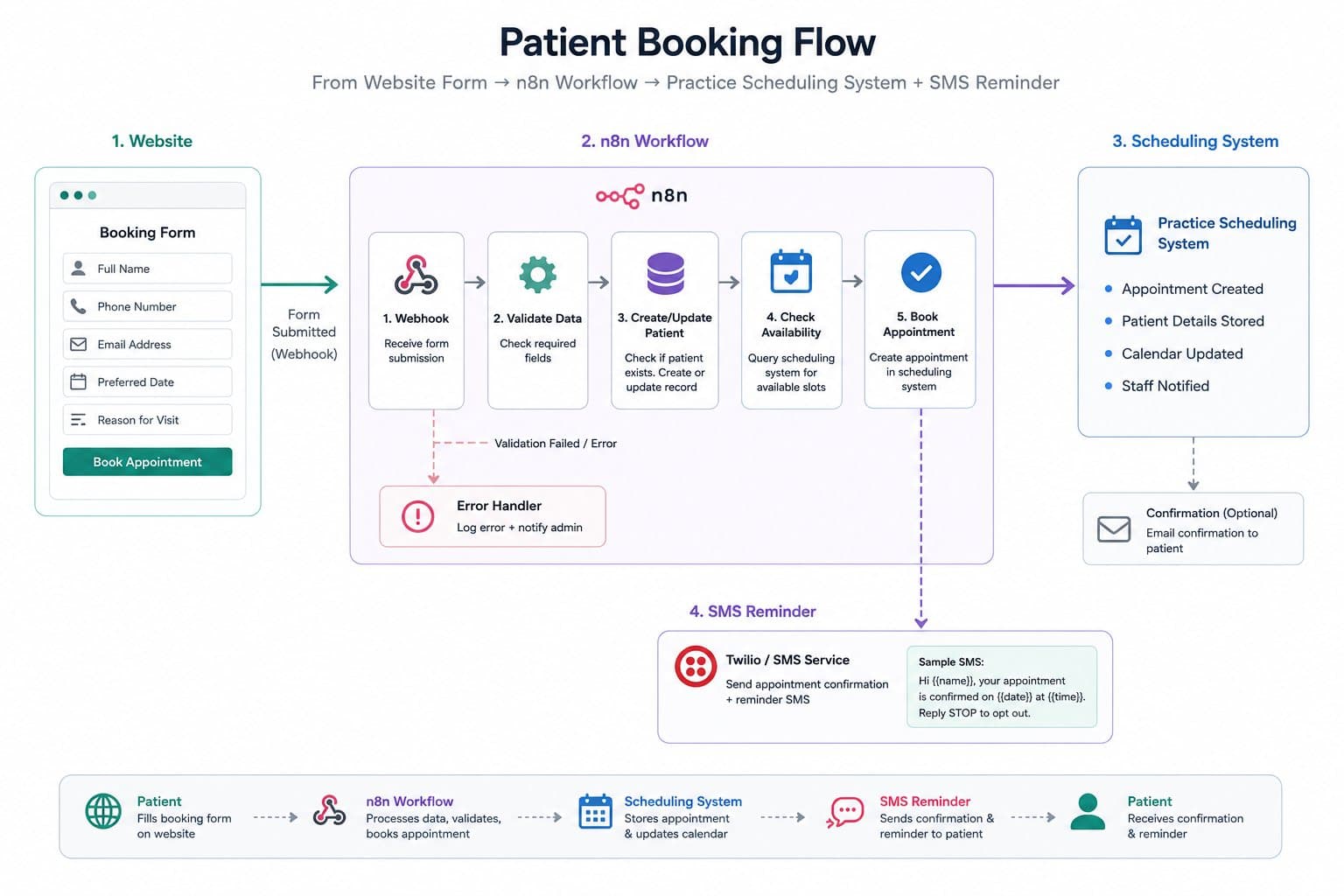
Appointment booking and intake Booking flows that write to your actual scheduling system rather than a generic embedded widget. I've built this against REST and webhook-based scheduling APIs, with n8n handling the reminder sequence (SMS and email) and the no-show follow-up, so front-desk staff aren't manually re-keying appointments from a form submission.
EHR and EMR integration work Where a build needs to talk to clinical systems, I work against HL7 or FHIR-based APIs for read access to appointment slots, provider availability, or patient-facing lab results. I'll usually push back on a full EHR integration until you actually have a scheduling bottleneck it would fix. It's easy to scope for a problem you don't have yet.
HIPAA-conscious infrastructure Hosting, forms, and data handling built around HIPAA's technical safeguard requirements: encrypted transit and storage for anything touching PHI, access logging, and a hosting environment that will sign a Business Associate Agreement. A website vendor calling itself "HIPAA compliant" isn't describing a certification anyone can actually sell you. Compliance is a program covering your whole organization, and a properly built site is one piece of it. I'll flag exactly what a BAA and your compliance counsel need to review before intake forms or a patient portal go live.
Accessibility built to WCAG 2.1 AA Keyboard navigation, screen reader labelling on every form field (particularly intake and insurance forms), and color contrast that holds up under real audit, not just a plugin badge. Healthcare sites carry real ADA litigation exposure, and this gets built in from the first template, not patched in after a demand letter.
Built on a modern, future-proof stack
Custom WordPress with ACF flexible content for provider and location management works well for most single-to-multi-location practices. For health-tech companies running a marketing site alongside a product, I build headless: WordPress or Strapi as the content layer, Next.js on the front end, so your product team can ship the app independently of the marketing site's release cycle.
n8n sits underneath either stack for the workflow layer: appointment reminders, intake form routing to the right department, insurance pre-verification handoffs, and patient satisfaction follow-ups after a visit. Where a practice wants a first line of patient-facing triage, I'll scope a RAG chatbot trained on your actual FAQ and services content, with a hard handoff to a human for anything clinical.
Who this is for
01
Private and multi-location practices
outgrowing a template site, needing provider bios, location pages, and a booking flow that reduces phone tag.
02
Health-tech and telehealth startups
needing a marketing site that can integrate with a product roadmap, not a static brochure disconnected from the app.
03
Medical device and health SaaS companies
needing a technical marketing presence with case studies, resource centers, and lead-routing into a CRM.
04
Agencies
needing white-label healthcare development capacity for a client project involving compliance or integration work outside their in-house skill set.
The right-fit signal isn't revenue. It's situation: multiple locations to manage, an EHR or scheduling system that needs to talk to the site, patient-facing forms handling anything sensitive, or a marketing site that has outgrown a page builder.
Why Flowagenz
I work out of Salem, Tamil Nadu, which means Western-grade engineering at a build cost that doesn't require a US or UK dev-shop retainer. Daily overlap covers US, UK, and Australian business hours, so a question sent at the end of your day gets picked up, not queued for tomorrow.
On completion, you get full ownership of the codebase and hosting access. No agency login you can't get removed, no plugin license tied to my account, no lock-in. If you want to bring development in-house later or hire a developer directly, that's your call to make, not mine to block.
Process
How it works
01
01
Scoping call.
We walk through your current site, scheduling and EHR systems, and any compliance requirements your practice or platform is already under. No generic quote before this call; a healthcare build's cost depends entirely on integration depth.
02
02
Architecture and data model.
I map out the content model (locations, providers, services) and any third-party API connections before a single template is built.
03
03
Build on staging.
Weekly async updates, with a milestone review at the design sign-off and again pre-launch.
04
04
Compliance and accessibility pass.
WCAG audit and a review of anything touching PHI against your BAA requirements, before go-live, not after.
05
05
Launch and handover.
Full code and hosting access transferred, plus a short walkthrough of the native editor for day-to-day content changes.
Standard practice or clinic sites run 3 to 5 weeks. Builds with EHR integration or a headless architecture typically run 6 to 10 weeks depending on how many systems the site needs to talk to.
FAQ
Frequently Asked Questions
Everything you need to know about our process and digital systems.
No, and be wary of anyone who promises that. HIPAA compliance is an organizational program, not a website feature. What I deliver is infrastructure built around HIPAA's technical safeguards, encrypted PHI handling, access logging, and a hosting provider willing to sign a BAA, and I'll clearly flag what your compliance counsel still needs to review before intake forms or a patient portal go live.
Ready to build a healthcare site that actually books patients
Tell us your current setup: how many locations, what scheduling or EHR system you're running, and where patients currently drop off. We'll scope the real build on a short call, not a generic quote.