Your booking engine, menu, and reservation flow run on one system you control, not a template fighting your POS or channel manager. We connect the site to the tools you already run, so direct bookings convert instead of bouncing off a slow gallery page.
Direct booking systems for hotels and restaurants
The problem, reframed
Most hospitality sites were built once, for a launch event, then left alone while the business added a POS, a channel manager, an online ordering app, and a review widget on top. None of it talks to each other. Someone updates the dinner menu on the website, then updates it again on the ordering app, then a third time on the delivery aggregator.
That is not a broken site. It is a site that was never asked to be the hub. Ours are.
What we build
01
Booking and reservation engines
Real-time availability synced to your PMS or channel manager (Cloudbeds, Little Hotelier, SiteMinder), not a static contact form pretending to be a booking flow. For restaurants, a table reservation and waitlist system that writes straight to your host stand or CRM instead of a second inbox to check.
02
Menu and rate management your team owns
Seasonal menus, dietary tags, and daily specials edited in a native block editor, no developer needed for a price change. Room rates and package pricing pull from your PMS so the website is never the stale copy of the real number.
03
Payments and deposits done properly
PCI-compliant deposit collection at checkout through Stripe or Razorpay, with authorization holds and refund logic matched to your actual cancellation policy, not a generic plugin default.
04
Schema and local search structure
Restaurant, Hotel, Menu, LocalBusiness, and FAQPage schema markup wired in from day one, plus Google Business Profile and Reserve with Google sync where the platform supports it. This is what gets your hours, menu, and star rating showing directly in search results instead of just a blue link.
05
Multi-location architecture
For groups running more than one property or outlet, each location gets its own structured data, its own booking widget, and its own local landing page, all pulling from one shared content model so a menu change at HQ does not mean five separate edits.
06
Performance for image-heavy sites
Hospitality sites live and die on Core Web Vitals because the whole point is showing off a room or a plate. We tune LCP on hero imagery specifically, not just run a generic speed audit and call it done.
Built on a modern, future-proof stack
I default to WordPress with ACF flexible content and Gutenberg blocks for independent restaurants and single-property hotels: fast to launch, easy for staff to self-manage, and cheap to maintain. For hotel groups running four or more properties or a restaurant brand expanding past three locations, I move to headless: Next.js on the front end, Strapi or headless WordPress on the back end, so the same content model can power the website, a future app, and a kiosk display without three separate builds.
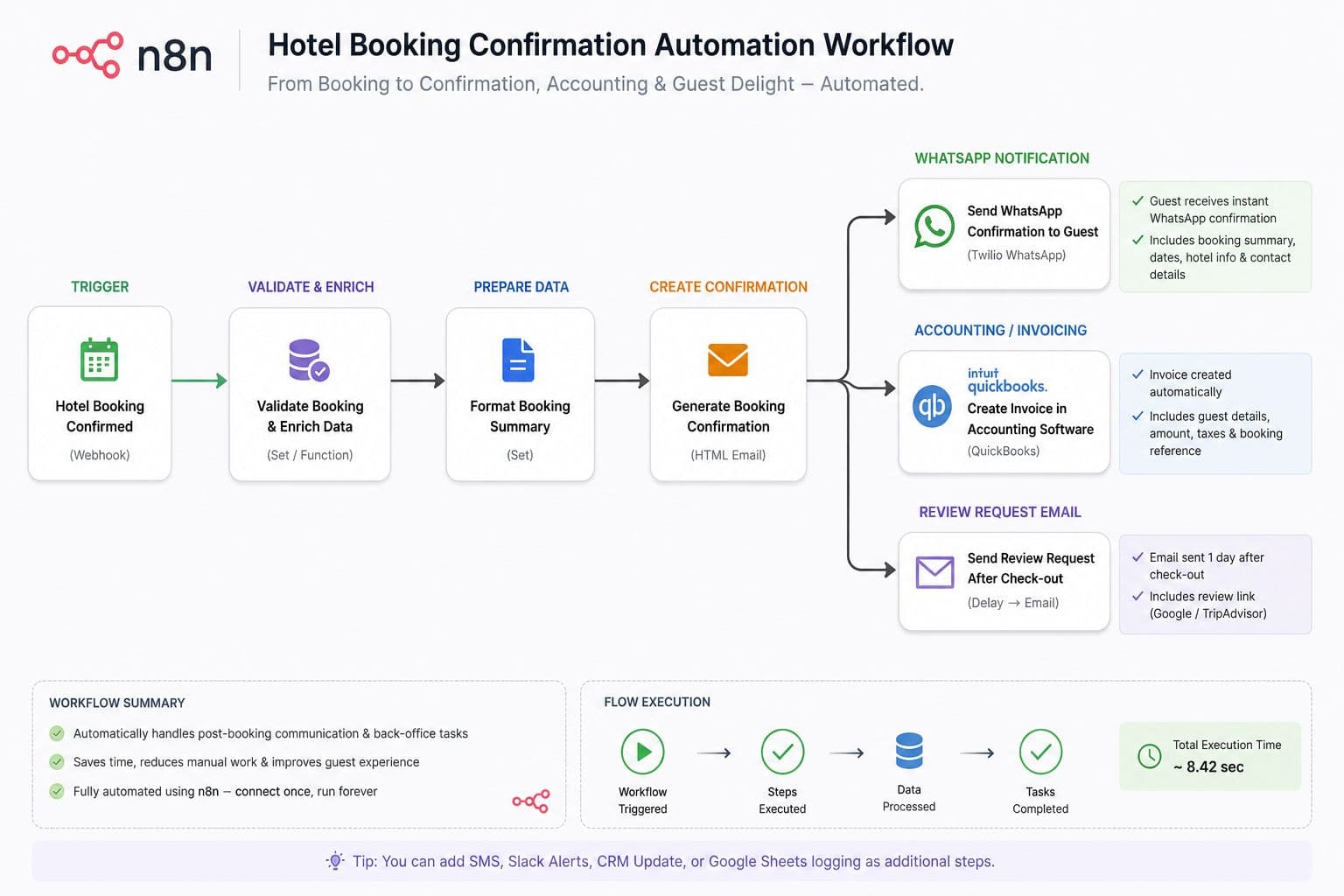
n8n sits underneath either stack for the automation layer: booking confirmations pushed to WhatsApp or SMS, deposit records synced to your accounting software, post-stay review requests fired on a delay, and a webhook wired between your POS and your loyalty tool if you have one. We handle the build and the handover documentation so your team can see exactly what each workflow does.
Who this is for
Independent restaurants paying 15 to 30 percent commission to delivery and reservation aggregators who want a direct ordering and booking path that actually gets used.
Boutique hotels and B&Bs losing margin to OTA commission on rooms that could book direct if the site did not feel slower and less trustworthy than the OTA listing.
Multi-location restaurant groups where menu and pricing updates currently touch three or four disconnected systems by hand.
Hotel groups and hospitality agencies needing a white-label development partner who can integrate a channel manager and PMS correctly the first time, not learn on the job.
The fit is about how many systems you are stitching together by hand and how much that is costing you in staff time, not a revenue cutoff. A single restaurant drowning in three disconnected apps needs this as much as a five-property hotel group does.
Why Flowagenz
We are based in Salem, Tamil Nadu, and we are direct about it: Western-grade engineering delivered at rates that do not carry a New York or London agency's overhead. Every project ships with full ownership of code and hosting access on completion. No vendor lock-in, no "you need us to touch it" dependency built into the handover.
We keep working hours that overlap real business hours in the US, UK, and Australia, and communication happens async by default so you are never waiting on a single live call to move a decision forward. On the technical side: REST and GraphQL API integrations with PMS and channel manager platforms, PCI-compliant payment flows, and n8n automation are standing capability, not a slide in a pitch deck.
Process
How it works
01
01
Discovery call and system audit.
We map every tool currently in your stack (POS, PMS, channel manager, ordering app) before writing a line of scope, so the quote reflects what actually needs to connect.
02
02
Custom scope and fixed quote.
No generic starting price. You get a scoped proposal based on your specific integrations and page count.
03
03
Build on staging with review checkpoints.
You see the booking flow and menu system working against real data before launch, not just static mockups.
04
04
Migration and go-live.
Scheduled around your booking calendar so a migration never lands during a peak weekend.
05
05
Handover and short support window.
Full documentation, credentials, and a defined post-launch support period before you are fully self-sufficient.
Standard timeline: 3 to 6 weeks for a single-property site with booking and payment integration, 6 to 12 weeks for a multi-location or headless build.
FAQ
Frequently Asked Questions
Everything you need to know about our process and digital systems.
Scope drives the number: a single-location site with a booking engine and payment integration typically runs 1,50,000 to 4,50,000 INR ($1,800 to $5,400). Multi-location or headless builds with PMS and channel manager integration run 5,00,000 to 15,00,000 INR ($6,000 to $18,000). We give you an exact figure after the system audit, not before.
Ready to stop stitching your booking stack together by hand
Tell us what you are currently running (PMS, POS, channel manager, ordering app) and we will scope a direct-booking site that actually talks to it. Book a system audit call and get a fixed quote, not a generic starting price.