Leads from Meta, Google Ads, WhatsApp and your website land in your CRM as one clean record, with the source and campaign attached and an owner notified. Flowagenz builds the n8n pipeline behind it, and you own every part of it.
Lead-to-CRM pipelines: every enquiry captured once
The problem, reframed
Most businesses do not have one lead source. They have five, and each one delivers leads differently: a Meta lead form sends a notification, a Google Ads form sends its own, a WhatsApp message sits on a phone, and the website form goes to a shared inbox. Someone copies each into the CRM when they have time.
The result is predictable. Leads arrive late, get entered twice, or lose the one field that mattered, which campaign they came from. Then the monthly report says "source: unknown" for half your pipeline and you cannot tell which ad spend is working.
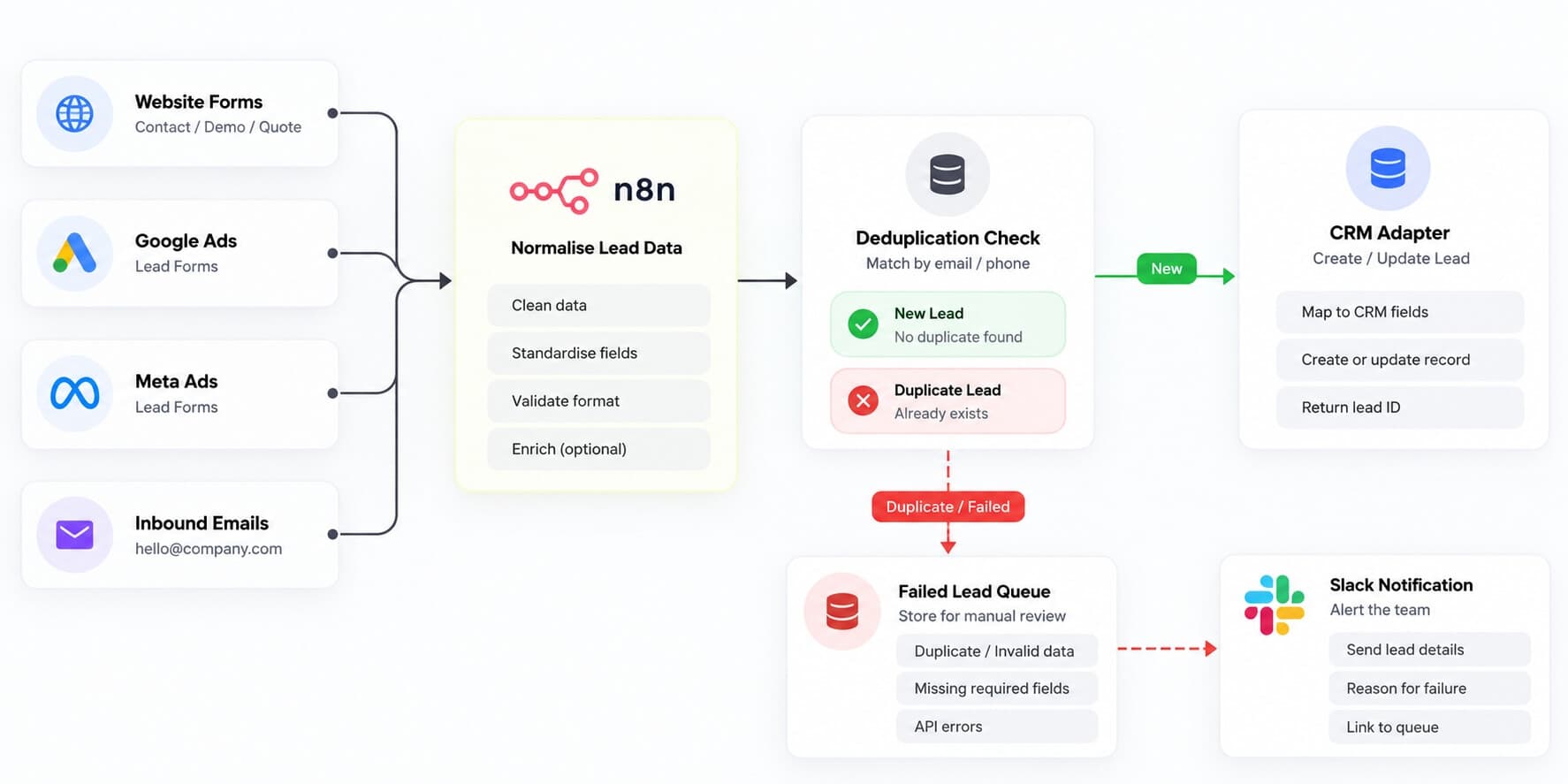
The fix is one pipeline, not five patches. Every source feeds a single normalisation step, so the CRM only ever sees one consistent shape of lead.
What we build
Flowagenz does not sell a CRM. It builds the pipeline that feeds the one you use, whether that is HubSpot, Zoho CRM, Pipedrive, or any CRM with a REST API.
01
Meta lead ads
Meta sends a webhook that carries only a lead ID. n8n then fetches the full lead from the Graph API using a page access token and maps the form answers to your CRM fields. The workflow subscribes to the page's lead events once and handles token renewal, so leads do not silently stop flowing when a token expires.
02
Google Ads lead forms
Google posts each lead to a webhook URL, along with a key you configure that n8n checks before accepting the payload. Leads that fail the check are rejected, so only real submissions reach your CRM. Campaign and form identifiers are carried through for attribution.
03
WhatsApp enquiries
Inbound messages arrive through the WhatsApp Cloud API webhook. n8n acknowledges the webhook immediately, then processes the message, so Meta's retries do not create duplicate leads. Replies follow WhatsApp's rules: free-form replies inside the 24-hour customer service window, approved templates outside it. Opt-in is recorded as a field on the contact.
04
Website forms
WordPress forms (Gravity Forms, WPForms, Contact Form 7), Next.js API routes and static-site forms post to n8n by webhook. Hidden fields capture UTM parameters and click IDs (gclid, fbclid) at the moment of submission, so attribution survives all the way into the CRM. Honeypot fields and a CAPTCHA check keep spam out before it reaches a rep.
05
Calls and other sources
Missed-call logs, booking tools, portal notification emails and spreadsheet uploads can feed the same pipeline. If a source can send a webhook, an email or an API response, it can become a lead.
06
The normalisation layer
Every lead is converted to one canonical record: name, email, phone in E.164 format, source, campaign, UTM fields, consent status and the original raw payload. The CRM step then maps that record to your fields. If you switch CRMs later, only that final mapping changes, and the sources do not need to be rebuilt.
07
Deduplication and idempotency
Each lead is stamped with its source and the source's own lead ID, and checked before processing. A webhook that fires twice produces one lead. A person who enquires on two channels updates one contact, matched on email first and phone second.
08
Routing and speed-to-lead
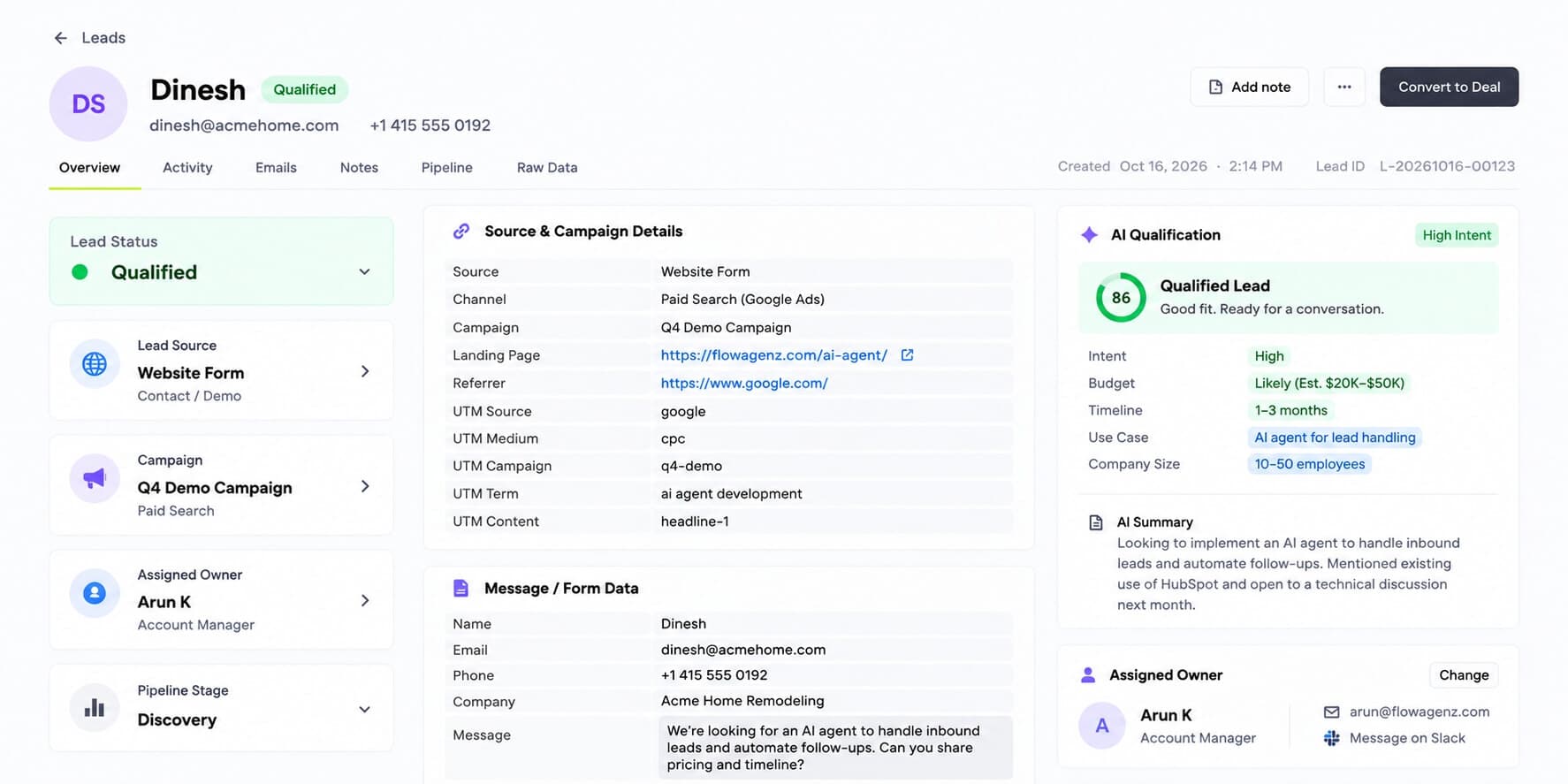
The assigned owner gets a Slack or email message with the full enquiry, plus a CRM task with a due time. If nobody acts within your window, it escalates. For channels that support it, an instant acknowledgement goes to the lead, so they know the enquiry arrived while a person gets ready to reply.
09
AI qualification and AI routing
An LLM node reads the free-text part of each enquiry and returns structured JSON: budget band, service interest, urgency, language. These map to CRM properties alongside the original text, so a rep can see why a lead was rated as it was. Anything that changes a deal stage stays a human decision.
Built on a modern, future-proof stack
n8n runs either self-hosted (Docker, PostgreSQL, and Redis queue mode when lead volume needs it) or on n8n Cloud. I default to self-hosting when lead data should stay on infrastructure you control.
A pipeline that drops leads silently is worse than no pipeline, so failure handling is part of the design. Every build includes an Error Trigger workflow that posts failed executions to Slack with a link to the run. Leads that cannot be written to the CRM, for example because the CRM was briefly down, go to a retry queue in PostgreSQL instead of vanishing. Every lead that enters the pipeline can be traced to a CRM record or to a visible failure.
From there, it can grow:
A RAG chatbot on your website that answers questions and captures the lead directly into the same pipeline.
A voice AI agent that handles inbound calls and enters them as leads with a summary.
A custom Next.js dashboard showing lead volume, source mix and response time, built on your own data.
These are upgrades for later, not conditions of the first build.
Who this is for
Growing businesses doing roughly $500K to $10M in annual revenue that buy leads through ads or portals, or take enquiries on several channels, and need to know which source actually produces customers. Below that, a single native CRM form integration is usually enough.
Ad-driven SMBs: Meta and Google spend with leads scattered across inboxes and phones.
Agencies: a white-label dev team to build lead pipelines for your clients under your brand.
Service businesses: contractors, clinics, real estate and education taking enquiries by form, call and WhatsApp.
Teams changing CRM: wanting a pipeline that survives the switch.
Why Flowagenz
You own all of it.
Workflows are delivered as exported JSON, ad-platform and CRM connections are created in your own accounts, and hosting access is in your name. No vendor lock-in is a contract term.
One senior engineer, start to finish.
You speak to the person building the pipeline. I give the engineering opinions, and we handle deployment, handover and support.
Safe by default.
Built and tested against a CRM sandbox and test leads first. Every workflow writes a run log of what it changed, so any automated write can be traced and reversed.
Based in Salem, Tamil Nadu.
Western-grade execution at offshore rates. US East Coast mornings are my evening, UK mornings are my afternoon, and Australian afternoons are my morning. Day to day, work moves asynchronously with written updates.
How it works
01
01
Scoping call and source audit.
Thirty minutes on every place a lead can come from today, where each one ends up, and what your CRM needs to receive. You get a fixed quote after this call, in USD or INR.
02
02
Pipeline design.
A written spec and diagram showing each source, the canonical lead record, the dedupe rules and the CRM mapping, which you approve before the build starts.
03
03
Sandbox build and testing.
Built against test leads from each source, with review checkpoints so you see progress as it happens.
04
04
Go-live in parallel.
The pipeline runs beside your current process for a short period, then takes over once the records match.
05
05
Handover.
Workflow exports, documentation, a recorded walkthrough, and 30 days of post-launch support.
A pipeline for up to four sources into one CRM typically takes 2 to 4 weeks. More sources, a data migration or heavy custom qualification add to that, and the scoping call gives you a firm date.
FAQ
Frequently Asked Questions
Everything you need to know about our process and digital systems.
It depends on scope, and I would rather quote properly than give a "starting at" figure that means nothing. What moves a quote: the number of lead sources, which CRM you use, whether existing data needs cleaning or migrating, and how much AI qualification you want. You get a fixed price after the scoping call, in USD or INR.
Book a lead pipeline scoping call
Tell me where your leads come from and which CRM they should end up in. In 30 minutes I will map every source, show you where leads are leaking today, and tell you what it would take to fix it. No pitch deck, no obligation.