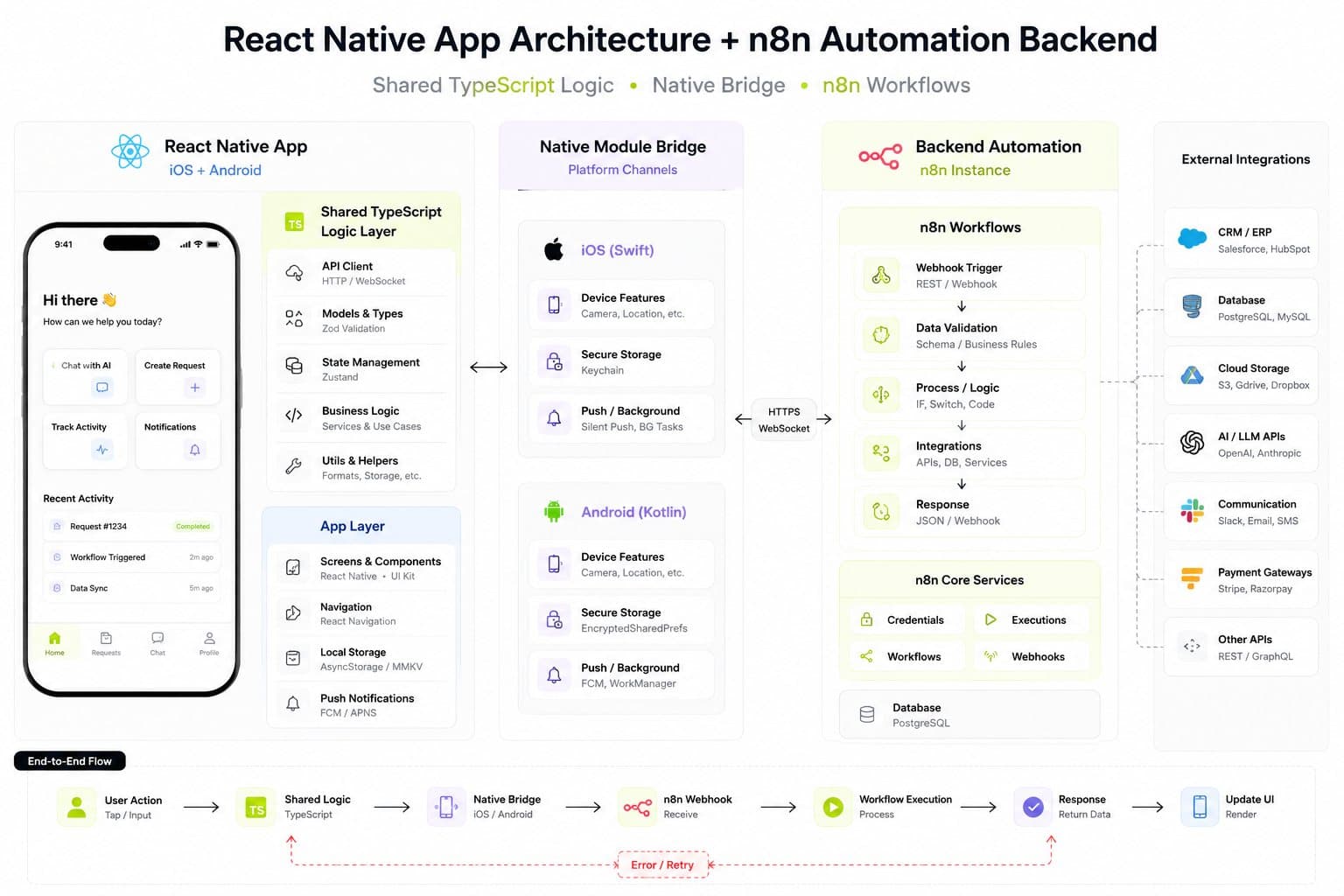
Your iOS and Android app comes from a single React Native codebase, built on the New Architecture with Fabric and TurboModules. One team, one sprint cadence, one release process, instead of two native codebases drifting apart six months after launch.
Page Label
React Native development that ships once, runs everywhere
The problem, reframed
Most teams do not need two native apps. They need one team that can move fast on both platforms without the app feeling like a compromise on either one.
The real decision is not "native versus React Native." It is whether your team can maintain one shared business logic layer with platform-specific native modules bridged in only where the OS actually demands it: camera, biometrics, background location, Bluetooth. Get that split right and you get near-native performance with a fraction of the maintenance surface. Get it wrong and you inherit two teams' worth of bugs anyway.
Flowagenz builds the split right from the first sprint: shared logic in TypeScript, native modules isolated behind a clean interface, and a build pipeline that catches platform drift before it ships.
What we build
Core app architecture
React Native on the New Architecture (Fabric renderer, TurboModules, JSI) for direct, synchronous communication between JavaScript and native code instead of the old async bridge queue
Hermes as the JS engine, with bytecode precompilation for faster cold starts on lower-end Android hardware
Navigation with React Navigation (stack, tab, and native-stack navigators) matched to platform conventions rather than one generic UI on both OSes
State and data layer built with Zustand or Redux Toolkit for local state, React Query or RTK Query for server state and caching
Offline and sync
Local-first storage with WatermelonDB or SQLite for apps that need to work on a flight or a warehouse floor with no signal
Conflict resolution logic for records edited offline and reconciled against the server, not just "last write wins" glossed over as a feature
Native device integration
Push notifications wired through FCM and APNs, including token refresh handling and silent push for background data sync
Biometric auth via Face ID and Touch ID (iOS LocalAuthentication) and BiometricPrompt on Android
Deep linking and universal links/app links so a WhatsApp message or email can open directly to the right screen, not just the app's home tab
Background task scheduling with iOS BGTaskScheduler and Android WorkManager for sync jobs that need to run when the app is closed
Release and operations
CI/CD with Fastlane or EAS Build, so App Store and Play Store submissions are a pipeline step, not a manual afternoon
Over-the-air update capability (CodePush or Expo EAS Update) for JS-only fixes that do not require a full store review cycle
Crash and performance monitoring wired in from day one (Sentry or similar), not bolted on after the first production incident
Built on a modern, connected stack
A mobile app rarely sits in isolation. Where it makes sense, the app's backend runs through the same n8n automation layer used for your web systems, so an order placed in the app, a lead captured on a form, and a message sent through WhatsApp Business API all land in the same workflow instead of three disconnected systems.
For apps that need in-app support or a knowledge assistant, a RAG chatbot can sit behind the same architecture already documented on our AI customer support pages, exposed through a native chat screen instead of a web widget. And where the app is one piece of a larger product, we structure the codebase to share types and business logic with a Next.js web front end in a monorepo, so a schema change happens once, not twice.
Core Values
Who this is for
01
Startups validating a mobile-first idea.
You need a real, submittable app fast, not a prototype that gets rebuilt the moment it gets funding.
02
SaaS companies extending a web product to native.
Your web app already works. The mobile app needs push, offline, and biometric login without becoming a second product to maintain.
03
Agencies needing white-label React Native capacity.
Your client wants a mobile app and your team is web-first. We build under your brand, you stay the point of contact.
04
Founders with a half-built React Native app.
An Expo eject gone wrong, a native module conflict blocking the build, or a codebase one developer left mid-sprint. We take over and bring it to production-ready standard without a rewrite unless a rewrite is genuinely cheaper than the fix.
This work fits businesses with a working product or a funded, scoped plan for one, evaluating a native mobile presence as the next real step rather than a first experiment.
Why Flowagenz
You get full ownership of the codebase and the App Store and Play Store developer accounts on completion. No proprietary framework, no dependency on us to ship your next update.
We're based in Salem, Tamil Nadu, which is why the engineering-hour rate looks different from a US or UK studio quote for the same New Architecture, TypeScript, and native-module work. We run daily async standups and keep meeting slots inside US, UK, and Australia business hours, so a blocked build gets a same-day answer instead of a 12-hour wait.
Process
How it works
01
01
Scoping call.
We map the platform-specific requirements (camera, biometrics, offline scope, push volume) that actually drive cost, rather than quoting off a feature list alone.
02
02
Architecture and design handoff.
Navigation structure, data model, and native module list get locked before a line of screen code is written.
03
03
Build in two-week sprints.
You get a TestFlight and internal Play Store build at the end of every sprint, not a single reveal at the end.
04
04
Store submission.
We handle App Store review requirements (privacy nutrition labels, permission justifications) and Play Store target API level compliance directly.
05
05
Handover.
Repository, CI/CD pipeline, and store accounts transfer to you, with documentation for anyone who picks up the codebase next.
A standard MVP-scope app with a handful of core screens and one or two native integrations typically runs 5 to 9 weeks from scoping call to store submission. A larger app with offline sync, biometric auth, and multiple third-party integrations runs longer; we scope that on the call rather than guess at it here.
FAQ
Frequently Asked Questions
Everything you need to know about our process and digital systems.
We flag it the sprint it happens, with the specific feature and the added time or cost attached, so you decide before it's built rather than finding it on the final invoice.
Ready to scope your app
Tell us the platforms, the core screens, and any native integrations you already know you need. We'll come back with a real sprint breakdown and a cost range in INR and USD, not a generic estimate.