Your store should run on a theme built around how you actually sell, not a template stretched to fit. We build custom Shopify storefronts, section by section, so your catalog, checkout, and content model match your business instead of the other way around.
Custom Shopify stores that stay fast as you grow.
The problem, reframed
Most Shopify stores start on a marketplace theme and grow app by app until the admin has twelve tools doing what three sections could do natively. That's not a failure, it's just the normal path for a store that grew faster than its build did.
The fix isn't a rebuild from zero. It's a custom Online Store 2.0 theme that absorbs what those apps were doing into native sections and blocks, then a checkout and catalog architecture that scales with your SKU count instead of fighting it.
The real cost of app sprawl isn't the subscription fees. It's every third-party script tag adding to your JS payload and pushing your Core Web Vitals scores down at the exact moment a customer is deciding whether to trust your checkout.
What we build
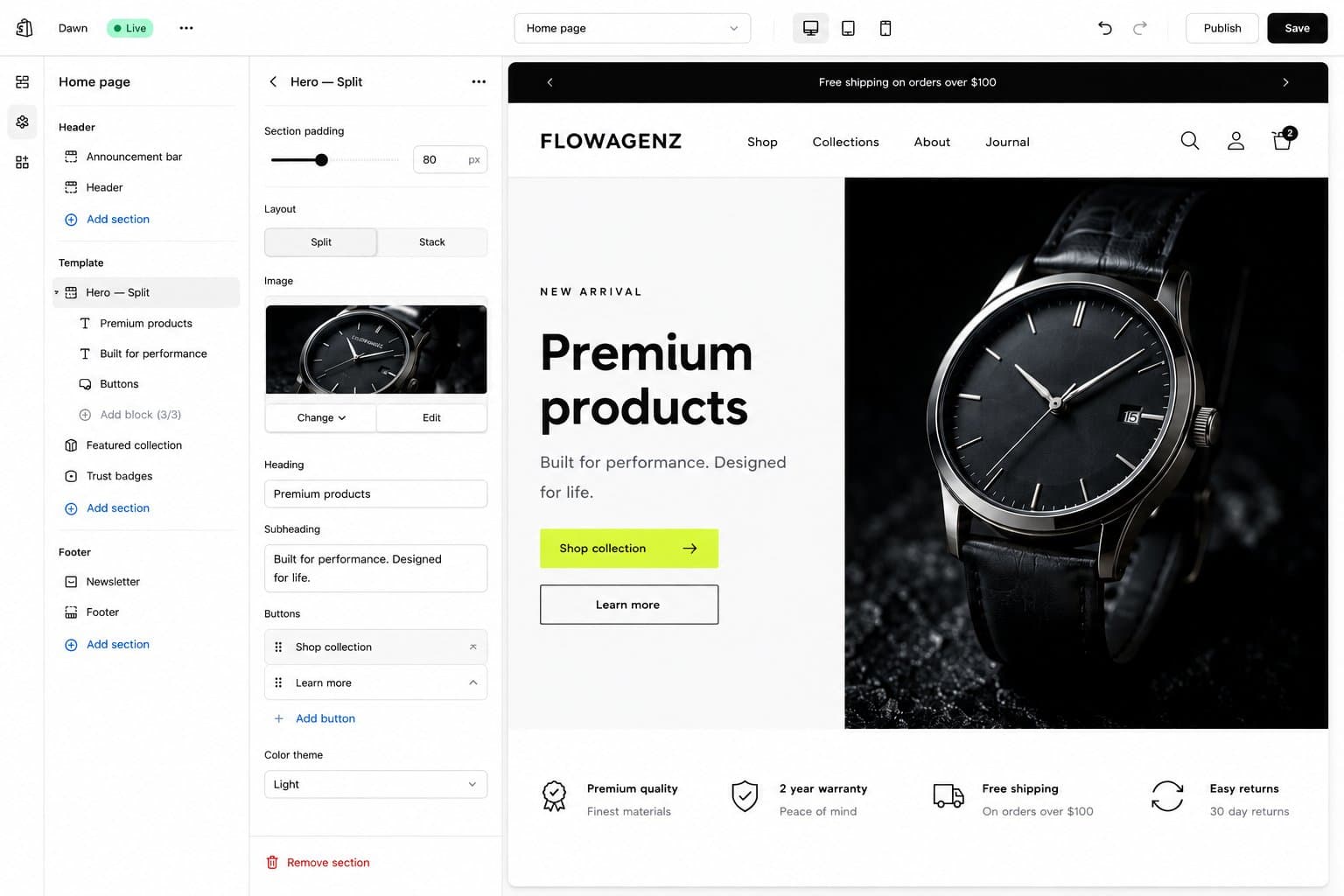
Custom Online Store 2.0 themes, section by section. Every page is a JSON template composed of Liquid sections and blocks, each one merchant-editable from the theme editor with no code required to change copy, images, or layout. No inline styles: colors, spacing, and type scale live as CSS custom properties scoped per section, so your design system stays consistent as you add pages.
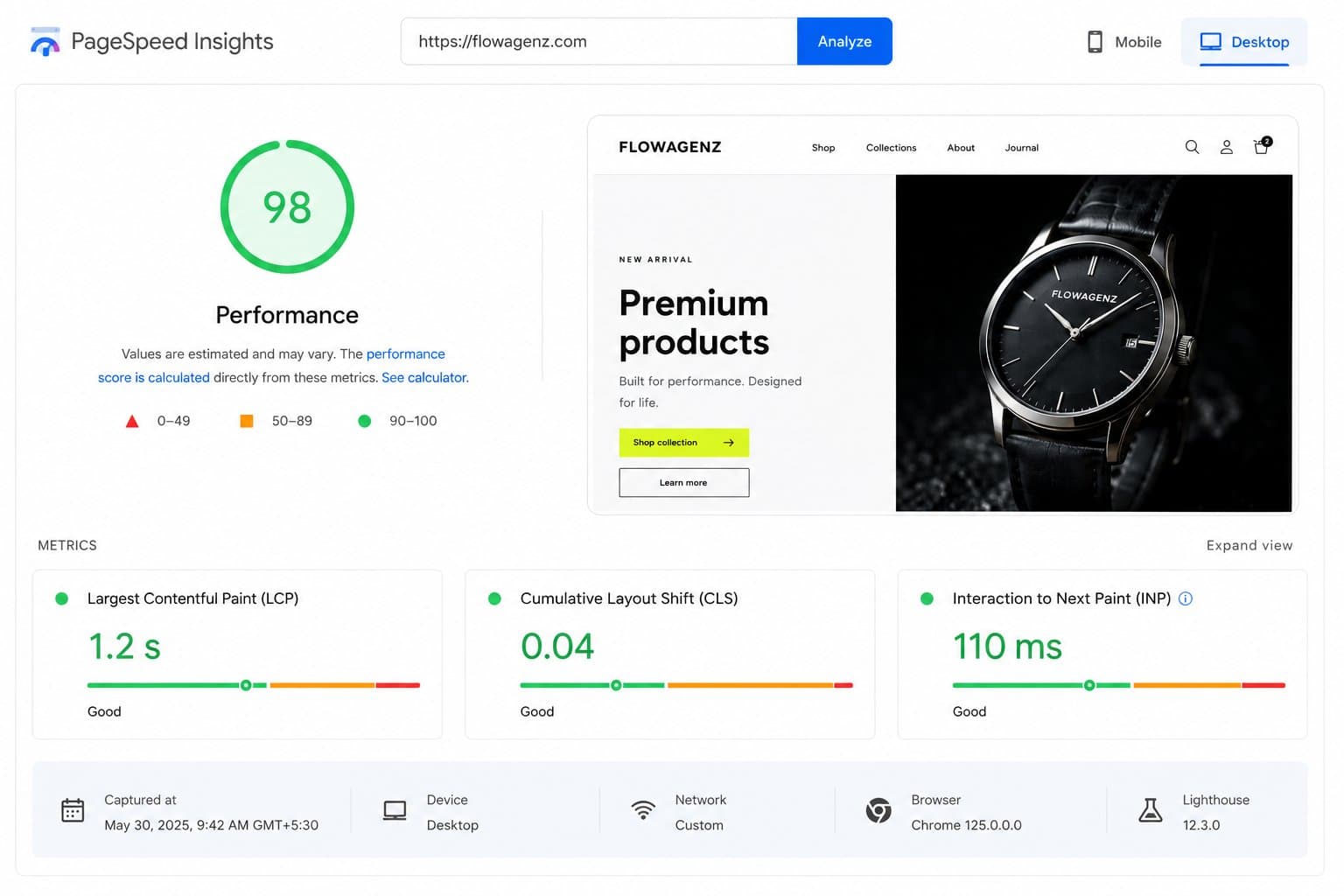
Core Web Vitals treated as a build spec, not a post-launch fix. LCP, CLS, and INP targets set before the first section is written. Image loading, font strategy, and third-party script placement chosen to hit those numbers, not patched in afterward with a speed app that just defers the problem.
Checkout customization scoped to what your plan actually allows. On Shopify Plus, that means Checkout Extensibility and custom Shopify Functions for discount logic, shipping rules, or payment customization the standard checkout doesn't support. On standard Shopify, checkout.liquid access no longer exists, so we work within Shopify's native checkout settings and post-purchase apps instead of promising customization the platform doesn't permit.
Schema and technical SEO carried through, not bolted on. Product, Organization, BreadcrumbList, and FAQ structured data generated from your actual content model and rendered server-side, so search engines read your catalog the way a shopper does.
Migrations that protect the SEO equity you've already built. Moving off WooCommerce, Wix, Magento, or BigCommerce means mapping every indexed URL to its new Shopify equivalent with 301 redirects, not letting the migration reset your rankings to zero. Order history, customer accounts, and metaffield data move over structured, not scraped.
App audits that cut script weight before adding anything new. Most stores we look at are running two or three apps doing overlapping jobs. We audit what's installed, fold what can be native into the theme, and keep the apps that are actually earning their JS budget.
Built on a modern, future-proof stack
Custom Online Store 2.0 is the default, and it's the right call for most stores. Depending on scale and where the business is headed, the same content and product model can extend into:
Shopify Functions for custom discount, shipping, and payment method logic on Plus plans.
Shopify Markets for multi-currency and multi-region storefronts from a single backend.
Hydrogen and Oxygen for a fully headless, React-based storefront when a Liquid theme stops being the right layer for your traffic or design ambitions.
n8n workflows connecting order and inventory events to your ERP, accounting software, or fulfillment partner.
A RAG chatbot trained on your product catalog and policies for support deflection or on-site product Q&A, when catalog size and support volume justify it.
I default to a Liquid-based Online Store 2.0 theme over headless Hydrogen unless there's a specific reason to go headless. Liquid themes are faster to build, cheaper to maintain, and Shopify's own investment in Online Store 2.0 means the native tooling keeps getting better, not deprecated.
Who this is for
01
DTC brands outgrowing a marketplace theme.
Your catalog, promotions, or content needs have outgrown what a $200 theme and eight apps can hold together cleanly.
02
Shopify Plus merchants needing Checkout Extensibility or Functions work.
You have a specific checkout or discount rule the native settings can't express, and you need it built as a proper Function, not a workaround that breaks on the next Shopify update.
03
Agencies needing white-label Shopify build capacity.
You hold the client relationship, we build the theme and hand it back under your name.
04
Merchants migrating from WooCommerce, Wix, or Magento.
You need the move to Shopify to preserve rankings and order history, not start the store's SEO history over.
The qualifying line isn't revenue, it's complexity: how many apps you're running, how tangled your discount and shipping logic is, and how much of your current build is Liquid you didn't write and don't fully trust.
Why Flowagenz
We're based in Salem, Tamil Nadu, and work directly with US, UK, and Australian clients on genuinely overlapping hours, not a handoff to a support queue once the contract's signed. A question raised at the end of your business day gets an answer before you're back online.
No vendor lock-in. Full ownership of your theme code, GitHub repo, and Shopify admin access on completion, with nothing held back for a future retainer. If you want to hire a developer directly afterward to maintain it, that's your call to make, not ours to block.
Process
How it works
01
01
Scoping call.
We walk through your current theme, app stack, and what's actually broken versus what's just outgrown its build. No generic quote before this happens.
02
02
Architecture and token setup.
Design tokens, section inventory, and content model get defined before a single section is built, so the theme is consistent by construction.
03
03
Section build.
Sections built and reviewed in batches on a staging store, so you're seeing real progress against the live catalog, not a static mockup.
04
04
Core Web Vitals and QA pass.
LCP, CLS, and INP checked against the build spec, plus a full device and checkout flow test before anything goes live.
05
05
Launch and handover.
Theme published, documentation handed over, and a defined support window for anything that surfaces once real traffic hits it.
A standard custom theme build runs 4 to 7 weeks depending on section count and catalog complexity. Migrations add time for redirect mapping and data verification, typically another 1 to 3 weeks.
FAQ
Frequently Asked Questions
Everything you need to know about our process and digital systems.
Scope drives the number: section count, whether Plus Functions are involved, and how much migration or app consolidation is in play. As a rough band, custom theme builds run 1,80,000 to 9,00,000 INR ($2,200 to $10,800), confirmed exactly after the scoping call, not before it.
Ready to scope your Shopify build?
Tell us what's actually slowing your store down, the app stack, the catalog size, the checkout limitation, and we'll scope the real fix on a call. No generic starting price, no pressure to sign before you've seen the plan.