Your booking engine, itinerary pages, and payment flow work as one system, not three plugins fighting each other. You get a site built on real commerce logic, with live availability and multi-currency pricing that holds up during peak season.
Page Label
Travel website development built for real bookings
The problem, reframed
Most travel sites start life as a WordPress theme with a booking plugin bolted on, and the plugin was never built for your catalog size or your currency mix. That is not a failure, it is a starting point. Our work is optimizing, refining, and completing an existing deployment, or building the booking layer properly from the first line of code.
The real decision is not "WordPress or custom build." It is whether your booking flow can carry a 10x jump in traffic during your peak season without the availability calendar falling out of sync with your back office. Get that axis right and the CMS choice becomes secondary.
What we build
01
Live availability and inventory sync
Your calendar reads from one source of truth, whether that is a property management system, a spreadsheet-backed inventory table, or a channel manager API. No manual double-entry between your site and your booking sheet.
02
Multi-currency, multi-language pricing
Prices render in the visitor's currency using live or scheduled exchange-rate updates, with language switching that does not break itinerary layout. Built for agencies selling the same package to a US buyer and a UK buyer at the correct displayed price.
03
Itinerary and package pages that scale
Day-by-day itinerary blocks, built as reusable ACF flexible content layouts on WordPress or as component-based Next.js sections, so your team adds a new 12-day package without a developer touching code. Filter and search by destination, duration, and price band, backed by proper database indexing so a 300-package catalog does not slow the search page down.
04
Payment flows that match how travel actually sells
Deposit-and-balance payment splits, refund and cancellation logic tied to your policy windows, and gateway integration (Stripe, Razorpay, PayPal) configured for the currencies you actually take.
05
Schema markup that gets you found
TouristTrip, TravelAgency, Product, FAQ, and Breadcrumb schema, structured so a package page can surface pricing and availability directly in search results, not just a blue link.
06
Automated confirmations and internal handoffs
8n workflows that fire a booking confirmation email, push the lead into your CRM, and message your ops team on WhatsApp or Slack the moment a deposit clears. No one has to refresh an inbox to catch a new booking.
Built on a modern, future-proof stack
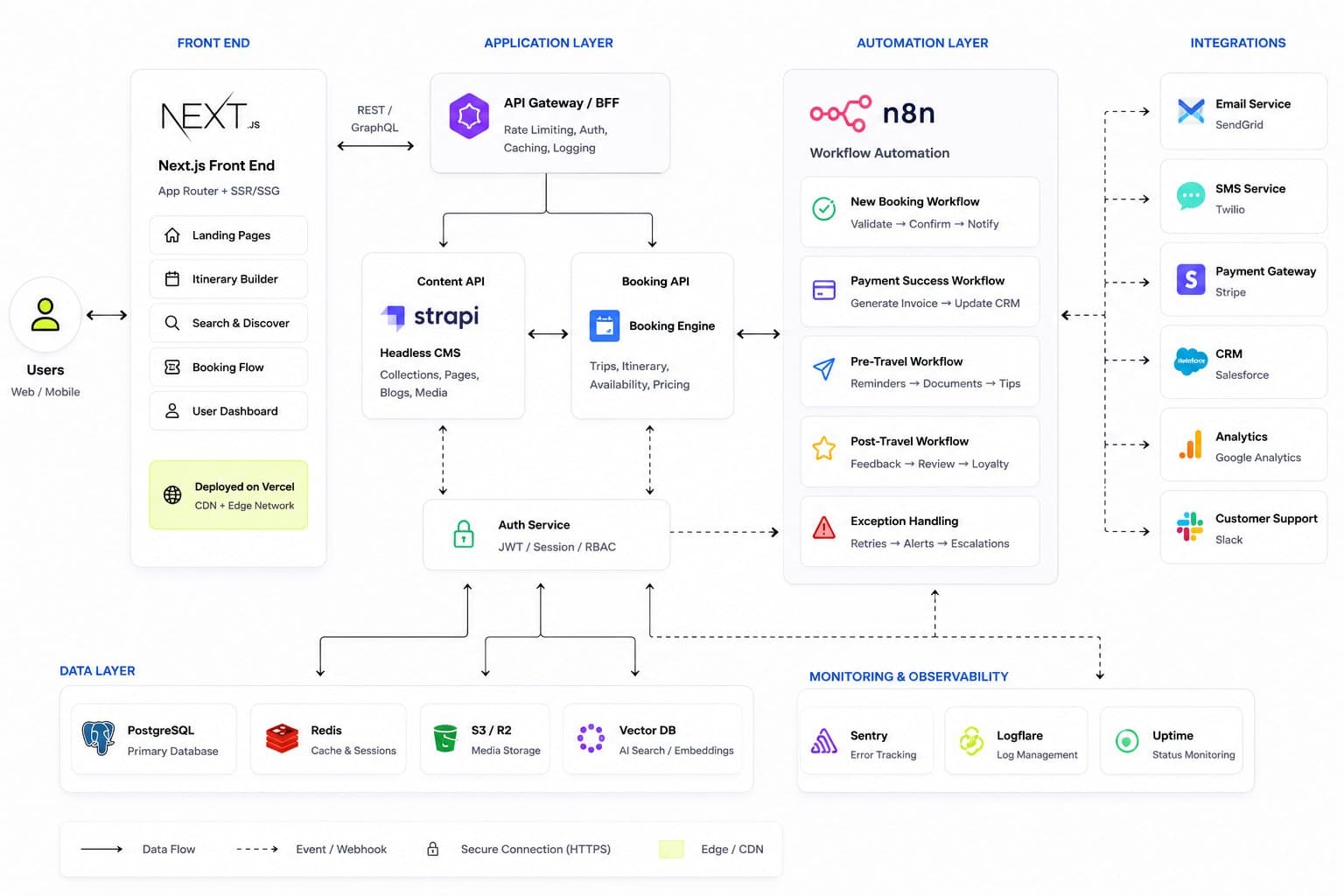
A standard build runs on WordPress with ACF and a custom booking layer. For agencies outgrowing that, we move the front end to Next.js with a headless WordPress or Strapi backend, which keeps content editing simple for your team while giving page speed a real ceiling to grow into. n8n handles the automation layer regardless of CMS choice, and a RAG chatbot trained on your actual itinerary and policy documents can handle "what's included" and "can I change my dates" questions before they reach a human inbox.
Who this is for
Tour operators and DMCs running a real package catalog who are still taking bookings through a contact form and a phone call.
Travel agencies moving off SaaS booking platforms (the Zaui and Rezdy style tools) that cap branding, take a commission on top of your margin, or lock your booking data into their dashboard.
Boutique and adventure travel brands that need an editorial-grade marketing site with a real booking engine underneath, not a template that looks the same as every other operator's.
Agencies white-labeling travel builds for their own tourism-sector clients, needing a development partner who ships without their name on the invoice.
This fits businesses running an active package catalog and real booking volume, whether that is 15 tours a year or 300. The filter that matters is operational complexity: how many currencies, how many integrations, how tangled your current booking stack already is, not a revenue cutoff.
Why Flowagenz
We work out of Salem, Tamil Nadu, which means Western-grade engineering at a cost base that does not carry a US or UK agency's overhead. That is not a caveat, it is the reason the pricing works.
No vendor lock-in. On completion, you get full ownership of the code repository and hosting access, and you are free to hire any developer, including ours directly, to maintain it afterwards.
We keep hours that overlap real US, UK, and Australian business hours for calls, and async updates run through whatever tool you already use (Slack, email, or a shared project board), so nothing waits on a live meeting to move forward.
I default to a headless architecture once a catalog crosses a few hundred packages or the client wants a genuinely fast front end. Below that, a well-built WordPress and ACF setup is the right call, and I will tell you that even when the headless build pays more.
Process
How it works
01
01
Scoping call.
We walk through your current booking stack, catalog size, currencies, and integrations. No generic quote before this happens.
02
02
Architecture and scope document.
You get a written breakdown of what is being built, what stack it runs on, and a realistic timeline.
03
03
Build in stages.
Core booking and payment flow first, then itinerary templates, then automation and schema. You see working staging builds at each stage, not a single reveal at the end.
04
04
Testing against real booking scenarios.
Deposit-and-balance flows, currency switching, and peak-load search all get tested before handover, not discovered by your first customer.
05
05
Handover.
Full code and hosting access transfer to you, along with documentation your team, or any future developer, can actually use.
A standard travel booking build runs 5 to 9 weeks depending on catalog size and integration count. Headless builds with a custom automation layer run longer, scoped on the call.
FAQ
Frequently Asked Questions
Everything you need to know about our process and digital systems.
It depends on catalog size, currency count, and how many systems it needs to talk to (a PMS, a channel manager, a CRM). We scope this on a call rather than quote a generic starting price, because a 20-package single-currency site and a 300-package multi-currency site are different projects with different budgets.
Ready to see this scoped against your catalog
Tell us your package count, currencies, and the booking system you are currently running, and we will scope a real timeline and architecture, not a template quote.