Calls are answered when nobody is free to pick up, the caller is qualified or booked in, and the summary lands on the right CRM record before your team sits down. Flowagenz builds the voice agent and the n8n workflows behind it, and you own the integration.
Voice AI answers calls, then updates your CRM
The problem, reframed
Missed calls are the most expensive leads you get, because a caller who rang you wants something now. After hours, during a site visit, or while your front desk is already on another line, those calls go to voicemail, and most callers do not leave one. If they do, someone types it into the CRM tomorrow, if at all.
A voice agent changes the first half of that: the call gets answered. The second half is where most voice AI projects stop short. If the conversation never reaches your CRM as a clean record with a next step, you have only moved the problem from a voicemail box to a transcript nobody reads.
This work is about the second half. The agent is the front door. The CRM record is the deliverable.
What we build
Flowagenz does not sell a CRM. It builds the voice layer and connects it to the one you use: HubSpot, Zoho CRM, Pipedrive, or any CRM with a REST API.
Inbound call answering
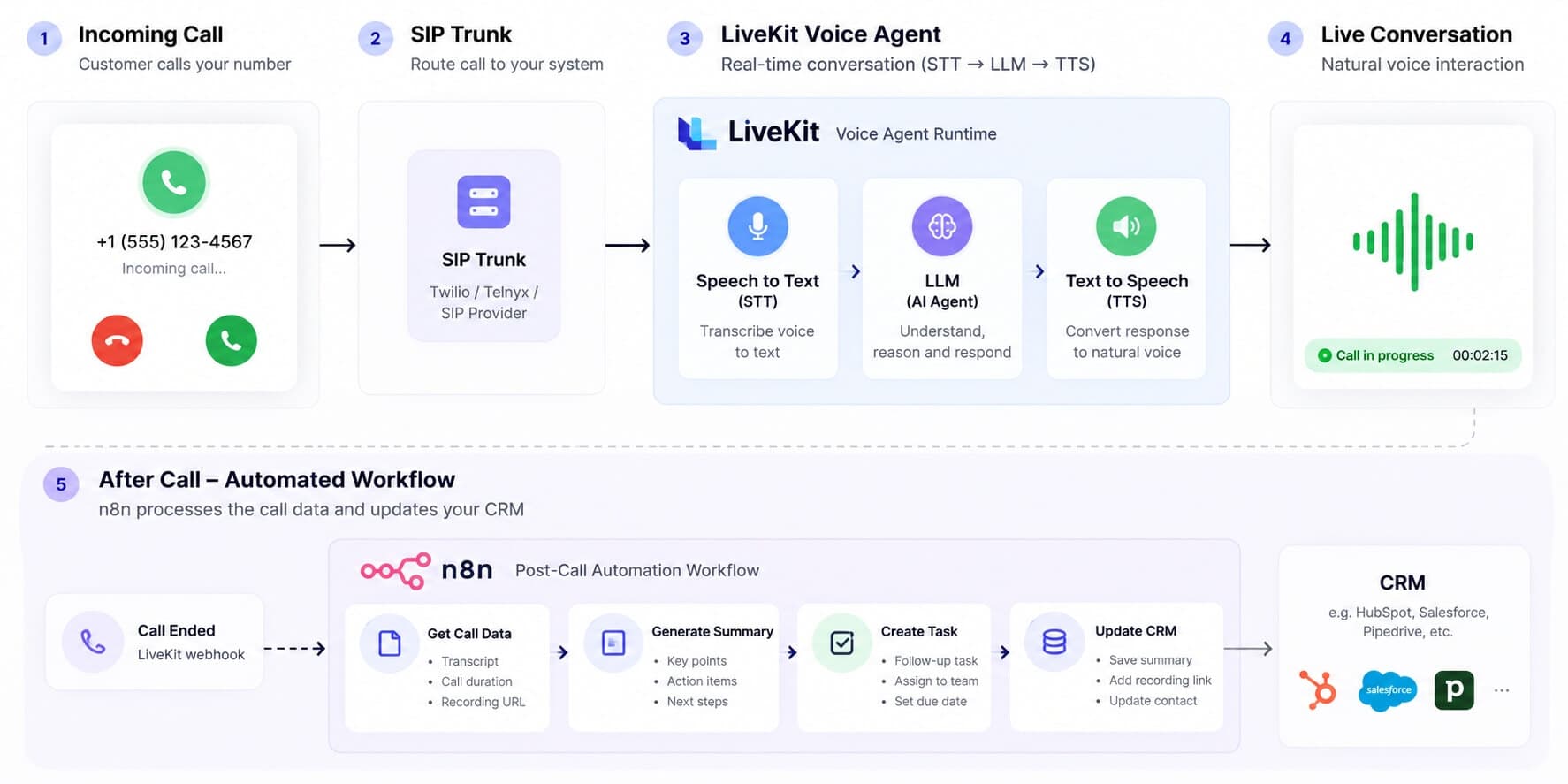
A voice agent picks up through a SIP trunk or telephony provider, greets the caller, finds out what they need, and answers common questions from your own documents through RAG. It stays inside the scope you give it, and a question it cannot answer goes to a human instead of getting an invented answer.
Qualification and booking
The agent collects the details you define, such as name, requirement, location and urgency, and books a slot directly into your calendar through its API. The answers are saved as structured fields, so the CRM receives data and not a wall of transcript.
The post-call workflow
When a call ends, the voice agent sends a webhook to n8n with the transcript and call metadata. From there:
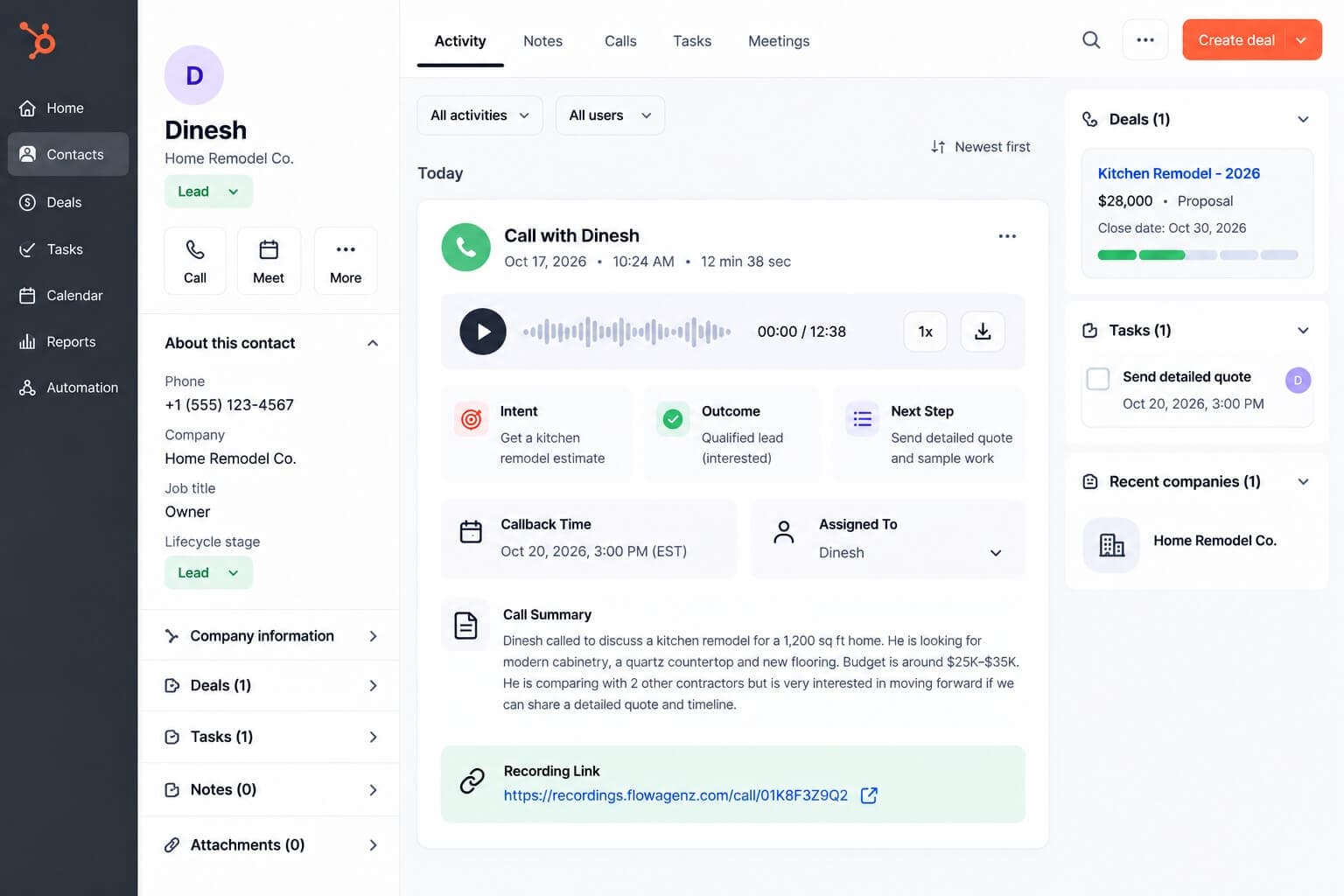
An LLM node produces a structured summary: caller intent, outcome, next step, and any promised callback time.
The contact is matched or created by phone number (E.164 format) through an upsert, so a repeat caller updates one record.
A call note, the summary, and a link to the recording are attached to the contact's timeline.
A follow-up task is created with a due time, and the owner is alerted in Slack or email if the call was marked urgent.
Deal stage changes stay a human decision.
Multilingual calls
The agent can take calls in English and in Indian languages where the speech and voice providers support them. Which languages are practical depends on the providers chosen, and I test them with real audio during the build, not on assumption.
Missed-call capture
Even without a full voice agent, missed calls can be logged as leads immediately, with an automatic WhatsApp or SMS message to the caller and a task for your team.
Warm transfer and escalation
Callers who ask for a person, sound upset, or hit a topic you have marked sensitive are transferred to a human, with a short summary passed along so they do not have to repeat themselves. Outside working hours, the agent offers a callback time instead and logs it as a task.
Built on a modern, future-proof stack
The voice layer runs on LiveKit, with separate speech-to-text, LLM and text-to-speech stages. Each stage can be swapped, so you can change a provider for cost, language support or quality without rebuilding the agent. Telephony connects through LiveKit's SIP support.
Voice conversations feel broken when the agent pauses too long to reply, so response time is budgeted stage by stage and tested on real calls, not just in a demo. Interruptions, background noise and accents are tested the same way.
The post-call workflows run in n8n, either self-hosted (Docker, PostgreSQL, and Redis queue mode when volume needs it) or on n8n Cloud. Every build includes an Error Trigger workflow that posts failures to Slack with a link to the run. If the CRM is briefly unavailable, call summaries wait in a retry queue and are written when it returns, so no call record is lost.
Our own multi-tenant voice AI product, CallIQ, uses the same LiveKit-based approach, so these are components we work with directly. If you would rather start with a hosted product than a custom build, ask about it on the scoping call.
From there, it can grow into a website chat widget that shares the same knowledge base, outbound reminder calls to existing customers who have consented, or a custom Next.js dashboard showing call volume, outcomes and missed-call recovery.
Who this is for
Growing businesses doing roughly $500K to $10M in annual revenue that take a meaningful number of phone enquiries, have staff who cannot always answer, and run a CRM already. If you get a few calls a week, a good voicemail greeting and a missed-call text will serve you better.
Service businesses: clinics, home services, contractors and real estate, where the call is the lead.
Agencies: a white-label dev team to build voice agents and CRM logging for your clients under your brand.
Multi-location teams: several phone numbers, one CRM, and no consistent call handling.
After-hours demand: businesses whose best enquiries arrive when the office is closed.
Why Flowagenz
You own all of it.
Workflows are delivered as exported JSON, the agent configuration and prompts are yours, telephony and provider accounts are created in your name, and hosting access is in your name. No vendor lock-in is a contract term.
One senior engineer, start to finish.
You speak to the person building the agent. I give the engineering opinions, including when a voice agent is the wrong answer for a particular call type.
Safe by default.
The agent discloses that it is an AI at the start of the call and tells callers when a call is recorded. It is built and tested against a CRM sandbox and test calls first. Every workflow writes a run log of what it changed, so any automated write can be traced and reversed.
Based in Salem, Tamil Nadu.
Western-grade execution at offshore rates. US East Coast mornings are my evening, UK mornings are my afternoon, and Australian afternoons are my morning. Day to day, work moves asynchronously with written updates.
How it works
01
01
Scoping call and call audit.
Thirty minutes on your call volume, call types, hours, languages and CRM. You get a fixed quote after this call, in USD or INR.
02
02
Conversation and workflow design.
A written spec of what the agent says and does, when it escalates, and what each call writes to the CRM, which you approve before the build starts.
03
03
Build and test calls.
Built against a sandbox and tested with real calls in your accent mix, with review checkpoints so you hear progress as it happens.
04
04
Go-live in a limited window.
The agent starts on overflow or after-hours calls only, then expands once you are happy with how it handles them.
05
05
Handover.
Workflow exports, prompt and configuration documentation, a recorded walkthrough, and 30 days of post-launch support.
A voice agent with CRM logging typically takes 3 to 5 weeks, depending on languages, telephony setup and how many call types it handles. The scoping call gives you a firm date.
FAQ
Frequently Asked Questions
Everything you need to know about our process and digital systems.
It depends on scope, and I would rather quote properly than give a "starting at" figure that means nothing. The build price depends on call types, languages, telephony setup and CRM. Running cost has a per-minute component, from telephony and the speech and language models, which is visible in your provider accounts. You get a fixed build price after the scoping call, in USD or INR.
Book a voice AI scoping call
Tell me roughly how many calls you get, when they arrive, and which CRM they should end up in. In 30 minutes I will tell you whether a voice agent fits, which calls it should handle, and what it would take to build. No pitch deck, no obligation.