Your team knows where the manual handoffs sit: the CSV re-uploaded every Monday, the approval buried in three Slack threads. Business process automation should remove that, not hand you another dashboard. We map the real process first, then automate it on infrastructure you control.
Business process automation for how you actually work
The problem, reframed
Most automation projects fail at the tool-selection stage. Someone picks Zapier or Make before anyone has written down what the process actually does, step by step, including the exceptions.
That gets you a demo that works for the happy path and breaks the first time a customer edits their order after checkout, or a vendor sends a differently formatted invoice. The fix is not a better tool. It is documenting the process, including its edge cases, before a single workflow gets built.
A process audit that takes two extra days upfront saves weeks of "why did this silently fail" debugging later. Skipping it is the single most common reason automation projects get quietly abandoned six months in.
What we build
01
Process mapping before automation
Every engagement starts with your team walking through the actual current process, tool by tool, including where humans currently catch errors. That map becomes the spec. Automating an undocumented process just moves the chaos somewhere less visible.
02
Cross-department handoffs
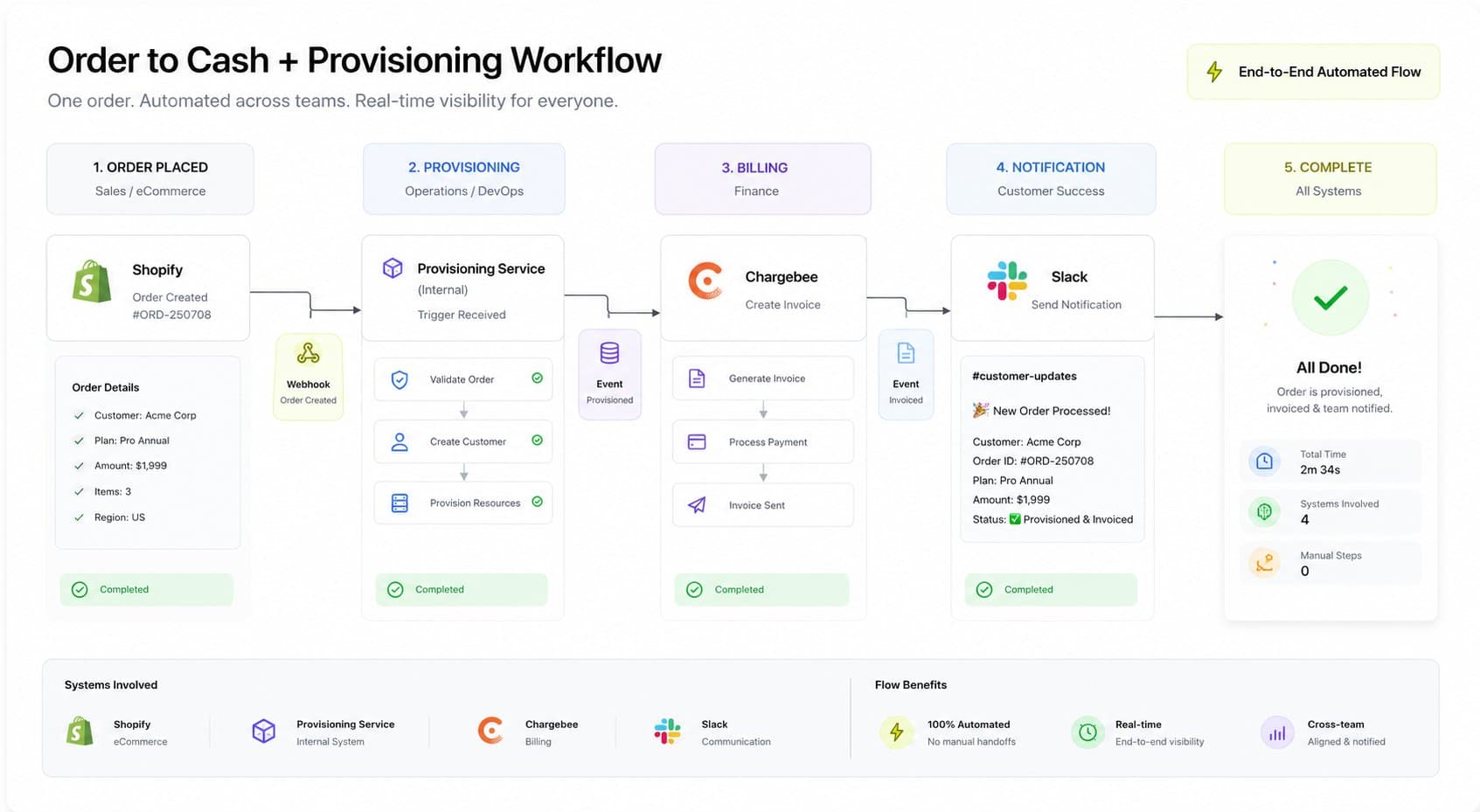
The highest-value automations usually sit between departments, not inside one: a sale in your CRM that should trigger provisioning, invoicing, and a Slack notification without three people copying data by hand. We build the workflow across the full handoff, not just the piece inside one tool.
03
Exception handling, not just the happy path
An automation that only handles the clean case is a liability once it is running unattended. Every workflow gets explicit branches for the failure modes your team already knows about: a duplicate webhook, a missing field, a record that does not match on the join key. Failures land in a visible error queue, not silently in a log nobody reads.
04
Data reconciliation across systems
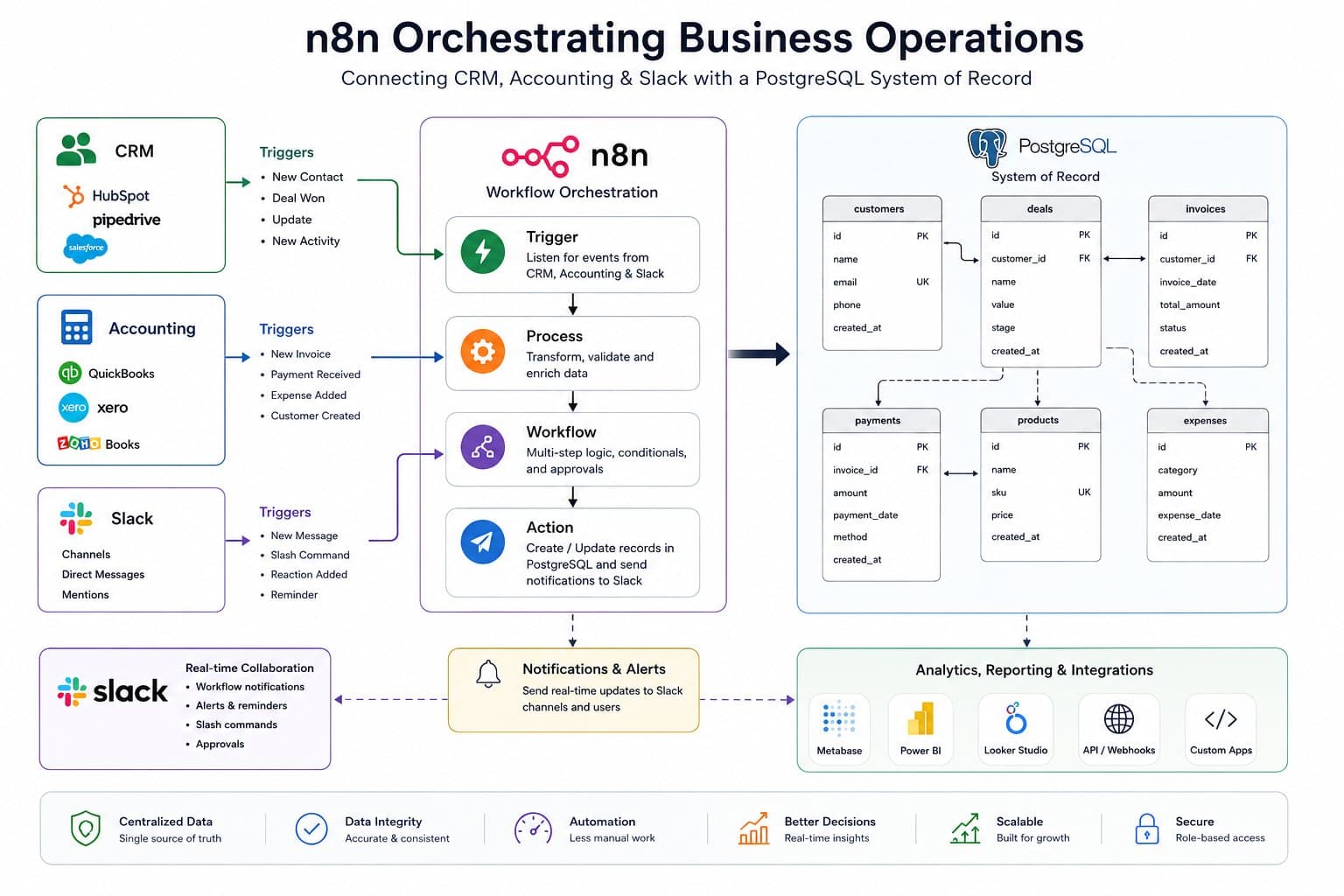
When the same customer or order exists in your CRM, your accounting tool, and your support desk, keeping those records in sync is usually the actual bottleneck, more than any single task being manual. We build the reconciliation logic that keeps identifiers consistent across systems, with a clear source of truth for each field.
05
SOP digitization
Where a process currently lives in a written SOP or in one person's head, we turn the decision logic into an explicit, inspectable workflow. If a rule genuinely needs human judgment, the workflow routes to a person for approval instead of guessing.
Built on a modern, future-proof stack
The default delivery engine is self-hosted n8n: webhook triggers, queue mode for high-volume workloads, and custom Code steps or purpose-built nodes for anything a native integration does not cover. Where the process needs a decision an if/else branch cannot make, an AI routing step handles classification or extraction, backed by a named model and a fallback path when confidence is low. For teams already running Postgres or Airtable as a system of record, workflows read and write against that directly instead of duplicating data into a new database.
Who this is for
Operations teams drowning in manual handoffs. Multiple tools, none of them talking to each other, and someone spending hours a week moving data between them.
Finance and ops teams reconciling data by hand. The same customer or invoice exists in three systems and nobody fully trusts which one is correct.
Agencies needing white-label automation capacity. You have the client relationship and the process knowledge; you need engineering hands to build and maintain the workflows.
Startups scaling operations without scaling headcount proportionally. The process worked at ten orders a day. It does not work at two hundred.
This is a fit question, not a revenue gate. If your team is juggling more than three or four tools with manual handoffs between them, or if a single automation failure would currently go unnoticed for days, that is the signal, regardless of company size.
Why Flowagenz
I default to self-hosted n8n over per-task SaaS platforms once a workflow becomes something the business depends on daily, because the moment a process is load-bearing, you want to own the runtime, not rent it by the task. Native Zapier or Make integrations are fine for a single two-step trigger; they get expensive and rigid fast once a process spans four or five systems with real exception handling.
We are based in Salem, Tamil Nadu, which means Western-grade engineering delivered at rates that do not require a US or UK agency markup. We keep working hours that overlap with US, UK, and Australian business days for live calls, with async updates in between so you are never waiting a full day for a five-minute answer.
On completion, you receive the exported workflows in n8n's native JSON format, all custom node or Code step source, and documentation covering what each workflow does and how to safely modify it. No vendor lock-in, no proprietary format holding the process hostage to us afterward.
Process
How it works
01
01
Process discovery call.
We walk through the current process end to end, including exceptions, and identify where the highest-value automation actually sits.
02
02
Process map and scope.
You get a written map of the process plus a fixed scope: which systems, which triggers, which exception branches.
03
03
Build on staging.
Workflows get built and tested against real (anonymized) data before touching production traffic.
04
04
Review checkpoint.
You see the workflow running before go-live, with a chance to flag edge cases we missed.
05
05
Handover and documentation.
You receive the exported workflows, source code, and a document explaining how to modify or extend each one.
FAQ
Frequently Asked Questions
Everything you need to know about our process and digital systems.
Pricing scopes to the number of workflows, the number of systems involved, and how much exception handling and AI routing the process needs. A single two-system automation with basic exception handling and a five-system cross-department workflow with AI classification are very different builds. You get a fixed quote from the discovery call, not an hourly estimate that drifts as scope creeps.
Ready to map the process that is actually costing you time
Tell me the tools you are running and where the manual handoffs sit today. I will map the real process on the call and tell you plainly whether business process automation is the right fit, or whether a lighter fix covers it.