Your CRM should route leads, flag deals going cold, and sync to your other tools without someone checking it by hand. CRM automation on HubSpot, Zoho, or Salesforce, built on your real object schema and your real sales process, not a template workflow pack.
CRM automation built on your actual data
The problem with most CRM automation
Most "CRM automation" is five native workflows strung together: a welcome email, a lead score bump, a Slack ping. That covers the obvious cases and quietly breaks on everything else, duplicate contacts merging the wrong record, a deal stage that skips your actual approval step, a webhook that fires before the associated company object even exists.
The reframe: automation quality is not about how many workflows you have running. It is about whether the automation understands your object model well enough to handle the case that is not in the template.
What we build
Not generic "workflow setup." Automation built on the specific object structure, field logic, and edge cases your pipeline actually has.
Lead routing and scoring on real criteria
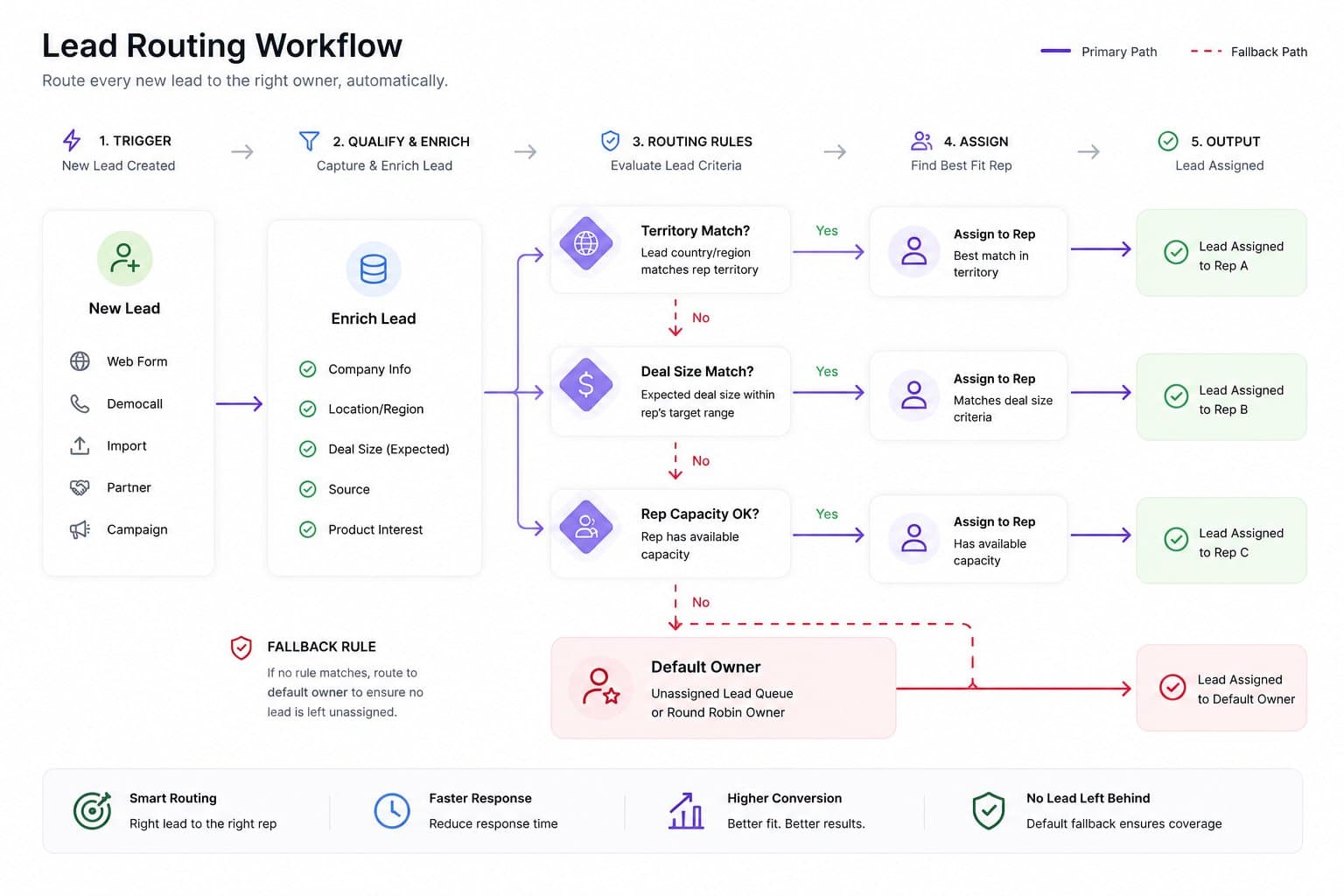
Round-robin assignment is the easy 80%. The harder 20% is routing by territory, deal size, product line, and rep capacity at the same time, without contacts getting stuck in an owner-less queue when two rules conflict. Most routing failures I have seen are not bad logic, they are a missing default owner for the case nobody designed for.
Deduplication that respects your data, not just email match
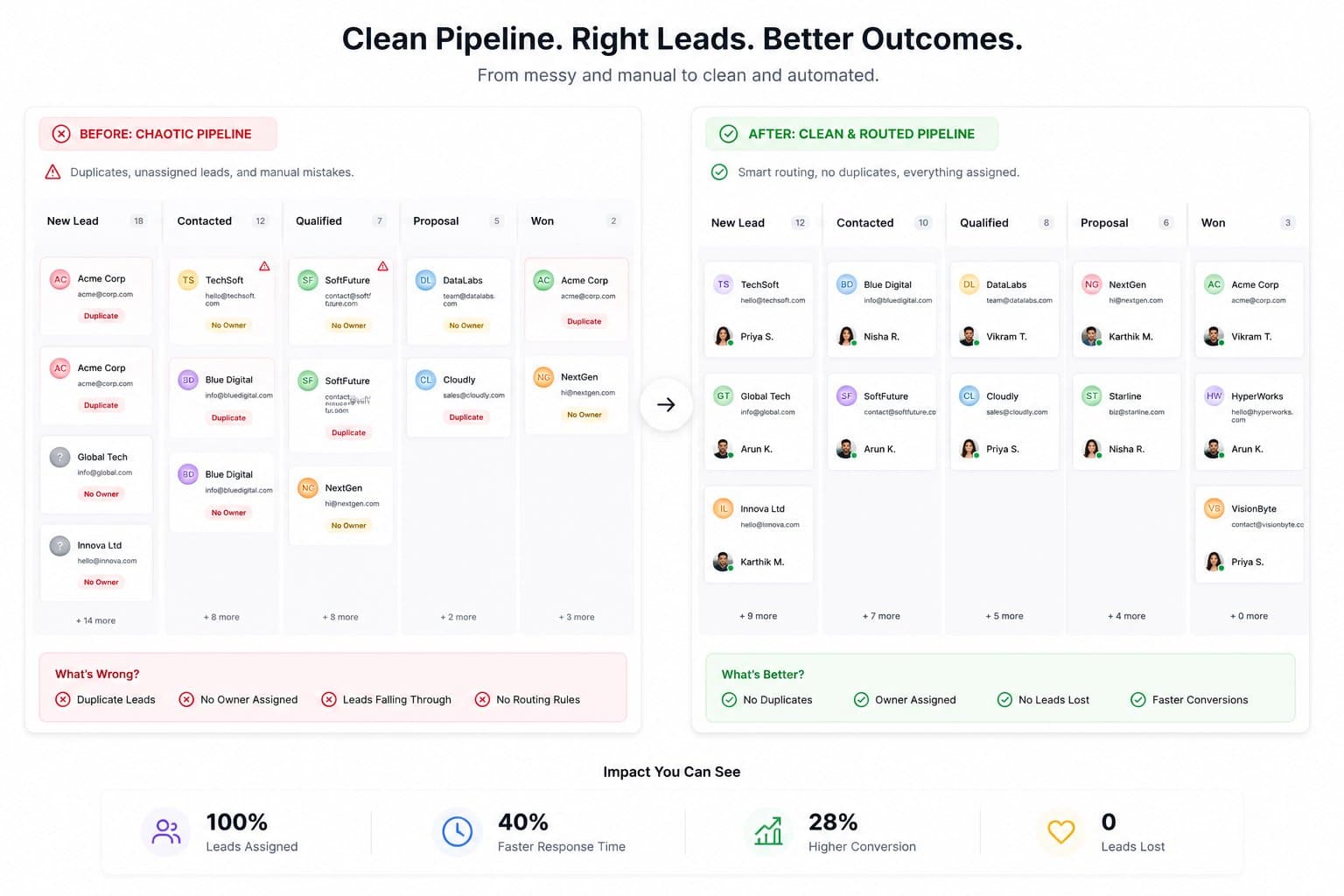
Native dedupe tools merge on exact email match and stop there. Real CRMs accumulate duplicates from form fills with typos, imported lists, and manual entry with different capitalization. A proper dedupe pass runs fuzzy matching on name and domain, flags uncertain merges for review instead of auto-merging, and preserves activity history and custom field data from both records on merge.
Custom objects and properties that mirror your business
HubSpot custom objects, Zoho custom modules, Salesforce custom fields and record types: your CRM should represent what your business actually tracks (subscriptions, locations, equipment, whatever your pipeline runs on), not force it into deal notes as free text.
Pipeline and lifecycle automation
Stage-change triggers that fire the right task, the right notification, and the right handoff, with validation rules so a deal cannot skip your approval stage by accident. Lifecycle stage automation that moves a contact from lead to MQL to customer based on actual behavior and CRM data, not a single form submission.
CRM to everything else, via n8n
Your CRM is one system among several. We build the n8n layer that syncs CRM data with Stripe for billing status, Xero or QuickBooks for invoicing, and Slack for deal alerts, with webhook retry and idempotency handling so a duplicate event does not double-count a deal or double-send an invoice.
Built on a modern, future-proof stack
Native workflow builders (HubSpot Workflows, Zoho Deluge, Salesforce Flow) for anything the platform can do natively and reliably. Self-hosted n8n for cross-system logic the native tools cannot reach: multi-step approval chains, external API enrichment, and syncing to systems the CRM was never built to talk to. Postgres as an external system of record when reporting needs outgrow what the CRM's own analytics can do. This is matched to your stage, not sold as a package.
Who this is for
Growing SMBs whose CRM has outgrown the default workflow templates and needs custom object logic.
White-label agencies needing a CRM automation partner who can build inside a client's existing HubSpot or Salesforce instance without breaking it.
Fast-growing startups migrating off spreadsheets or a basic CRM plan into a properly structured pipeline before the sales team scales past five reps.
Teams with tool sprawl (CRM, billing, support, and ops all in separate systems) that need one integration layer instead of five point-to-point Zaps.
We qualify by situation: number of CRM objects in play, volume of manual data entry, and how many other systems need to stay in sync, not by a revenue cutoff.
Why Flowagenz
We work from Salem, Tamil Nadu, with engineering hours that overlap US, UK, and Australian business days for live handoffs, not just async email. That combination gets you the same senior-engineer build quality as a US or UK boutique shop, at a fraction of the day rate, because the cost difference is location, not skill.
No vendor lock-in. On completion, you get full ownership of every workflow, every custom object configuration, and every integration credential. If you want to hire the engineer who built it directly afterwards, that conversation is fine by us.
Process
How it works
01
01
Audit call.
We map your current CRM setup: objects, existing workflows, integration points, and where manual work is happening. 45 to 60 minutes.
02
02
Scoping document.
A written breakdown of what gets automated, what stays manual by design, and a fixed quote. No call-only pricing black box.
03
03
Build on staging.
Workflows and integrations built and tested against a staging pipeline or sandbox instance, never directly in your live CRM.
04
04
Review and handoff.
You test real scenarios before go-live. Documentation and credentials transfer on completion.
05
05
Post-launch window.
A defined support window to catch edge cases the first few weeks of real data surface.
FAQ
Frequently Asked Questions
Everything you need to know about our process and digital systems.
Scope drives the number, since a five-workflow HubSpot cleanup and a full Salesforce object redesign with n8n integrations are different projects. Expect custom scoping over a call rather than a generic starting price, because a fixed number before we see your CRM would be a guess either too high or too low.
Get CRM automation that matches how you actually sell
Tell us which CRM you run and where the manual work is happening. We will scope a fixed plan on a short call, no generic package pricing, no lock-in on the other end.