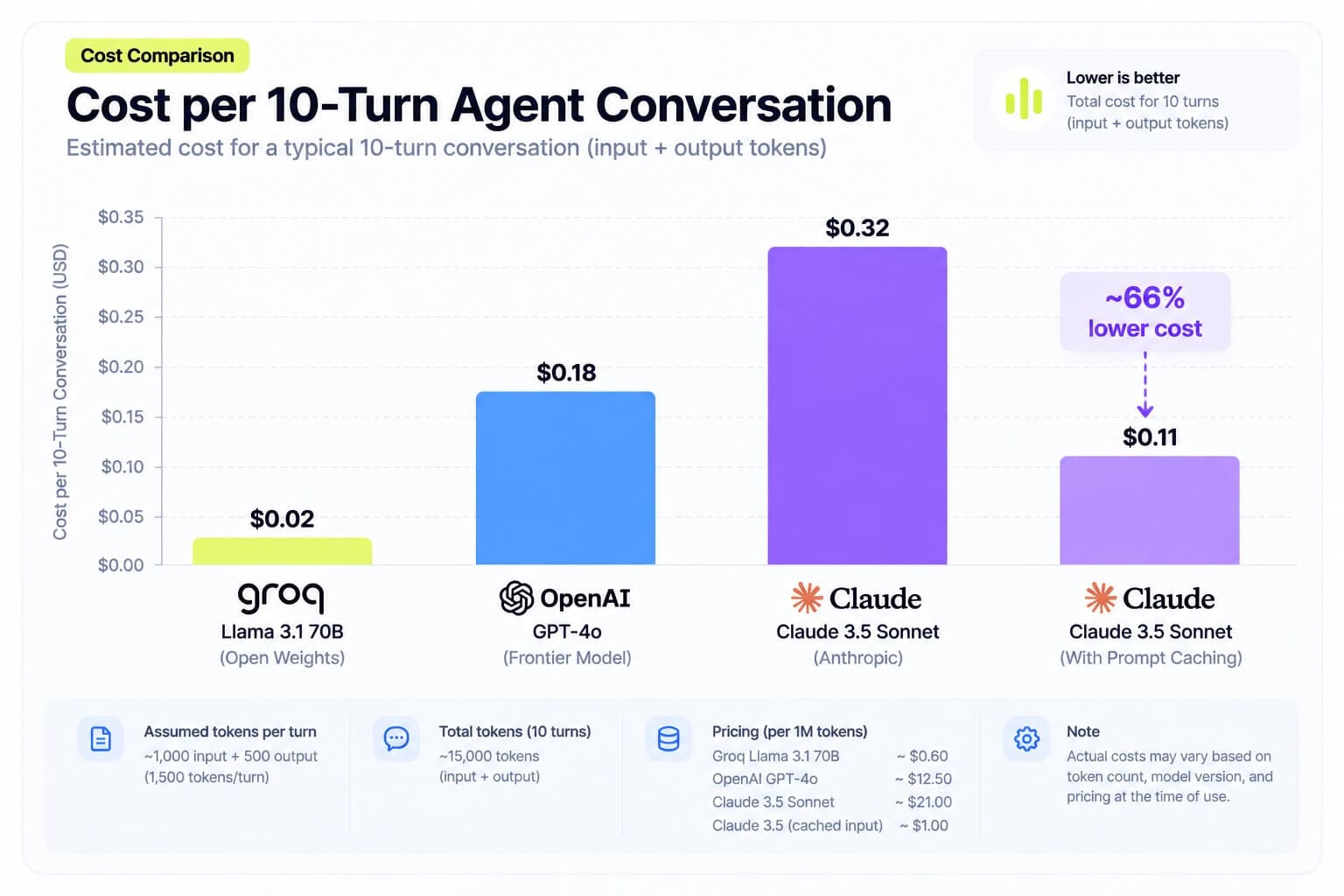
Raw per-token pricing is the wrong unit for deciding what an AI agent actually costs to run. A model that's four times cheaper per token isn't four times cheaper per conversation if it needs more turns to resolve the same request, or if your system prompt gets sent fresh on every single message instead of being cached. Cost per conversation, the number that actually shows up on your monthly bill, depends on turn count, context growth, and caching strategy at least as much as it depends on the headline per-token rate.
It's also worth being upfront about something most comparisons bury: Groq isn't a model maker, it's an inference platform running open-weight models (Llama, Kimi, DeepSeek, and OpenAI's open-weight GPT-OSS line) on its own custom chips. OpenAI and Anthropic sell their own proprietary frontier models. Comparing Groq's cheapest Llama endpoint against GPT-5.5 or Claude Opus on price alone isn't a fair fight, and several independent pricing analyses make exactly this point rather than presenting it as a clean win for whichever number is lowest.
The headline gap looks dramatic, Groq can run 6 to 8 times cheaper than frontier proprietary models on identical token volume. Whether that gap actually matters for your agent depends on whether an open-weight model handles your specific task at a quality bar you're willing to accept, and how much of your real cost is coming from a repeated system prompt that caching would substantially reduce regardless of which provider you're on.
What "cost per conversation" actually depends on
Turn count. A support conversation that resolves in 3 turns costs a fraction of one that takes 12 turns to get to a resolution, and this varies by model capability as much as by task complexity, a model that needs to ask more clarifying questions or makes more failed tool calls before succeeding will run a higher real cost than the per-token rate alone suggests.
Context growth. Every turn in a conversation typically re-sends the full prior context (or a summarized version of it) alongside the new message, so a long-running conversation's later turns cost meaningfully more than its earlier ones, purely from context size, before accounting for the actual response length.
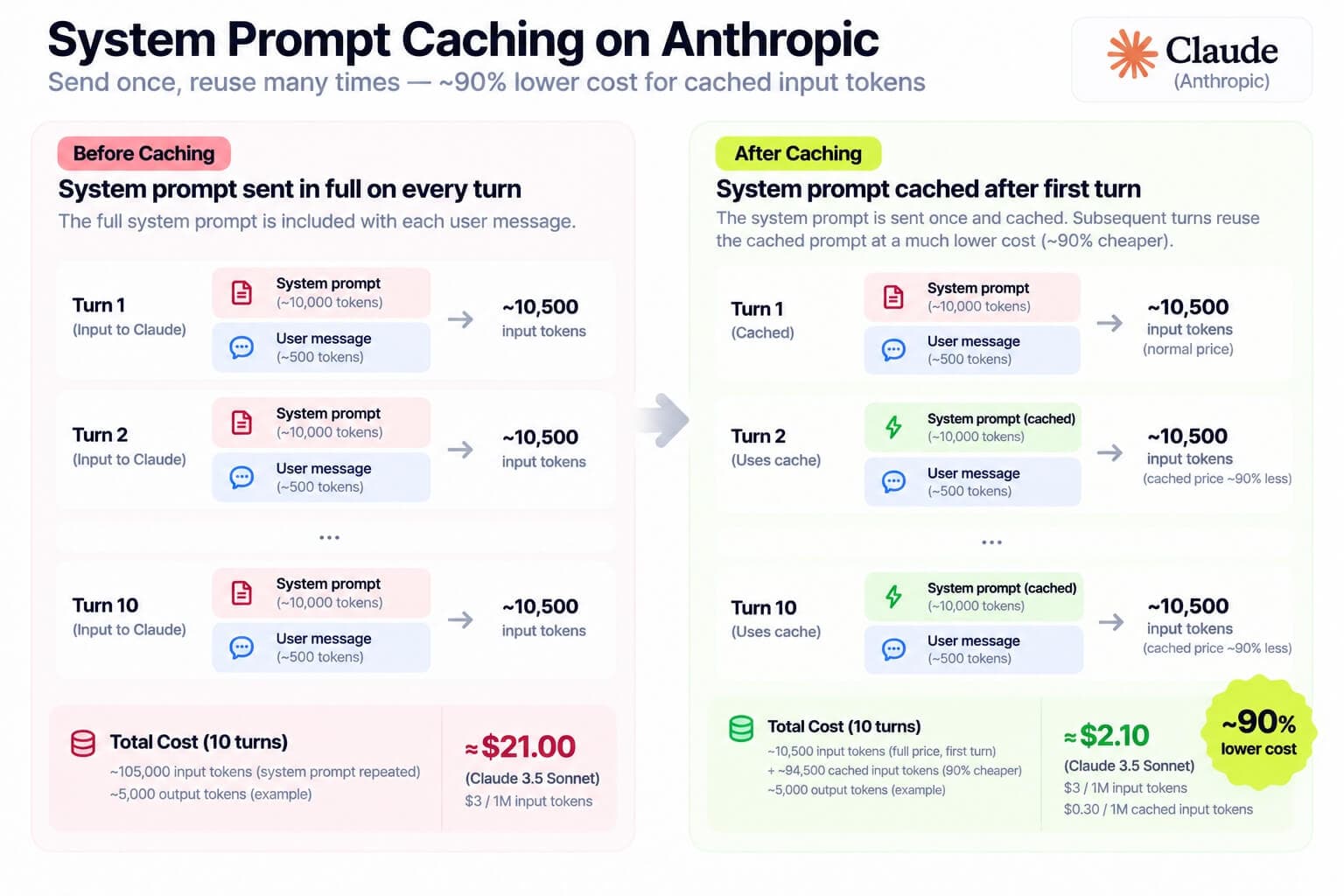
System prompt size and caching. An agent's system prompt, instructions, tool definitions, knowledge base excerpts, gets sent on every single call unless caching is in place. For an agent with a substantial system prompt, this is very often the largest single cost driver in the entire conversation, and it's also the cost most directly reducible through caching.
The prompt caching math that changes everything
This is the detail most raw pricing comparisons skip, and it matters more for agent workloads specifically than for one-off completions. Anthropic's Claude API offers a 90 percent discount on cached input tokens, meaning a system prompt that gets reused across many turns or many conversations costs a tenth of its normal rate after the first call establishes the cache. OpenAI and other providers offer comparable caching discounts on repeated prompt prefixes as well, though the specific discount rate and caching mechanics vary by provider.
For an agent with a long, detailed system prompt, tool definitions, a support knowledge base excerpt, brand voice guidelines, this is not a minor optimization, it's frequently the single largest lever available for reducing real cost per conversation, and it applies regardless of which provider you're using. A cost comparison that only shows raw per-token rates without factoring in caching is missing the detail that most changes the real bill for an actual production agent.
A worked example: what a typical agent conversation actually costs
Take a support agent handling a moderately complex, 8-turn conversation, roughly 3,000 tokens of system prompt and context sent per turn on average, and 150 tokens of response per turn. That's roughly 24,000 input tokens and 1,200 output tokens for the full conversation, before any caching.
On Groq's Llama 3.3 70B ($0.59/$0.79 per million): roughly $0.015 for the conversation, uncached.
On a frontier OpenAI model in the $2.50/$15 per million range: roughly $0.078 for the conversation, uncached.
On Claude in a comparable frontier tier, without caching: a similar order of magnitude to the OpenAI estimate, roughly $0.08 to $0.10 for the conversation.
On Claude with prompt caching applied to the reused system prompt portion: the input-token cost for that repeated portion drops by 90 percent, meaningfully narrowing the gap against Groq's raw pricing, since a large share of what made the frontier model expensive was the same system prompt being billed at full price on every single turn.
These are illustrative estimates based on current published rates, not a guarantee of what any specific real workload will cost, actual token counts, model versions, and caching hit rates vary enough that the only reliable number is one calculated against your own actual conversation logs.
Where the gap is real, and where it's a different product entirely
The gap is real and matters when: the task is well-defined, low-complexity, and an open-weight model demonstrably handles it at an acceptable quality bar, classification, simple extraction, routing decisions, straightforward FAQ-style responses. Here, Groq's dramatically lower per-token cost, combined with its genuine speed advantage, is a real, substantial saving with limited downside.
The gap is a different product entirely when: the task needs genuinely strong reasoning, nuanced multi-step tool use, or long-context understanding where a frontier proprietary model's capability, not just its price, is what the task actually requires. A cheaper model that needs more retries, more clarifying turns, or produces a worse resolution rate can end up costing more per successfully resolved conversation than a more expensive model that gets it right the first time, the token price was never the whole cost.
Speed as a cost category, not just a convenience
For voice agents and other latency-sensitive applications specifically, Groq's custom LPU inference architecture delivering 500-plus tokens per second is a real, structural advantage that shows up as a cost saving in a less obvious place: lower latency means a more natural conversational flow, which reduces the friction-driven abandonment and repeated-question overhead that a slower, more sluggish agent interaction tends to generate. This is harder to quantify cleanly than a per-token rate, but it's a genuine factor worth weighing for any use case where response speed materially affects the user experience, not just the bill.
Decision framework
Route to Groq (open-weight models) when: the task is well-scoped and an open model's capability is sufficient, cost sensitivity is high, or response latency is a primary product requirement, particularly for voice.
Route to a frontier proprietary model (OpenAI or Claude) when: the task needs strong multi-step reasoning, nuanced judgment, or long-context understanding where capability gaps translate directly into resolution quality, and the cost difference is justified by fewer retries and better outcomes per conversation.
Use prompt caching aggressively regardless of provider for any agent with a substantial, reused system prompt, this is close to a free win on real cost and should be standard practice rather than an advanced optimization.
Consider a hybrid, model-routing architecture for agents handling a mix of task complexity, cheap, fast models for routine classification and routing, a frontier model reserved for the genuinely complex share of conversations that actually need it. This is increasingly the standard pattern for cost-conscious production agent architectures rather than picking one model for every request.
The bottom line
The real cost of running an AI agent isn't the number on a provider's pricing page, it's that number multiplied by your actual turn count and context growth, then reduced by whatever caching strategy you have in place. Groq's raw per-token pricing is genuinely, substantially cheaper for open-weight models, and that's a real advantage for well-scoped, latency-sensitive tasks. OpenAI and Claude's frontier pricing reflects a different capability tier, and prompt caching, particularly a high cached-token discount where a provider offers one, can close a meaningful part of the cost gap for agents with substantial, reused system prompts. Model the real numbers against your own conversation patterns before choosing based on a headline rate from any provider.
Let's create something together
If you're trying to model real API cost for an agent you're building, Flowagenz can estimate cost per conversation against your actual use case and turn patterns before you commit to a provider. Happy to walk through the numbers on a short call.