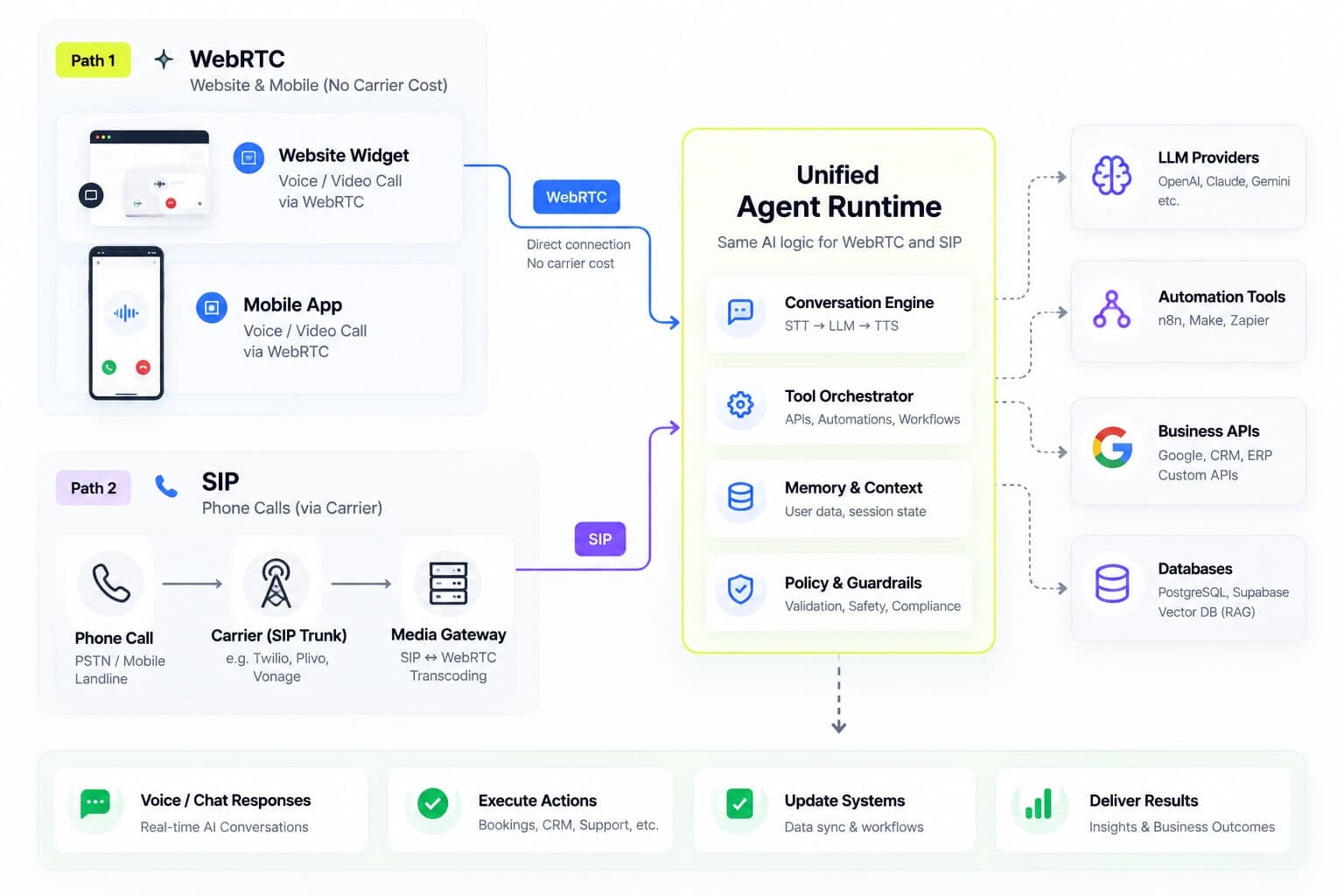
A "talk to our AI" button on a website runs on fundamentally different infrastructure than a phone-based voice agent, and that difference changes the real cost math more than most build-vs-buy content accounts for. A website voice widget connects over WebRTC, straight from the visitor's browser, no phone number, no carrier, no telephony bill. A phone-based agent connects over SIP, which means every minute carries a carrier cost on top of whatever the AI stack itself costs. If the user is already on a screen, you're paying for inference only. If they're calling a number, you're paying for inference plus a phone network underneath it.
This matters for a decision most teams don't realize they're making: most write "build vs buy" guides for voice AI as if it's one undifferentiated category, but a website widget and a phone agent have different vendor landscapes, different cost structures, and, increasingly in 2026, different architectural roles within the same underlying system.
For most businesses adding a voice option to their website specifically, this is a lower-stakes, lower-cost decision than a full phone-based voice agent deployment, precisely because there's no carrier cost baked into every conversation.
WebRTC is built for browser-to-browser or browser-to-server real-time communication, and a website voice widget uses it to stream audio directly from the visitor's microphone to your AI stack, no phone infrastructure involved at any point. SIP, by contrast, is the protocol phone systems run on, and a phone-based voice agent has to interface with that telephony world, incoming calls arrive as compressed, lower-quality audio (G.711 at 8kHz) that needs a media gateway to transcode into a format the AI stack can actually work with, adding both a real cost and a small amount of processing latency that a website widget never has to deal with.
The practical result: serious production voice deployments in 2026 increasingly run both, one shared agent runtime with two ingress paths, WebRTC for anything starting on a screen (website widget, mobile app, in-person kiosk), SIP for anything starting on a phone. This isn't an either-or choice at the company level, it's a use-case-level choice, and understanding this distinction is exactly what prevents overpaying for phone-grade infrastructure on a widget that will only ever run inside a browser.
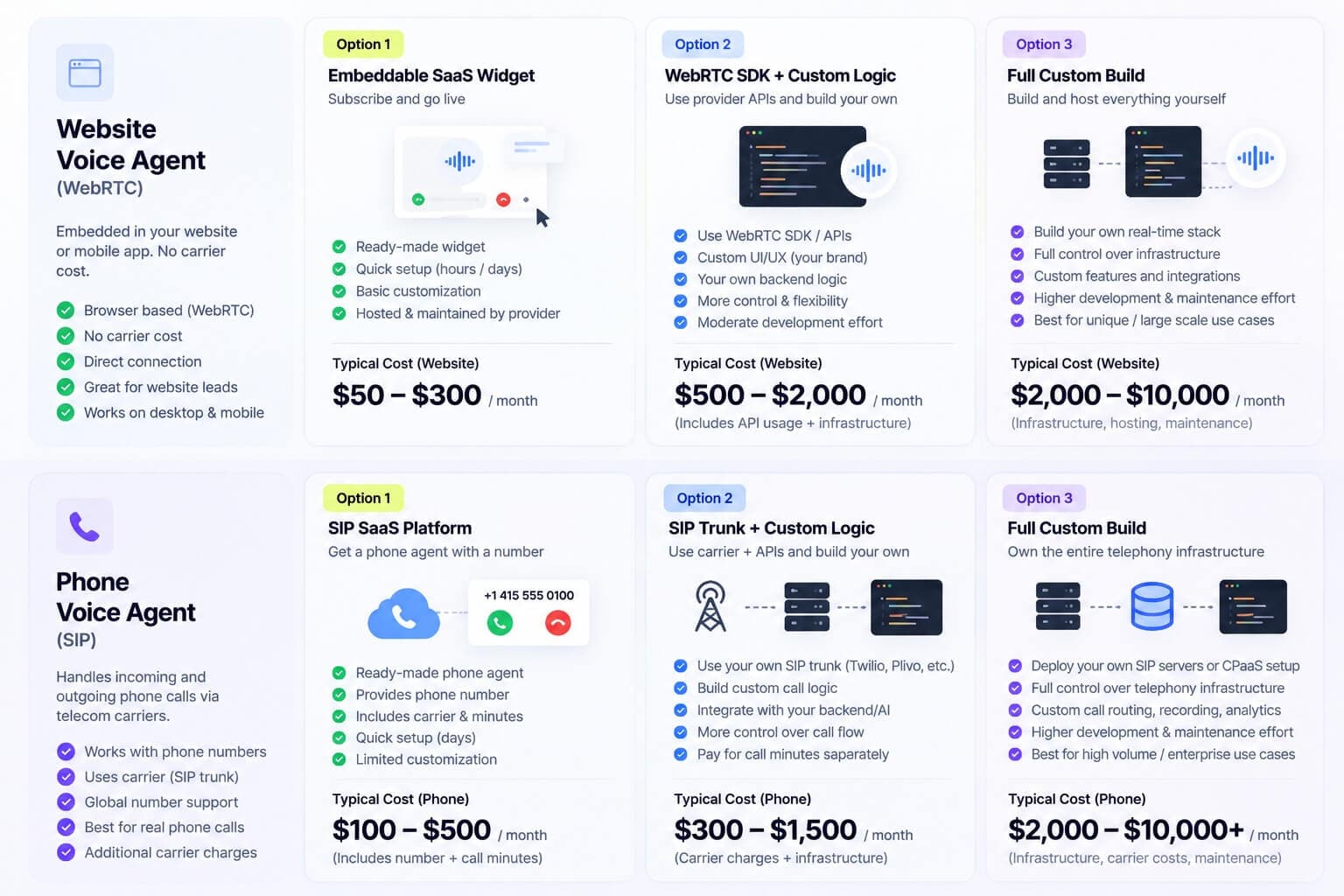
Managed platforms increasingly offer voice widgets as a variant of their standard voice agent product, sitting on the same underlying stack as their phone offering but delivered as an embeddable browser widget instead of a phone number. This is the fastest path to a working "talk to our AI" button, typically live within days, with pricing following the same per-minute logic as phone-based platforms, minus the telephony markup, since there's no carrier cost to pass through.
The real, all-in cost still runs higher than the advertised headline rate, the same pattern that applies to phone-based SaaS platforms: advertised rates in the $0.05 to $0.15 per minute range commonly land closer to $0.15 to $0.33 per minute once speech-to-text, the language model, and text-to-speech are all accounted for, roughly two to four times the headline number. This gap is smaller in absolute terms for a website widget than for a phone agent, since there's no carrier fee stacking on top, but it's still real and worth modeling before committing to a platform based on its advertised rate alone.
This is the tier most build-vs-buy content skips entirely, and it's specifically relevant to website widgets in a way it isn't for phone agents. Rather than building real-time media infrastructure from scratch, an expensive, months-long undertaking, a website voice widget can be built on top of an existing WebRTC SDK, LiveKit, Daily, and Agora are common choices, using their native SDKs and building only the UI and conversational logic layer on top. This lands in a real, moderate cost range, roughly $35,000 to $50,000, meaningfully cheaper than a full custom voice AI build from scratch, because the hardest infrastructure problem, reliable real-time audio streaming, is already solved by the SDK provider.
This tier makes sense specifically when a business wants a website voice widget with genuinely custom behavior, deep integration with internal systems, a distinctive conversational design, that a generic embeddable widget from a SaaS platform can't accommodate, but doesn't need the far larger investment a full custom voice AI stack would require.
When a website voice widget is actually the right addition
It's a strong fit when: the site already has meaningful traffic where a voice option would reduce friction, complex product configuration, high-consideration purchases, support flows where typing is genuinely slower than talking, and when the business wants voice interaction without taking on phone infrastructure at all.
It's probably unnecessary when: the existing text chat widget is already resolving most inquiries effectively, since adding voice on top of a working chat solution is additive complexity without a clear, demonstrated gap it's filling. Voice earns its place by solving a specific friction a text interface genuinely can't, not by being a more impressive-looking feature.
Consider the hybrid architecture when: the business already has, or plans to build, a phone-based voice agent too. Sharing one backend agent runtime across both WebRTC (website) and SIP (phone) ingress paths avoids building and maintaining two separate conversational AI systems that happen to answer the same underlying questions.
What to check before choosing a website voice vendor
Since embeddable widget offerings vary in how transparently they price and how much control they expose, a few concrete questions are worth asking any vendor before committing:
Does the widget's pricing include telephony fallback, or is it purely browser-based? Some platforms bundle an option to escalate a browser conversation to a real phone call for complex cases, which reintroduces a carrier cost into what would otherwise be a carrier-free interaction, worth knowing upfront rather than discovering in a surprising invoice line.
What happens on unsupported browsers or restricted microphone permissions? WebRTC support and microphone access aren't universal across every browser and device configuration, a real widget needs a sensible fallback (typically to text chat) rather than simply failing silently for a share of visitors.
Can the widget's voice and conversational behavior be customized, or is it a fixed, generic experience? This is the practical difference between the embeddable SaaS tier and the WebRTC-SDK-plus-custom-logic tier, if brand-specific voice, tone, or deep integration matters, check this before assuming a quick embed covers it.
Is call or conversation data staying within your own infrastructure, or routing through the vendor's platform? For any business with data residency or compliance requirements, this is worth confirming explicitly rather than assuming, the same way it matters for phone-based voice agent platforms.
The bottom line
A website voice widget isn't just a smaller version of a phone-based voice agent, it runs on genuinely different infrastructure with a meaningfully different, generally lower, cost structure, since there's no carrier network involved at any point. For most businesses, an embeddable SaaS widget or a WebRTC-SDK-based custom build covers the real range of what's needed, and reserving full from-scratch infrastructure investment for phone-based deployments at genuinely high volume, rather than a website widget, is usually the right call. If phone and website voice are both on the roadmap, plan for one shared backend from the start rather than building two systems that will eventually need to say the same things.
Let's create something together
If you're deciding how to add voice to your website, or whether it should share a backend with a phone-based agent, Flowagenz builds both and can walk through what actually fits your traffic and use case. Happy to talk it through on a short call.