An answer engine over your own knowledge base, built with hybrid search, reranking, and retrieval quality evaluation, not the chunk-and-embed tutorial pattern that demos well and falls over on real questions. If the answer isn't in your documents, it says so instead of guessing.
Page Label
RAG chatbots grounded in your actual documents
The problem, reframed
The default RAG pattern most teams ship, split documents into chunks, embed them, stuff the top three matches into the prompt, works in a demo and degrades fast in production. Pure vector search misses the queries that matter most: exact identifiers, error codes, product SKUs, and version numbers embed nearly identically to each other, so a search for one retrieves noise instead of the right chunk. And most teams never measure retrieval quality at all, meaning nobody actually knows whether the bot is finding the right context before it answers.
I think the real engineering in RAG is almost entirely in retrieval, not generation. Any model can write a fluent answer from whatever context it's handed. The work that determines whether the answer is correct is getting the right context in front of it in the first place, and knowing, with a real metric, whether that is happening reliably.
What we build
01
Hybrid search, not vector search alone.
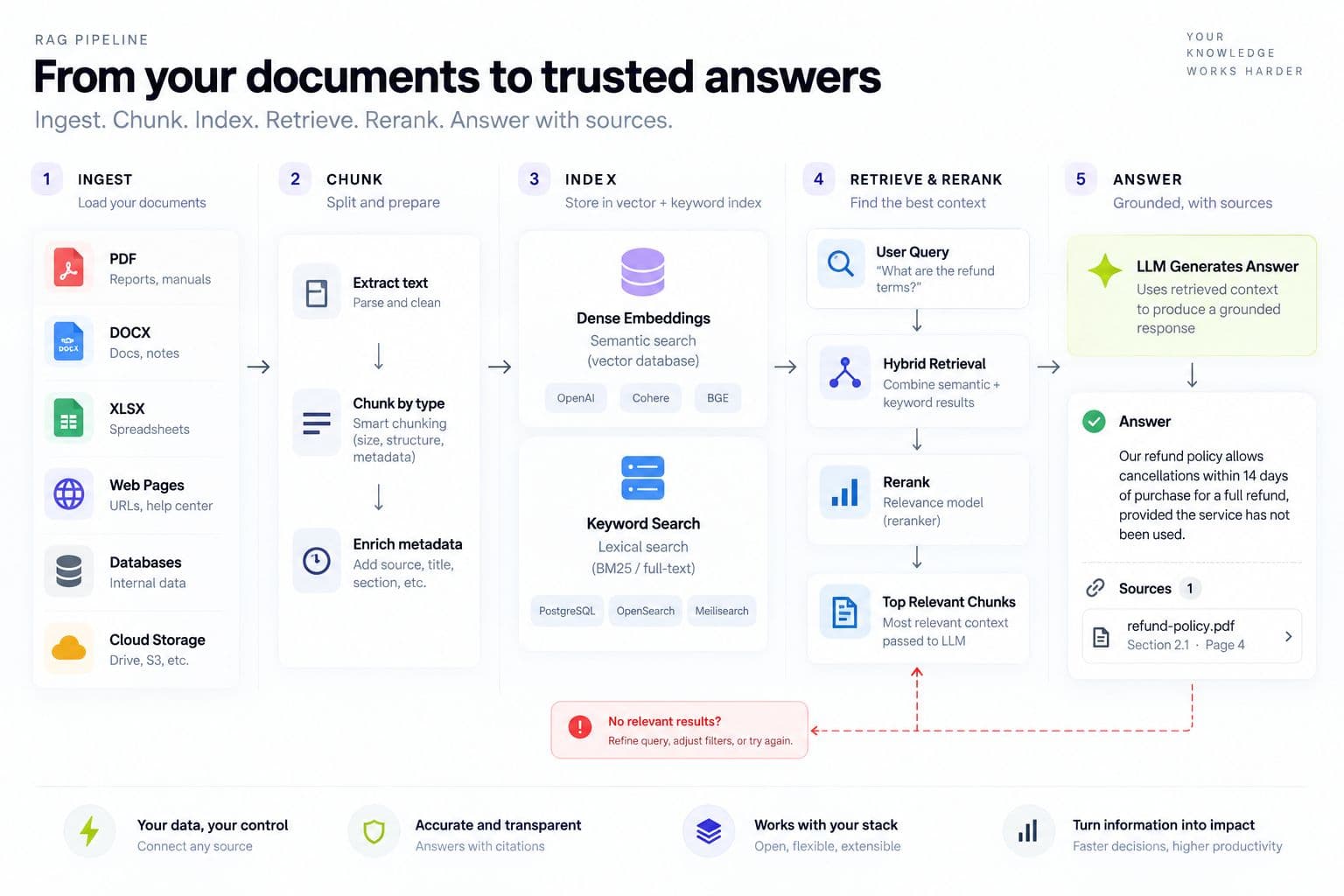
Dense embedding search finds chunks that are topically similar; keyword search (BM25) finds chunks containing the exact terms in a query. We fuse both, because a question containing an exact product code, an error string, or a specific number needs the keyword match that pure semantic search reliably misses.
02
Structure-aware chunking.
Tables, code blocks, and structured data get extracted as their own chunk type and searched with keyword matching rather than embedded as prose, since embedding a table column by column destroys the information it carries. For long-form documents, we use semantic chunking that splits where meaning actually shifts, not a fixed token count that cuts a sentence in half.
03
Reranking before generation.
A cross-encoder reranking pass on the initial candidate set before anything reaches the model, which measurably improves precision on the chunks that actually end up in the prompt versus retrieval alone.
04
Grounded generation with visible sourcing.
The model answers from retrieved context and cites which document it drew from, and is explicitly instructed to say the knowledge base doesn't cover a question rather than filling the gap from its own general training.
05
Retrieval evaluation, built and reported.
We build an evaluation set from real questions and measure retrieval quality directly, recall at k, not just eyeball whether the final answer looks right. Most RAG systems ship without this. It is the difference between knowing your retrieval works and hoping it does.
06
Ingestion that keeps the index current.
New and updated documents get re-chunked and re-indexed automatically through an n8n-orchestrated pipeline triggered off your actual content source, so the knowledge base doesn't quietly go stale after the initial build.
Recently shipped
Built for a SaaS company with a scattered documentation problem. Their support team answered the same product questions repeatedly because the right passage existed somewhere across Confluence, Notion, and PDF help docs, but nobody could find it fast enough. We built a RAG chatbot with hybrid search, structure-aware chunking for tables and code blocks, and cross-encoder reranking. The evaluation set from real support tickets showed recall at 5 improved from 0.42 on pure vector search to 0.81 after hybrid retrieval and reranking. The bot answered from actual documents, cited its sources, and said "I don't know" on questions outside the knowledge base instead of guessing.
Built on a modern, connected stack
Postgres with pgvector is our default for the retrieval index. It handles the vector volume most RAG deployments actually need without adding a separate database to operate, and we move to a dedicated vector store only when scale genuinely calls for it. Claude API and OpenAI handle generation, and self-hosted n8n runs the ingestion and re-indexing pipeline so ongoing document updates stay part of the same automation layer as everything else we build. If the bot needs a real tool layer between the LLM and your structured data, an MCP server we build slots directly into the same architecture.
Who this is for
01
Companies with a real documentation library,
internal or customer-facing, where support or product teams are answering the same questions repeatedly because the docs exist but nobody can find the right passage fast enough.
02
SaaS companies
wanting an in-product assistant that answers from their actual help docs instead of a generic chatbot with no grounding.
03
Teams who already tried a no-code RAG tool
and hit retrieval quality problems, wrong answers, missed exact matches, no way to measure what was actually going wrong.
04
Internal knowledge teams
consolidating scattered documentation, Confluence, Notion, PDFs, into one queryable assistant.
Why Flowagenz
Retrieval code and index you own outright.
Full ownership of the ingestion pipeline, the retrieval logic, and the index on completion. No recurring per-query fee to a hosted RAG platform.
Based in Salem, Tamil Nadu.
Western-grade engineering at a rate structure offshore delivery makes possible.
Real overlap, not vague promises.
Async-first communication with working hours that overlap US Eastern mornings, UK afternoons, and Australian business hours on the same day.
We measure retrieval, we don't guess at it.
A demo that looks convincing on five friendly questions tells you nothing about how the system handles the other five hundred. We build the evaluation set and report the numbers because that is the only honest way to know if a RAG system actually works.
How it works
01
01
Document and question audit.
We review your actual knowledge base, including the messy parts, tables, inconsistent formatting, scattered sources, and collect real questions your users or team actually ask.
02
02
Ingestion and index build.
Structure-aware chunking, hybrid indexing, and the n8n pipeline that keeps the index current as documents change.
03
03
Retrieval tuning and evaluation.
Hybrid search and reranking tuned against a real evaluation set built from your actual questions, with recall and precision measured, not assumed.
04
04
Grounded generation and handover.
The generation layer wired to cite sources and decline to answer outside its knowledge base, with documentation for your team on how to extend the knowledge base going forward. Typical builds run 3 to 6 weeks depending on document volume and structure.
What you get on handover
Every RAG chatbot build ships with the following:
Full source code for the ingestion pipeline, retrieval logic, reranking, and generation layer
Hybrid search index with both dense embeddings and keyword search (BM25) in Postgres with pgvector
Structure-aware chunking handling tables, code blocks, and long-form documents correctly
Cross-encoder reranking improving precision on the chunks that reach the generation prompt
Retrieval evaluation set built from your real questions, with recall at k and precision metrics reported
Grounded generation with source citations and explicit "I don't know" behavior on uncovered questions
Automated ingestion pipeline through n8n keeping the index current as documents change
Knowledge base extension guide for your team to add new documents, adjust chunking rules, and tune retrieval
API key and environment variable list with secure storage guidance
Staging and production testing notes documenting retrieval quality and generation behavior against your real documents
30-day post-launch support for retrieval tuning, threshold adjustment, and knowledge base expansion
Zero dependency on Flowagenz infrastructure; everything lives in your codebase, your database, your control
FAQ
Frequently Asked Questions
Everything you need to know about our process and digital systems.
AI Chatbot Development covers the broader range of conversational and workflow bots. This page is specifically about retrieval engineering for a bot whose job is answering questions grounded in a document corpus. If your project is document Q&A, this is the more precise scope; if it needs broader conversational flows or workflow triggers alongside document grounding, we will scope both together.
Ready to ground your chatbot in real answers
Send us a sample of your documentation and the kinds of questions people actually ask, and we will scope the retrieval architecture on a short call. No generic pitch.