Your product or your internal tools get a proper Model Context Protocol server: the right tools and resources exposed, scoped auth on the transport, and a build your engineers can read on day one. No black-box wrapper around an undocumented API.
Custom MCP servers, built and owned by you
The problem, reframed
Most "add MCP support" requests turn into a thin wrapper that exposes every internal endpoint as a tool with no scoping, no confirmation step on writes, and no thought given to what happens when a model hallucinates a call. That is not a security problem you notice on day one. It is a permissions design problem that shows up the first time an agent takes an action nobody reviewed.
I think the interesting engineering in MCP work is almost never the transport. It is deciding which sixty percent of your API should never become a tool call at all, and which actions need a human-in-the-loop confirmation gate before the model can execute them. Anyone can wire up a JSON-RPC handler in an afternoon. Deciding what an agent should be trusted to do unattended takes judgement.
What we build
01
Tool, resource, and prompt design.
We map your existing API or internal system to MCP primitives deliberately rather than mechanically: read-heavy operations exposed as resources, discrete actions as tools with tight input schemas (Zod on the Node SDK, Pydantic on the Python SDK), and reusable prompt templates only where they earn their place. Destructive or state-changing tools get an explicit confirmation step in the client contract, not just a docstring warning.
02
Transport and protocol compliance.
We build to the current MCP specification, including the 2026-07-28 revision's move to a stateless request model, and handle protocol version negotiation so older clients on the 2025 spec keep working against the same server. stdio transport for local, desktop-integrated servers (Claude Desktop, Claude Code); Streamable HTTP for remote, multi-tenant servers that need to serve more than one client session.
03
Authorization that matches the transport.
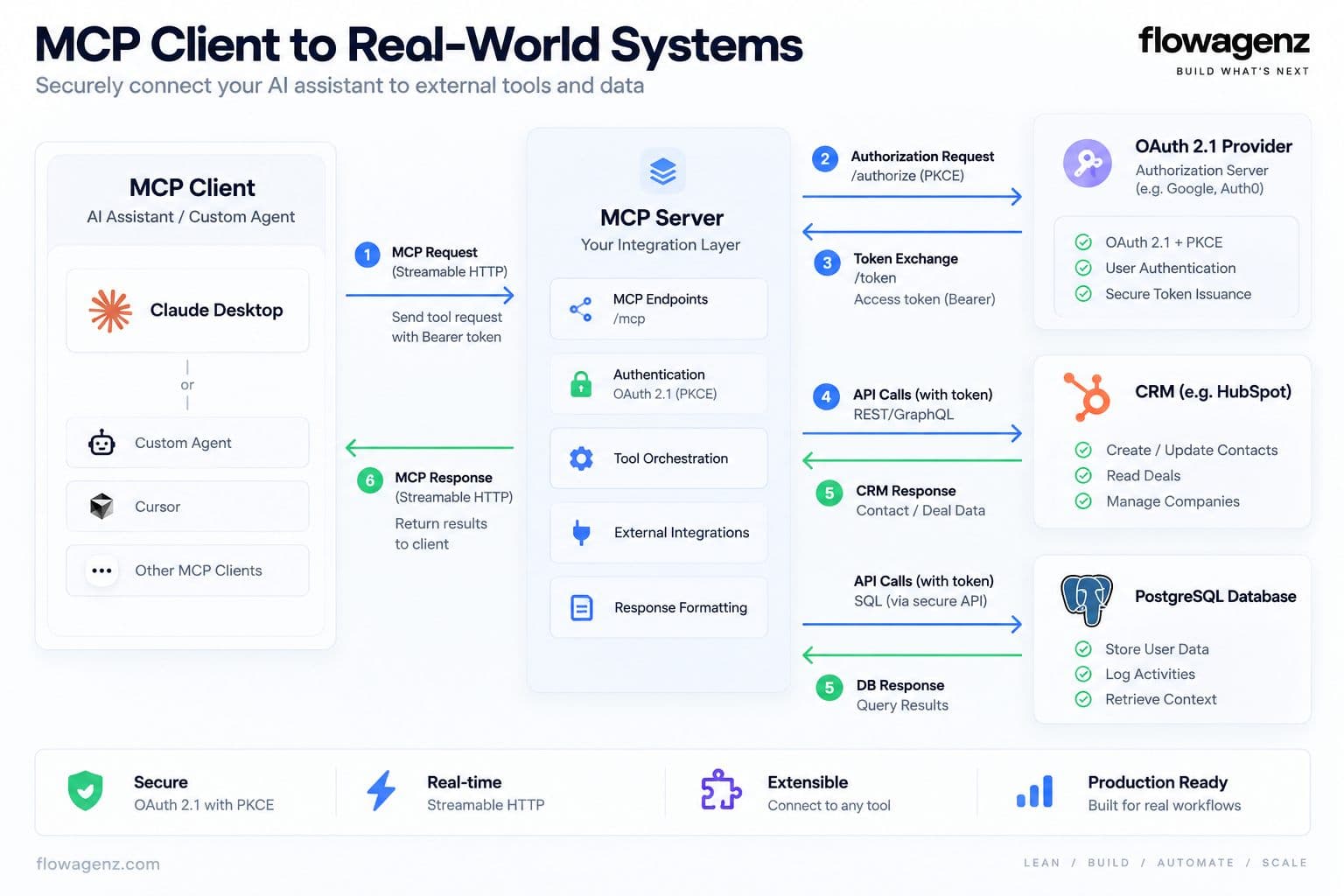
Remote HTTP-based servers get OAuth 2.1 with Resource Indicators (RFC 8707) so a stolen token can't be replayed against a different downstream server, plus Client ID Metadata Documents instead of a dynamic client registration database your team has to maintain and patch. stdio servers pull credentials from the environment, per spec, rather than reimplementing a web auth flow that adds no security on a local process.
04
Testing, versioning, and handoff.
Every server ships with an MCP Inspector session recorded for your team, a versioned changelog against the protocol revision it targets, and deployment docs that assume your engineer has never touched MCP before. The 2026-07-28 spec deprecated Roots, Sampling, and Logging in favor of narrower, more auditable primitives. We build against the current spec and note explicitly what to change if you are migrating an older server rather than starting fresh.
Built on a modern, connected stack
We are not bolting MCP onto a stack we don't otherwise use. Claude API and OpenAI integrations, self-hosted n8n for the automation layer, and Postgres with pgvector for retrieval are already how we build AI systems for clients. An MCP server we hand you slots into that same world: an n8n workflow can call your new MCP tools directly through n8n's MCP node, and a RAG pipeline you already have running on pgvector can be exposed as an MCP resource instead of a bespoke API you maintain twice.
Whether every internal tool needs its own MCP server versus one server with well-scoped tool namespaces is a genuinely unsettled call, not an agreed best practice yet. I will tell you which side of that fits your system rather than defaulting to whichever is faster to build.
Who this is for
SaaS companies who want their product driven from Claude, ChatGPT, or an internal agent without hand-rolling a second integration surface for every AI client that shows up.
Agencies and dev shops needing white-label MCP build capacity for a client's AI integration, delivered with documentation good enough to hand straight to the client's team.
Startups building agentic products that need a real tool layer between an LLM and their own data, not a demo that falls over past the first few tool calls.
Teams with an existing REST or GraphQL API who want it exposed to agents with proper scoping instead of a wrapper that turns every endpoint into an unguarded tool call.
We work with teams past the point of tool sprawl and ad-hoc integrations, where a system needs a deliberate interface rather than another script. That is a situation filter, not a revenue gate.
Why Flowagenz
Code and infrastructure you own outright.
Full ownership of the server code and hosting on completion. No vendor lock-in, no dependency on us to keep the server running after handover.
Custom MCP server development for US, UK, and Australian teams. Built in Salem, India. Shipped with full code ownership
Western-grade engineering at a rate structure offshore delivery makes possible, not a discount on quality. We work with US, UK, and Australian clients as standard practice.
Real overlap, not vague promises.
Async-first communication with working hours that overlap US Eastern mornings, UK afternoons, and Australian business hours on the same day, so a question doesn't sit for 18 hours waiting on a reply.
We build the surrounding stack, not just the server.
Because n8n automation, RAG chatbots, and Claude API integration work are already what we do, an MCP server we build for you fits into infrastructure we understand end to end, not a one-off protocol exercise.
Process
How it works
01
01
Scoping call.
We map your API or system, decide what should and should not become an agent-facing tool, and agree the transport (stdio vs Streamable HTTP) based on who is going to run the client.
02
02
Primitive design.
Tools, resources, and any prompt templates get spec'd with input schemas before a line of server code is written, including which actions require confirmation.
03
03
Build.
Server implementation against the current MCP spec, with protocol version negotiation so you are not forced to drop support for older clients on day one.
04
04
Auth and hardening.
OAuth 2.1 with Resource Indicators for remote servers, or environment-based credentials for local stdio servers, plus rate limiting on any tool that touches a paid downstream API.
05
05
Handover.
MCP Inspector test session, deployment docs, and a walkthrough with your engineers. Typical builds run 2 to 5 weeks depending on how many tools and how much existing API surface needs mapping.
What you get on handover
Every MCP server ships with the following:
Full Source Code – Complete Node.js/Python code. The client owns the code.
MCP Inspector Test Recording – Proof of the tested tool calls and responses.
Deployment Documentation – Step-by-step instructions to deploy and run the MCP server.
OAuth 2.1 Documentation – OAuth Client ID details, if authentication is configured.
Versioned Changelog – MCP specification version used and migration notes.
Environment Configuration –
.env.examplewith all required variables documented.30-Day Support – Bug fixes and technical clarification for 30 days after handover.
No Flowagenz Dependency – The MCP server runs entirely on the client's own infrastructure and accounts.
FAQ
Frequently Asked Questions
Everything you need to know about our process and digital systems.
It depends on how many tools you need, how much of your existing API needs restructuring rather than direct exposure, and whether you need remote OAuth 2.1 auth or a simpler local stdio server. We scope on a short call rather than quoting a flat number blind, because a five-tool internal server and a twenty-tool multi-tenant remote server are different projects. Once scoped, we quote in INR and USD together.
Book your MCP scoping call
30 minutes. We map your API, decide what becomes a tool, and give you a fixed quote. No discovery fee.