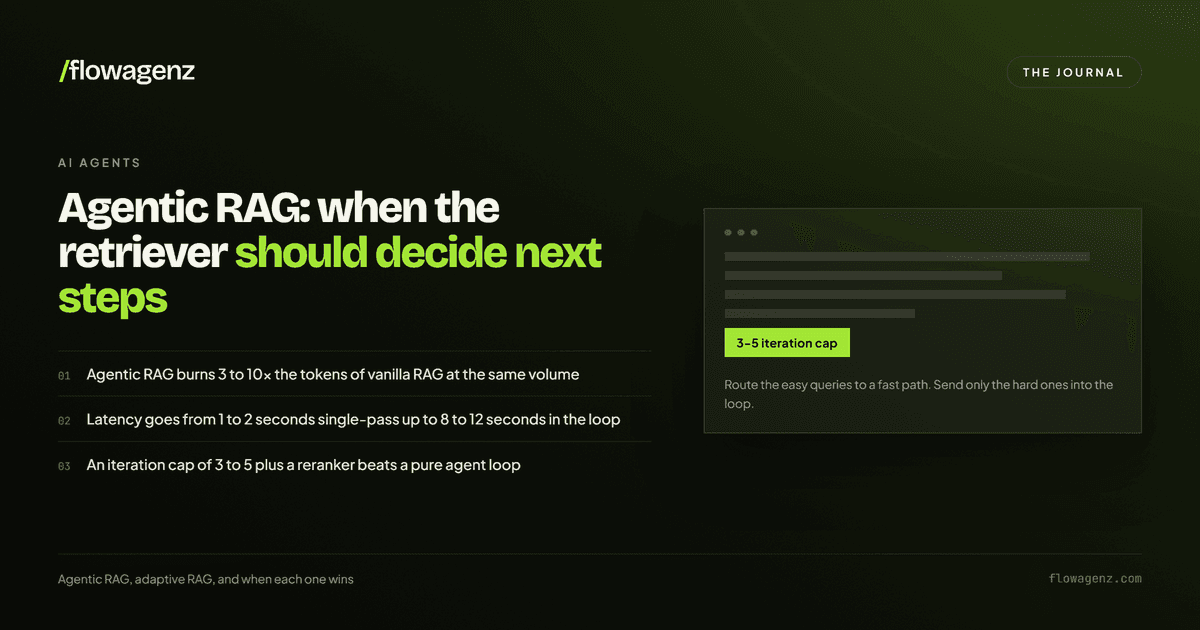
Agentic RAG: when the retriever should decide next steps
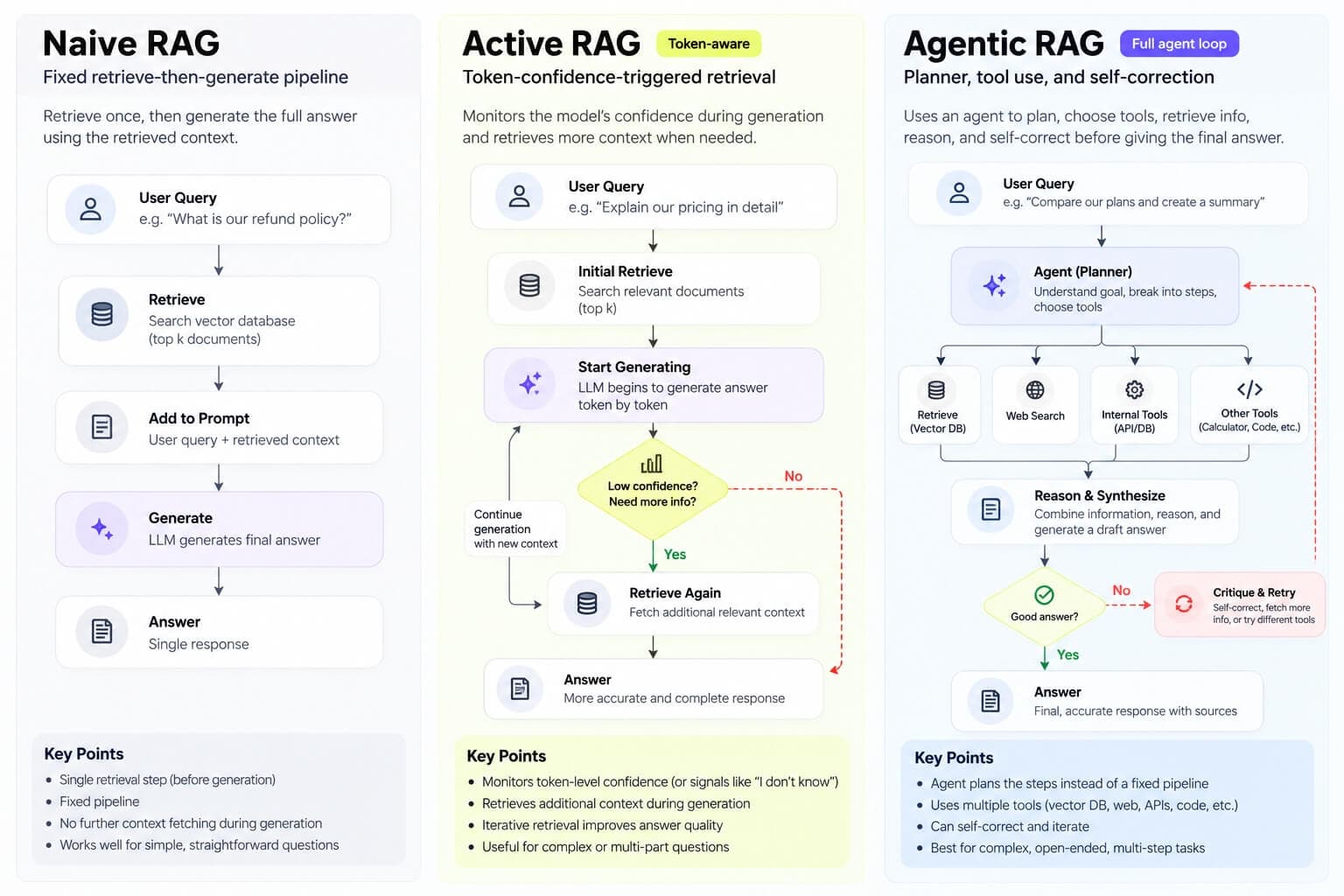
Most explanations of agentic RAG collapse it into the same thing as Active RAG, a model that decides, mid-generation, whether to pause and look something up. That's a real, useful technique, FLARE and similar approaches have been doing it for a while, but it's a narrower, single-pass mechanism, not agentic RAG. A 2026 taxonomy paper on agentic retrieval draws the actual line clearly: Active RAG decides when to retrieve using token-level confidence during one generation pass. Agentic RAG separates planning from generation entirely, it's policy-driven, runs multi-step tool use, and can take real actions that never produce an output token at all, discarding a bad retrieval, switching tools mid-task, deciding the evidence gathered so far is good enough to stop. Confusing the two leads to building something that sounds agentic and behaves like a slightly smarter single-shot pipeline.
The harder, more honest question underneath the hype: does agentic RAG actually outperform a well-built fixed pipeline, or does the extra autonomy mostly add cost and latency for marginal accuracy gains? A 2026 experimental comparison asks exactly this, testing agentic RAG against what the researchers call Enhanced RAG, a fixed but genuinely good pipeline with a semantic router, a query rewriter, a retriever, and a reranker. That comparison is the right frame for this post: agentic RAG is a real architecture with real wins on specific problems, not a strictly-better upgrade over everything that came before it.
The practical decision isn't "should every RAG system be agentic." It's matching the retrieval architecture to how much genuine, runtime uncertainty exists in your actual queries. A lookup against one well-structured knowledge base rarely needs an agent deciding whether to retrieve, a question that might need two different sources combined, or might need zero retrieval at all depending on phrasing, genuinely does.
What makes a RAG system actually agentic
Current research organizes agentic RAG around four capabilities working together, not any single one of them in isolation:
Query understanding and planning. Interpreting what's actually being asked and choosing a strategy before touching the retriever, not just embedding the raw query and searching.
Tool and retrieval orchestration. Deciding when to retrieve, from which source, and whether a non-retrieval tool (a calculator, an API call, a database query) is actually what the question needs instead.
Multi-hop reasoning and decomposition. Breaking a complex question into sub-questions, retrieving for each separately, and combining the results, rather than hoping one retrieval pass surfaces everything needed.
Self-reflection. Critiquing the agent's own retrieved evidence and generated answer, and triggering another retrieval pass when the evidence doesn't actually support a confident answer.
This framing matters because a system that only does the first of these, query planning, without genuine self-reflection or the ability to retry, is closer to a smarter router than to agentic RAG proper. The name gets applied loosely across a wide range of actual sophistication.
The formal version: retrieval as a decision problem
One rigorous way current research frames this, useful for understanding what's actually happening under the hood: model the agent's retrieval behavior as a partially observable decision process. The agent doesn't have full visibility into what the right answer is or whether its current evidence is sufficient, it's operating on a belief state built from what it's retrieved and reasoned through so far. Each retrieval is an action the policy can choose to take or skip. Tool calls return observations that update that belief state. And, critically, there has to be an explicit termination condition, a maximum loop depth, or the system can retrieve indefinitely without ever generating an answer.
That last point isn't an academic footnote, it's a real engineering requirement. The same discipline covered in our guide to AI agent security best practices, capping an agent's maximum iterations explicitly, applies directly here: an agentic RAG loop with no hard stop on retrieval attempts is a cost and latency risk, not just a theoretical edge case.
Named techniques worth knowing
A few specific, well-studied approaches sit at different points on the spectrum between naive and fully agentic:
Self-RAG trains the model to emit explicit reflection tokens that control both whether to retrieve and how to critique what came back, selective retrieval built into the model's own output rather than bolted on externally.
Adaptive-RAG routes each query to one of three strategies, no retrieval, single-step retrieval, or multi-step retrieval, based on a predicted difficulty label for that specific query, rather than treating every question the same way.
Corrective RAG (CRAG) adds an explicit correction step: after retrieval, evaluate whether what came back is actually good enough, and trigger a different retrieval strategy if it isn't, rather than passing possibly-irrelevant chunks straight to generation.
FLARE, the clearest example of Active RAG rather than fully agentic RAG, anticipates upcoming low-confidence tokens during generation and re-queries the retriever specifically to fill that gap, a single-pass mechanism, not a separate planning loop.
ReAct interleaves reasoning traces with tool-use actions, the pattern most modern agent frameworks (including the AI Agent node covered in our n8n AI node guide) build their retrieval-as-a-tool behavior on top of.
Is it actually worth the added cost and complexity
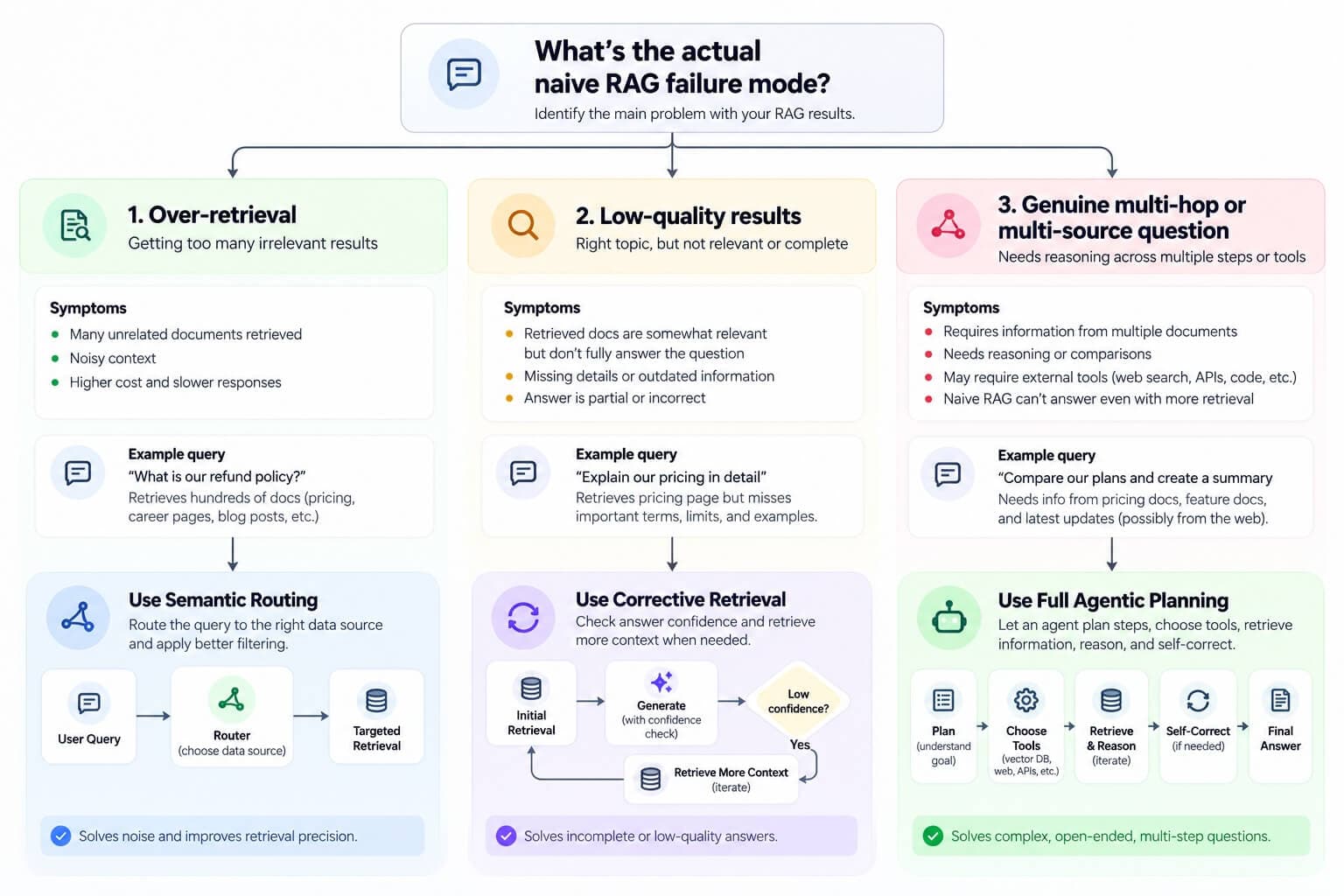
This is the question most agentic RAG content skips in favor of describing the architecture. The honest 2026 research answer: it depends on whether the underlying weakness you're trying to fix is one agentic RAG actually addresses. A 2026 comparative study structures the test around naive RAG's specific, named shortcomings, retrieving even for queries that don't need it, missing multi-hop questions that need several sources combined, failing to recover when the first retrieval attempt comes back empty or irrelevant, and checks whether Enhanced RAG (a well-built fixed pipeline with routing and reranking) or full agentic RAG actually solves each one better.
The practical implication: if your real failure mode is retrieving when you shouldn't (a simple chatbot FAQ bot retrieving for "thanks, that's all" style messages), a semantic router in a fixed pipeline solves that cheaply, no agent required. If your real failure mode is genuinely multi-hop questions where the right answer needs combining evidence from sources the system doesn't know it needs until partway through, that's where agentic RAG's planning and iteration earn their real cost. Budget-aware research on this exact question frames it correctly: this is a cost-accounting decision, not just an accuracy comparison, since every additional retrieval attempt an agent takes has a real, measurable latency and token cost attached to it.
Where this connects to the rest of the pipeline
Agentic RAG doesn't replace the fundamentals covered elsewhere, it sits on top of them. Retrieval quality still depends on getting chunking right, an agent deciding to retrieve a second time doesn't fix a chunk that was poorly formed in the first place. The production RAG pipeline layers, query transformation, hybrid search and reranking, evaluation, monitoring, all still apply underneath an agentic control loop, agentic RAG adds a decision layer on top of a retrieval system that still needs to be built well in its own right. And the added iteration an agentic system introduces is a real, documented source of hallucination risk if the self-reflection step isn't genuinely calibrated, an agent that retries confidently on bad evidence is a more expensive way to produce the same wrong answer.
Decision framework
Stick with naive or lightly-enhanced RAG if: queries are consistently single-hop, answerable from one well-structured source, and the main risk is occasionally retrieving when it isn't needed, a semantic router solves that cheaply.
Add Active RAG (confidence-triggered mid-generation retrieval) if: the task is long-form generation where knowledge gaps show up partway through an answer, and a single-pass fix during generation is sufficient.
Go fully agentic if: real questions genuinely need multiple sources combined, the right retrieval strategy isn't knowable in advance, and the cost of a wrong or incomplete answer justifies the added latency and token cost of a planning and self-correction loop, with an explicit, hard cap on how many retrieval attempts the agent can take.
The bottom line
Agentic RAG is a real, specific architecture, planning separated from generation, policy-driven tool and retrieval choices, genuine self-correction, not just a model that occasionally re-queries mid-answer. It earns its added cost and complexity on genuinely multi-hop, multi-source problems where the right retrieval strategy isn't knowable in advance, and it's overkill, an expensive way to solve a problem a semantic router already handles, for simpler, single-hop lookups. Match the architecture to the actual uncertainty in your queries, cap the agent's retrieval attempts explicitly, and treat "agentic" as a real engineering trade-off rather than an automatic upgrade.
Book a short call to walk through your specific case.
If you're deciding whether your RAG system actually needs agentic retrieval or a simpler, cheaper fixed pipeline would do the job, Flowagenz can assess your real query patterns before recommending an architecture.