An independent academic benchmark published in May 2026, Voice of India, tested nine proprietary STT APIs and three open-source models across 15 Indian languages on real-world audio, not clean studio recordings. Sarvam's models came out on top for accuracy in 13 of those 15 languages. On the other end, AssemblyAI's Universal model exceeded a 100 percent word error rate on some languages, a result so poor it means the transcription was, on average, less useful than no transcription at all for that language. That's the real spread you're choosing between when picking an STT provider for Indic languages, and it's a genuinely different picture than what most general-purpose STT comparisons, built and tested primarily on English, will tell you.
This matters specifically because Deepgram and Whisper, both excellent, well-regarded tools for English and broad global-language coverage, weren't built with Indian phonetics, code-switching, or telephony conditions as their primary design target the way Sarvam's stack was.
If the product speaks primarily to Indian users, especially in regional languages or Hindi-English code-mixed speech, Sarvam's accuracy advantage on real, independent benchmarks is substantial enough that it should be the default starting point to evaluate against, not an afterthought considered only after Deepgram or Whisper underperform.
What each one actually is
Deepgram is a cloud-native STT platform built for speed and developer experience, sub-300ms streaming latency, and its Flux model added native end-of-turn detection in April 2026, genuinely useful for voice agents where knowing when a caller has actually finished speaking matters as much as transcription accuracy itself. Its monolingual models have expanded to 30-plus languages with monthly additions, including some Indic language support, but Deepgram's core design center of gravity is broad, general-purpose language coverage and voice-agent latency, not Indian-language-specific accuracy engineering.
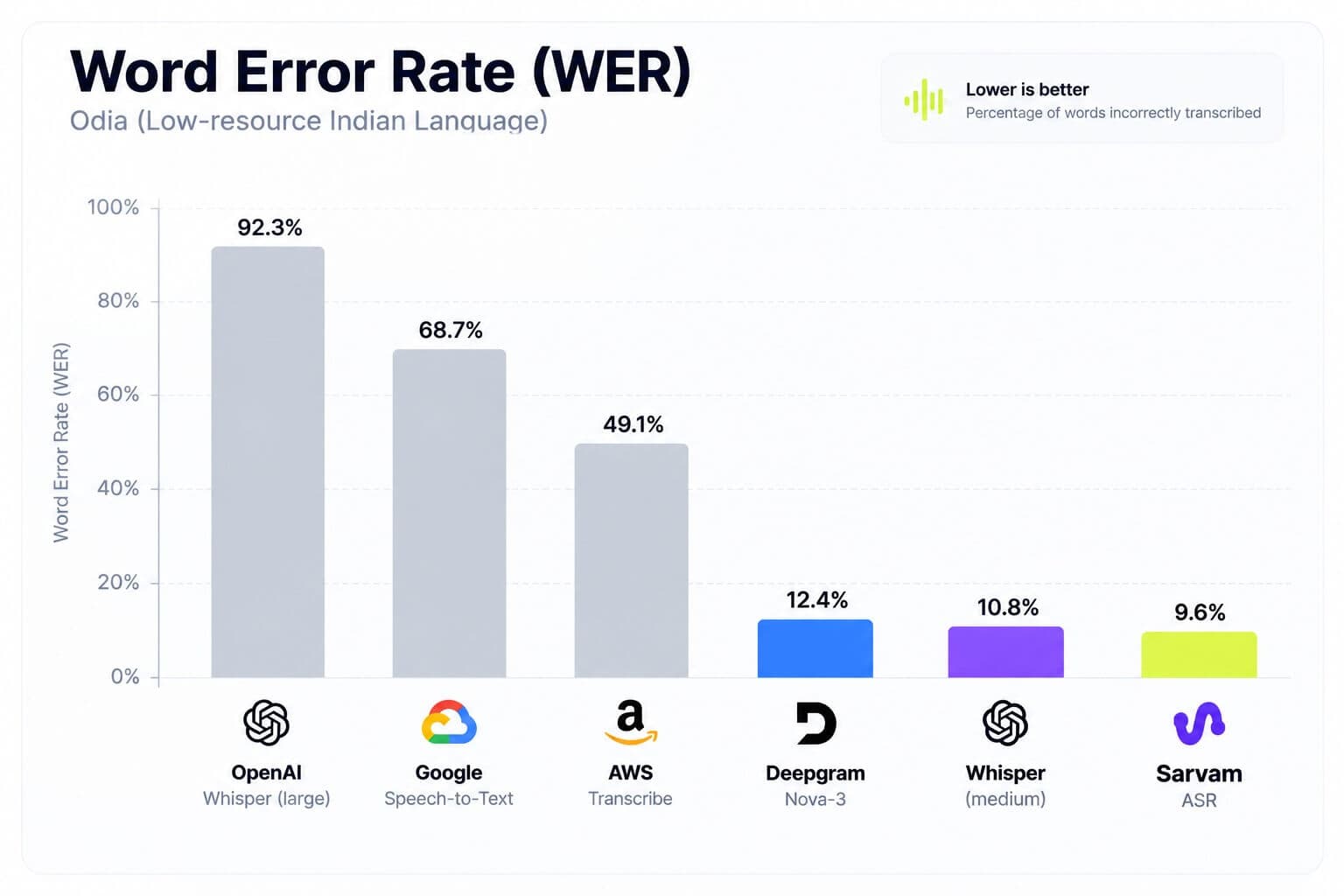
Whisper (OpenAI) is an open-source model trained on 680,000 hours of multilingual audio, covering 99-plus languages, with a genuinely useful trait no proprietary API offers: full self-hosting control and no per-minute API cost if you run it yourself. Its broad language claim is real, and its overall average word error rate across all supported languages sits around 12 percent. That average hides real variance, though, Whisper's accuracy on well-resourced languages like English is strong, while its performance on lower-resource Indian languages specifically can degrade substantially, a pattern confirmed in independent testing on genuinely low-resource languages like Odia.
Sarvam is an Indian AI company building its speech stack, Saarika (transcription), Saaras (transcription plus direct translation), and Bulbul (text-to-speech), specifically around Indian phonetics, accents, and the code-mixed speech patterns (Hindi-English and similar) that dominate real Indian conversational audio. Saarika supports 11 Indian languages with strong telephony performance (optimized for 8kHz audio, the standard for phone calls) and multi-speaker handling. Its newer Saaras models extend language coverage further, and the company has also released Indic DiarBench, an open benchmark covering all 22 scheduled Indian languages for both transcription accuracy and speaker diarization jointly, a genuinely useful contribution to the broader Indic speech research space, not just a marketing benchmark.
What the actual accuracy data shows
The Voice of India benchmark is worth taking seriously specifically because it's independent academic research, not a vendor's own reported numbers, testing real-world audio conditions across 15 languages rather than clean, ideal recordings. Sarvam's models achieved the lowest word error rate in 13 of those 15 languages, with AI4Bharat's open-source Indic Conformer and ElevenLabs Scribe v2 showing moderate performance behind Sarvam, and several major providers, including AssemblyAI in some cases, performing dramatically worse, high enough error rates in specific languages to be functionally unusable for production.
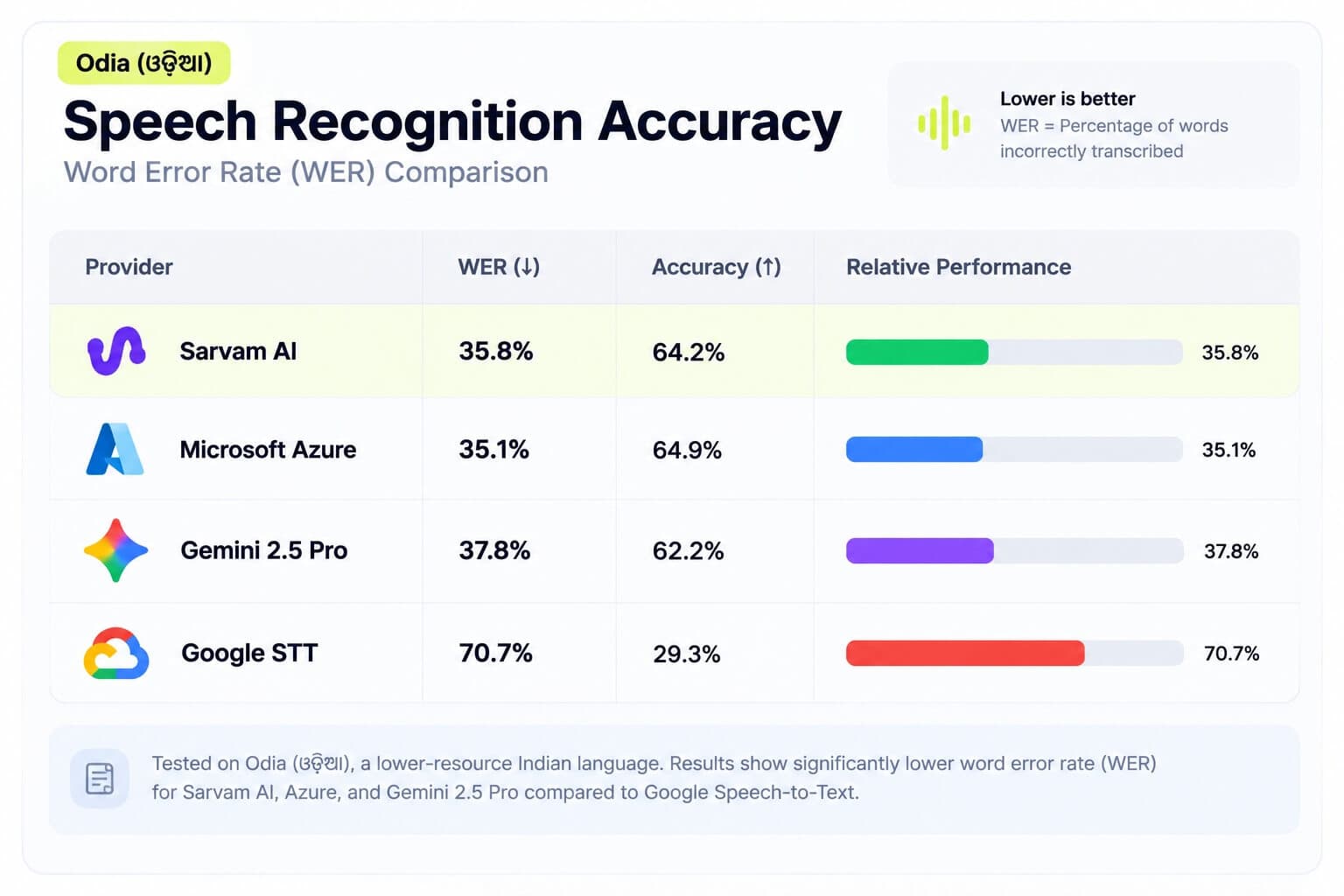
A separate, independent benchmark focused specifically on agricultural-context audio in Odia, a genuinely lower-resource Indian language, found Sarvam AI at 35.8 percent word error rate, competitive with the best-performing system tested (Azure's diarization-enhanced model at 35.1 percent), while Google STT, despite leading in better-resourced languages like Hindi and Telugu, dropped to 70.7 percent WER on Odia specifically, and Whisper's error rate on the same language exceeded even that. This is the pattern worth internalizing: a provider's strong performance on Hindi or English tells you very little about how it will perform on a lower-resource regional language, and the gap between providers widens, not narrows, as you move to less commonly represented languages.
Sarvam's own published claims, that its Saaras V3 model beats Gemini 3 Pro, GPT-4o Transcribe, Deepgram Nova-3, and ElevenLabs Scribe v2 on the IndicVoices and Svarah (Indian-accented English) benchmarks, are self-reported by the company and worth treating with the appropriate caution any vendor's own benchmark deserves. That said, the direction of the claim is consistent with what the independent Voice of India research separately found, which gives it more credibility than a self-reported number standing alone would carry.
Where each one genuinely wins
Deepgram wins when: the product needs best-in-class latency and turn-detection for a voice agent, and the language mix is primarily English or broadly international rather than deeply focused on Indian regional languages. Its Flux model's sub-300ms end-of-turn detection is a real, measurable advantage for natural-feeling conversational flow that neither Whisper nor Sarvam's published benchmarks currently match as directly.
Whisper wins when: self-hosting and cost control matter more than squeezing out the last percentage point of accuracy, or when the product needs to support a genuinely broad, unpredictable mix of languages beyond what any single specialized provider covers. Its open weights also mean it can be fine-tuned on domain-specific or dialect-specific audio if a team has the resources to do that work.
Sarvam wins when: the product speaks primarily to Indian users, especially outside Hindi and English, or handles the code-mixed speech patterns (Hindi-English, and similar mixing in other Indian languages) that are extremely common in real Indian conversational audio and that global models consistently struggle with. Telephony-specific use cases, phone-based voice agents specifically, benefit further from Sarvam's explicit optimization for 8kHz call audio.
Decision framework
Choose Deepgram if: latency and turn-detection are the primary technical constraint, and Indian-language accuracy is a secondary or non-existent requirement.
Choose Whisper if: self-hosting, cost control, or extremely broad language coverage beyond what any specialized Indic provider offers is the priority, and a moderate accuracy trade-off on lower-resource Indian languages is acceptable for the use case.
Choose Sarvam if: the product's real users are speaking Indian languages, especially regional languages beyond Hindi, or genuinely code-mixed speech, and accuracy on that specific audio matters more than broad multilingual coverage or the absolute lowest possible latency.
Consider a hybrid approach if: the product serves a genuinely mixed audience, English-primary in some flows, Indian-language-primary in others, since nothing prevents routing different conversation types or detected languages to different STT providers within the same overall system.
The bottom line
For Indic-language speech-to-text specifically, independent benchmark data gives Sarvam a real, meaningful accuracy edge over Deepgram and Whisper, particularly on lower-resource regional languages and code-mixed speech, the exact conditions most general-purpose global STT providers weren't built around. Deepgram remains the stronger choice when latency and turn-detection are the primary constraint and the language mix is broadly international. Whisper remains a strong, cost-effective, self-hostable option when broad language coverage and infrastructure control matter more than squeezing out maximum Indic-language accuracy. Test against your own real audio and language mix before committing, since even strong benchmark data is still a generalization your specific use case may or may not match exactly.
Let's create something together
If you're building a voice product for Indian users and need to choose the right STT stack, Flowagenz has evaluated all three of these in production voice agent builds. Happy to walk through what fits your specific language mix on a short call.