A multi-tenant RAG platform serving 50 clients doesn't need 50 Pinecone indexes, and it also shouldn't dump all 50 clients into one shared index with nothing but a metadata filter standing between one client's data and another's. Both extremes get this wrong in different ways: N separate indexes is real operational overhead that doesn't scale cleanly, while metadata-filtering-only in one shared index is a single query bug away from one tenant seeing another tenant's data, since semantic search is approximate by nature, a query can return a near-match from the wrong tenant if the filter isn't applied correctly on every single call.
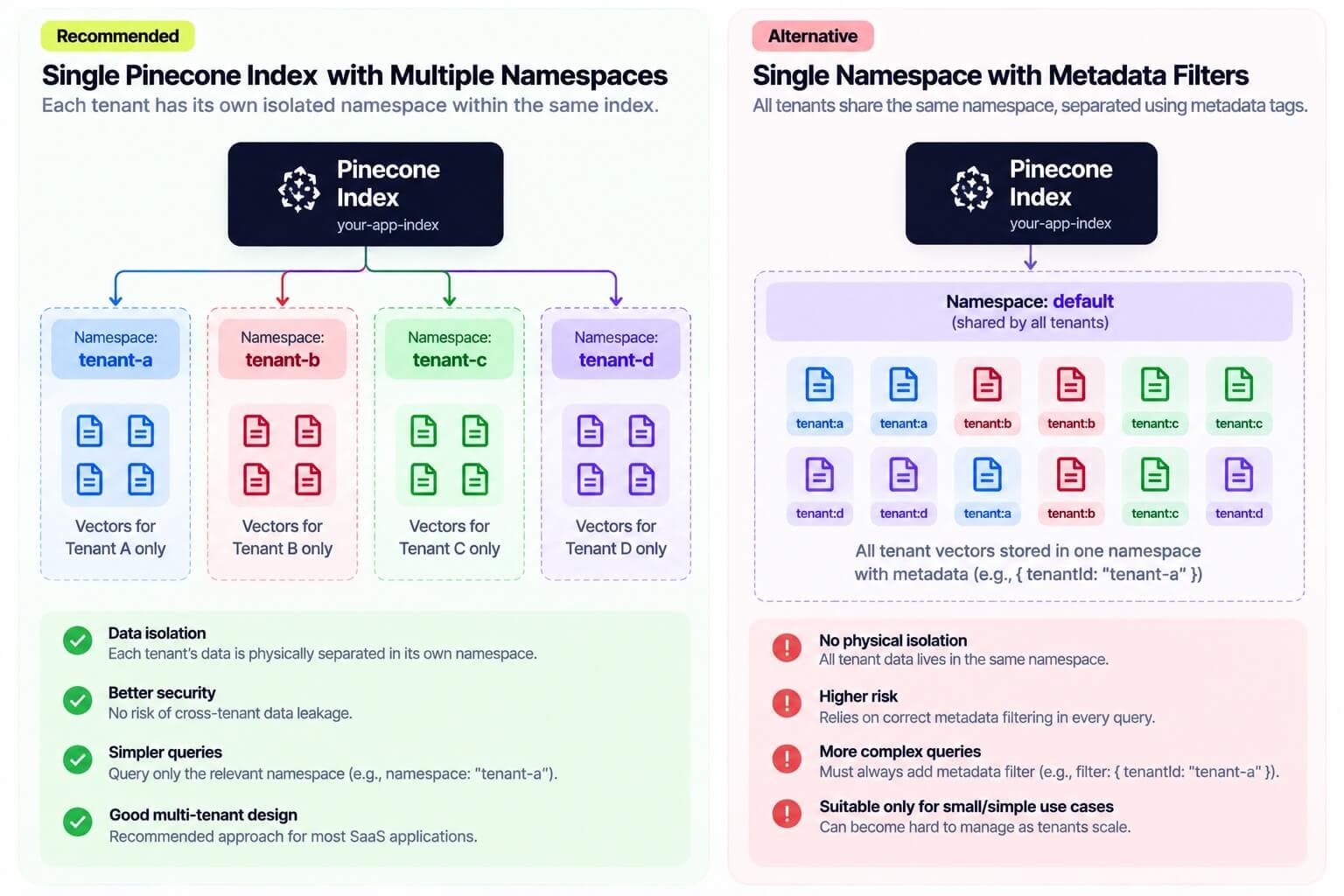
Pinecone's own documented recommendation for this exact problem is neither extreme: one namespace per tenant within a shared index. Namespaces in a serverless index are physically separated at the storage layer, not just logically filtered, which is a meaningfully stronger isolation guarantee than metadata filtering while still avoiding the operational cost of managing a separate index per client.
The real architecture decision isn't binary, it's picking the right isolation level per tenant based on actual regulatory pressure and risk, documented deliberately rather than defaulted into. A recent formalization of this space, the Silo, Pool, and Bridge taxonomy published in academic research in January 2026, names exactly these three patterns and, importantly, frames isolation as an end-to-end property spanning four separate planes, not just a vector database configuration choice.
The four planes where isolation actually has to hold
This framing matters because it's easy to solve isolation at the vector database layer and still leak data somewhere else in the pipeline.
Data plane: the source documents and raw content ingested per tenant.
Vector plane: the embeddings and how they're partitioned in the vector database, namespaces, metadata, or separate indexes.
Orchestration plane: the application logic that constructs queries, applies tenant filters, and routes requests, the layer most vulnerable to a simple code bug undoing everything the vector database's isolation was supposed to guarantee.
LLM plane: what actually ends up in the model's context window. Even a perfectly isolated vector query can be undermined here if retrieved chunks aren't verified against the requesting tenant's ID before being assembled into the prompt.
A real multi-tenant RAG architecture needs isolation enforced at each of these four planes, not just the vector database. Treating vector-level partitioning as the whole solution is exactly the gap that produces a cross-tenant data leak from what looks, on the surface, like a well-architected system.
Why namespaces beat metadata filtering as the default
Physical partitioning, not just logical filtering. In Pinecone's serverless architecture specifically, each namespace is stored separately, genuine physical isolation rather than records living in the same physical space with a tag distinguishing them. Metadata filtering, by contrast, still scans across the shared namespace and filters at query time, which means the underlying data for every tenant is sitting in the same physical space regardless of how careful the filter logic is.
Query cost and performance. Namespace queries are scoped to that namespace's actual size, so querying a 1GB tenant namespace costs meaningfully less and returns faster than scanning a 100GB shared namespace and filtering down to that tenant's records after the fact. This is a real, compounding cost difference at scale, not a minor optimization.
No noisy neighbors. In a serverless architecture, one tenant's heavy query volume doesn't degrade performance for other tenants sharing the same index, because reads and writes are scoped to individual namespaces. This specific guarantee doesn't hold on pod-based (non-serverless) Pinecone indexes, where namespaces still share underlying compute resources, worth checking explicitly which architecture tier a given setup is actually running on.
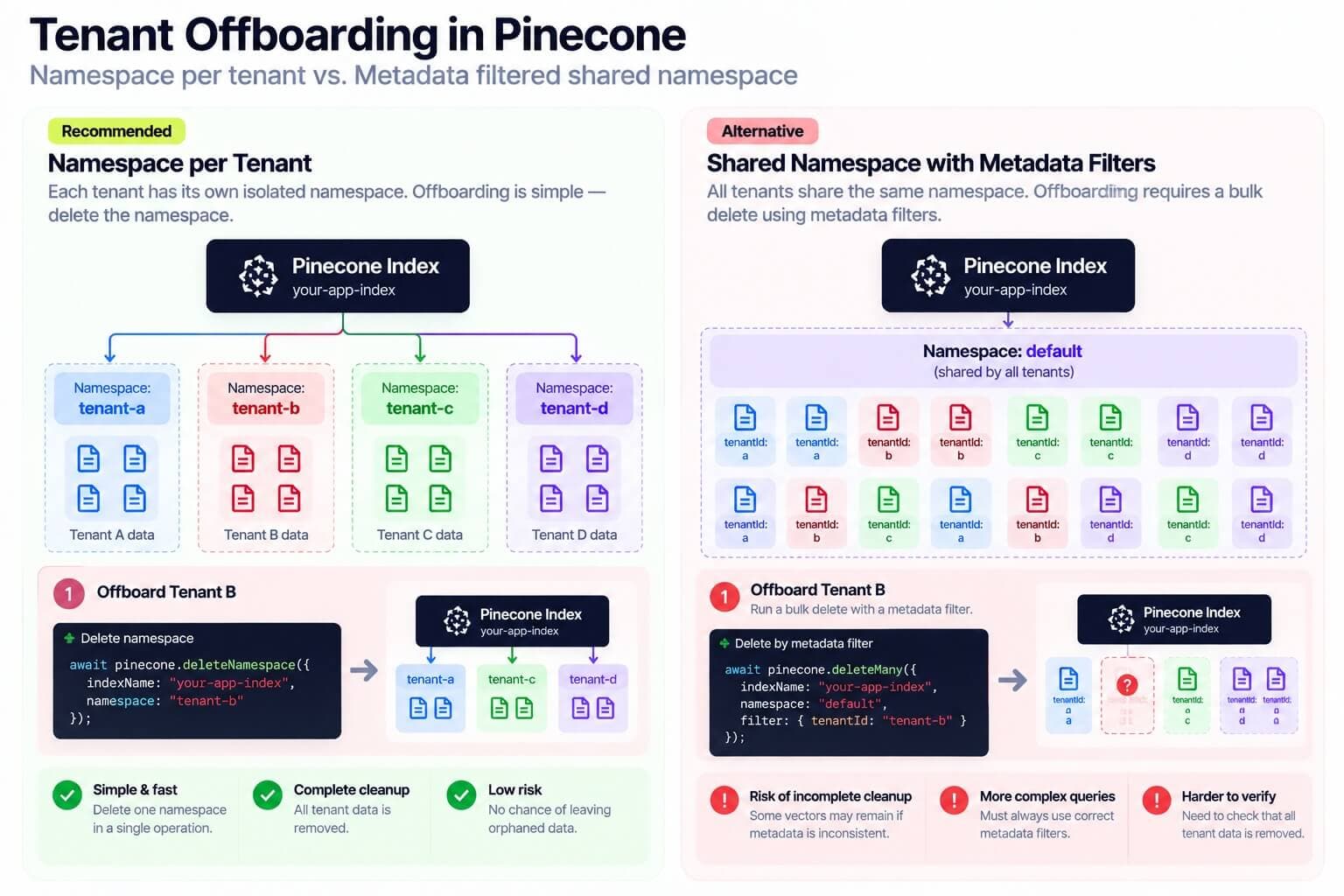
Trivial, near-instant offboarding. Removing a tenant means deleting their namespace, a lightweight, close-to-instant operation. Removing a tenant from a metadata-filtered shared namespace means finding and deleting every record matching that tenant's ID, a heavier, more error-prone operation with a real risk of leaving orphaned records behind if it's not executed completely.
When separate indexes are still the right call
Namespace-per-tenant isn't the universal answer for every tenant in a multi-tenant platform. Specific tenants, particularly in finance or healthcare, or anywhere contractual or regulatory requirements demand physical infrastructure separation beyond what namespace partitioning provides, genuinely warrant a fully separate index rather than a namespace within a shared one. The right approach is deciding this deliberately, per tenant, based on real regulatory pressure and documented reasoning an auditor could review, not applying one pattern uniformly across every tenant regardless of their actual requirements, or conversely, defaulting every tenant into the more expensive separate-index pattern out of excess caution when it isn't actually needed.
Defense in depth: don't trust the filter alone
Enforce tenant isolation at the vector store query layer using a signed claim, commonly a JWT carrying the tenant ID, that the application backend generates and validates on every request, rather than relying on application code alone to remember to apply the right filter every single time. This closes a real, common failure mode: a developer adds a new query path, an internal admin tool, a new API endpoint, a batch job, and forgets to apply the tenant filter, and if the filter is the only thing enforcing isolation, that one omission is a direct cross-tenant leak.
The LLM plane check matters just as much and is the step most architectures skip: before assembling retrieved chunks into the model's context, verify each chunk's tenant ID matches the requesting tenant, even though the vector query should have already scoped correctly. This is deliberately redundant, and that redundancy is the point, a defense-in-depth check here catches a bug anywhere upstream, a misconfigured namespace, a query built without the right filter, before it turns into an actual data leak reaching the LLM's context and, from there, potentially the response shown to the wrong tenant's user.
Keeping source-system permissions in sync
A subtler, easy-to-miss isolation gap: if the underlying content source has its own access controls, an internal wiki with page-level permissions, a CRM with role-based visibility, those permissions need to be mirrored into the chunk metadata at ingestion time and kept current as they change, not just captured once at initial sync. A permission change in the source system, someone loses access to a document, needs to propagate into the RAG index promptly, ideally through a webhook-driven update rather than waiting for the next scheduled full re-sync, or a user can retain retrieval access to content they've since been revoked from in the source system itself.
A practical checklist
Pick the isolation pattern deliberately per tenant (namespace, or separate index for high-compliance cases), and document the reasoning, not just the choice.
Enforce the tenant filter at the query layer via a signed token claim, not solely through application code remembering to apply it correctly on every code path.
Verify retrieved chunks' tenant ID before they reach the LLM's context window, as a redundant, defense-in-depth check independent of the vector query's own filtering.
Mirror source-system permissions into chunk metadata at ingestion, and refresh them on permission-change events, not just on a periodic full re-sync.
Normalize content before embedding it, raw, inconsistent provider payloads produce worse retrieval quality and are harder to debug when something does go wrong.
Set per-tenant rate limits and quotas explicitly, to prevent one tenant's heavy usage from degrading service for others, and treat this as policy to enforce, not an assumption the infrastructure handles automatically.
The bottom line
Multi-tenant RAG isolation is an end-to-end property spanning data, vector, orchestration, and LLM planes, not a single configuration choice at the vector database. Namespace-per-tenant in a serverless architecture is the right default for most multi-tenant SaaS platforms, offering real physical isolation without the operational overhead of managing a separate index per client, reserving that heavier pattern for the specific tenants whose regulatory requirements genuinely demand it. Enforce the tenant boundary at the query layer through a signed claim, verify it again before content reaches the LLM's context, and keep source-system permissions in sync as they change, treating isolation as a property that has to hold at every layer, not just the one that's easiest to configure.
Let's create something together
If you're architecting or auditing a multi-tenant RAG platform, Flowagenz builds this pattern regularly and can review your current isolation strategy across all four planes. Happy to walk through your specific architecture on a short call.