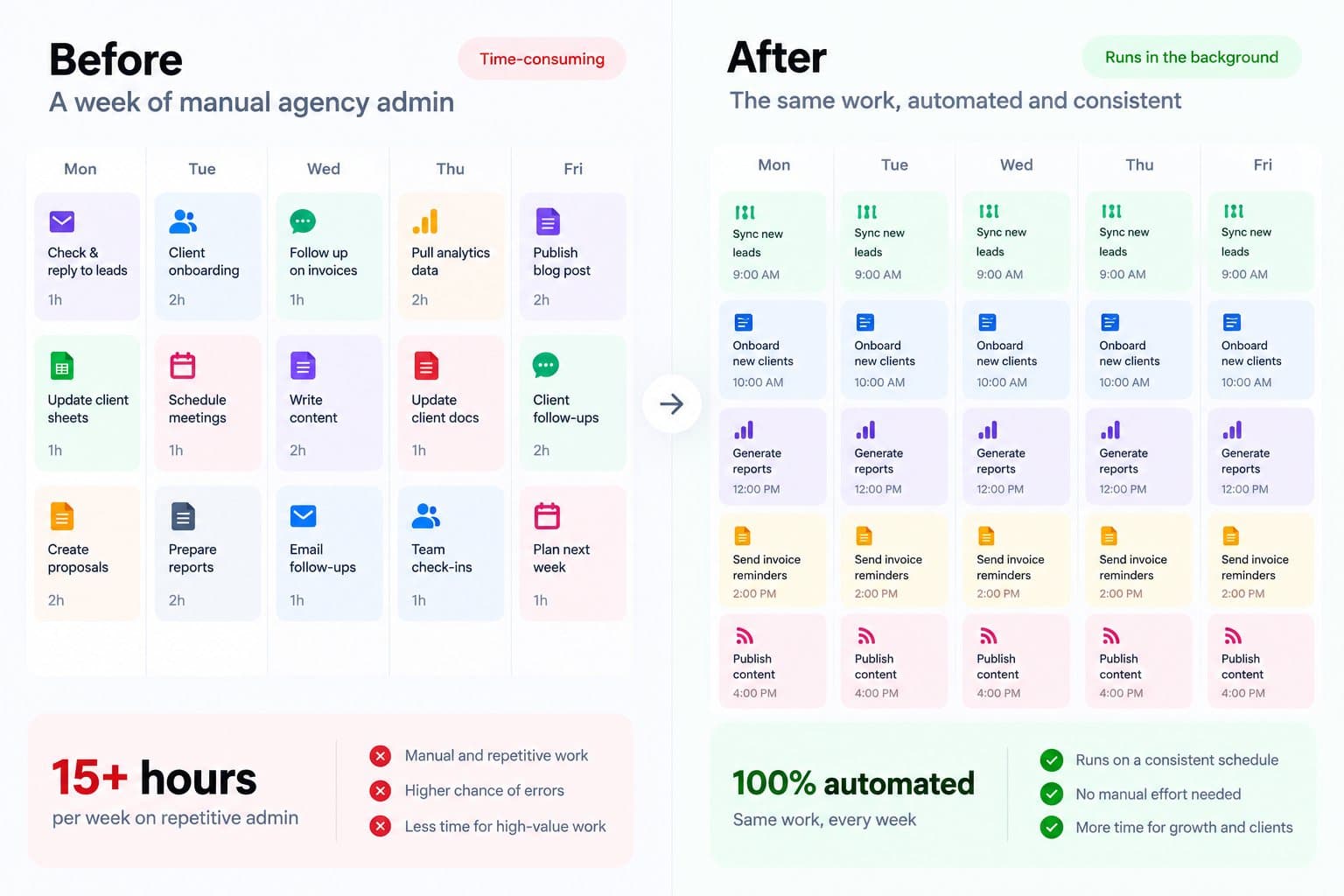
The "10+ hours a week" in this title isn't a client testimonial or a case study pulled from a vendor deck, it's a transparent calculation: take the real, typical time cost of five recurring agency tasks done manually, multiply by how often a mid-sized agency actually does them in a week, and the total lands past 10 hours before you even get to the harder-to-quantify wins, fewer dropped follow-ups, faster client reporting turnaround, less context-switching. The methodology is shown for each workflow below specifically so the number is checkable against your own agency's actual volume, not something you have to take on faith.
None of these five need custom AI agent logic to deliver real value, they're solid, deterministic automation, the kind that fails predictably and is easy to debug when something does go wrong, which matters more for agency operations than flashy AI features that are harder to trust with real client work.
These ranges assume a small to mid-sized agency, adjust the frequency column to your own actual volume, the workflow structure and per-instance time estimates should hold regardless of agency size.
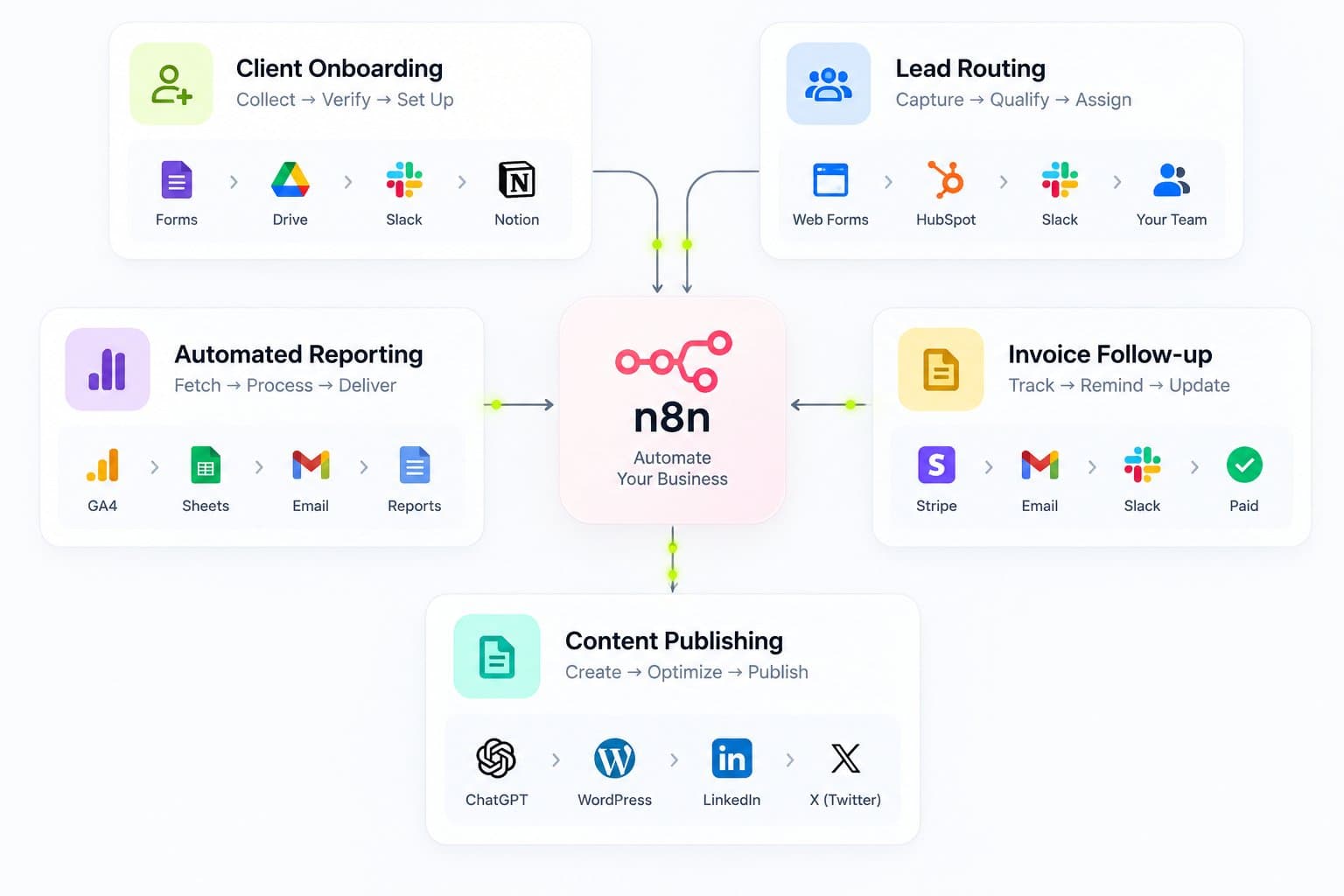
1. Client onboarding automation
The manual version: a new client signs, and someone manually creates a project folder, adds them to the CRM, sends a welcome email, creates a Slack channel, and assigns initial tasks, typically 45 to 60 minutes of scattered admin work across four or five different tools, easy to do inconsistently when it's someone's tenth task of the day.
The n8n version: a form submission or CRM stage change (HubSpot deal moving to "Closed Won" is a common trigger) fires a workflow that creates the client record with consistent field structure, generates a project folder from a template in Google Drive, posts a formatted welcome message to a new Slack channel using Block Kit for proper formatting, and sends a branded welcome email through a transactional provider rather than Gmail directly, since Gmail's sending limits (roughly 500 a day on consumer accounts) make it a poor fit for anything beyond low-volume, ad hoc sends.
Why the manual time estimate is real: this isn't a single five-minute task, it's four or five separate tool switches, each with its own small setup and formatting overhead, which is exactly the kind of task that takes longer than it feels like it should and gets done inconsistently under deadline pressure.
2. Lead qualification and routing
The manual version: an inbound lead comes in through a form or chat widget, and someone manually checks it against basic qualification criteria, company size, budget signals, urgency, then routes it to the right salesperson or adds it to a follow-up queue, typically 10 to 15 minutes per lead once you include the actual research and CRM data entry.
The n8n version: the form submission triggers a workflow that enriches the lead with basic firmographic data (company size, industry) through an enrichment API, scores it against defined criteria, creates or updates the CRM record (HubSpot's contact and deal operations handle this cleanly), and routes a Slack notification to the right team member based on the score and territory, all within seconds of the lead actually submitting the form, rather than whenever someone next checks their inbox.
Why the manual time estimate is real: the research and data-entry portion of lead qualification is genuinely repetitive and rule-based for the large majority of leads, exactly the kind of task automation handles reliably, while the judgment calls on genuinely ambiguous leads still route to a human rather than getting automated away.
3. Automated client reporting
The manual version: pulling performance data from Google Analytics, ad platforms, and whatever else a client's campaign touches, then compiling it into a report and sending it, typically 30 to 45 minutes per report once you include formatting and writing a summary, and agencies running weekly or biweekly reporting across multiple clients burn real hours here every single week.
The n8n version: a scheduled trigger pulls data from each relevant source through their APIs, compiles it into a consistent report format (a Google Sheets template populated programmatically, or a generated PDF), and sends it to the client automatically on a fixed schedule, with the underlying data pull and formatting fully automated even if a human still reviews the summary commentary before it goes out.
Why the manual time estimate is real: this is one of the most consistently cited time sinks in agency operations, not because any single step is hard, but because it's genuinely tedious, repetitive, multi-source work that has to happen on a fixed schedule regardless of what else is going on that week.
4. Invoice and proposal follow-up
The manual version: tracking which invoices are overdue and which proposals haven't gotten a response, then sending a follow-up, typically 10 minutes per follow-up once you include checking status and writing a message that doesn't feel like a form letter, and this is exactly the kind of task that gets deprioritized when things get busy, which is precisely when it matters most for cash flow.
The n8n version: a scheduled workflow checks invoice status against your accounting system or CRM, and for anything overdue past a defined threshold, sends a tone-matched follow-up, gentler for a first reminder, firmer for a repeat late payer, without anyone having to remember to check and act on it manually. The same pattern works for proposal follow-up: no response after a set number of days triggers a check-in message automatically.
Why the manual time estimate is real: the actual sending takes a few minutes, but the real cost is the task getting skipped entirely under time pressure, which shows up as slower cash flow and stalled deals rather than as a visible time cost, making this one of the higher-leverage workflows on this list relative to its small per-instance time estimate.
5. Content publishing pipeline
The manual version: taking an approved piece of content and manually formatting and posting it across each relevant channel, LinkedIn, the company blog, an email newsletter, typically 15 to 20 minutes per post once you include platform-specific formatting and image handling, multiplied across every piece of content an agency publishes on behalf of itself or its clients.
The n8n version: an approval trigger (a status change in a content calendar tool, or a simple form submission once a draft is approved) fires a workflow that formats and publishes to each configured channel automatically, pulling the right image, applying platform-specific formatting, and logging the publish confirmation back to the content calendar, with a human still writing and approving the actual content, automation handles only the repetitive publishing mechanics.
Why the manual time estimate is real: cross-platform publishing is a classic case of low-complexity, high-repetition work, each individual post takes a predictable, moderate amount of time, and the aggregate across a real weekly content volume adds up to a genuinely significant chunk of time that automation removes cleanly.
Why these five specifically, and not others
These workflows share three traits that make them good automation candidates, worth using as a filter for evaluating any other task an agency might consider automating: the steps are well-defined and repeatable (not requiring judgment on most instances), the task happens on a real, recurring schedule or trigger (not a rare, one-off event where automation ROI is weak), and a failure is easy to detect and recover from (a missed Slack notification is noticed quickly; a silent, undetected failure in something higher-stakes is a worse trade). Tasks that fail these three tests, anything requiring real case-by-case judgment, anything rare enough that building automation costs more than the time it would ever save, are usually better left manual, or handled by an AI agent with proper guardrails rather than deterministic automation.
The bottom line
The real time savings here come from removing scattered, repetitive admin work that's individually small but adds up across a real week of agency operations, not from any single dramatic automation. Check the methodology in the table against your own actual task frequency before treating 10 hours as a guarantee, and start with whichever workflow maps to your agency's actual biggest recurring time sink, not necessarily the one at the top of this list.
If you want help scoping and building any of these workflows for your agency's actual tools and volume, Flowagenz builds n8n automation for agencies regularly. Happy to walk through your specific setup on a short call.