Claude or OpenAI wired into your existing app, your existing auth model, and your existing data schema, not a bolted-on chat widget from a different product. Built to ship behind a feature flag, into the deploy pipeline you already run.
AI features added into the product you already have
The problem, reframed
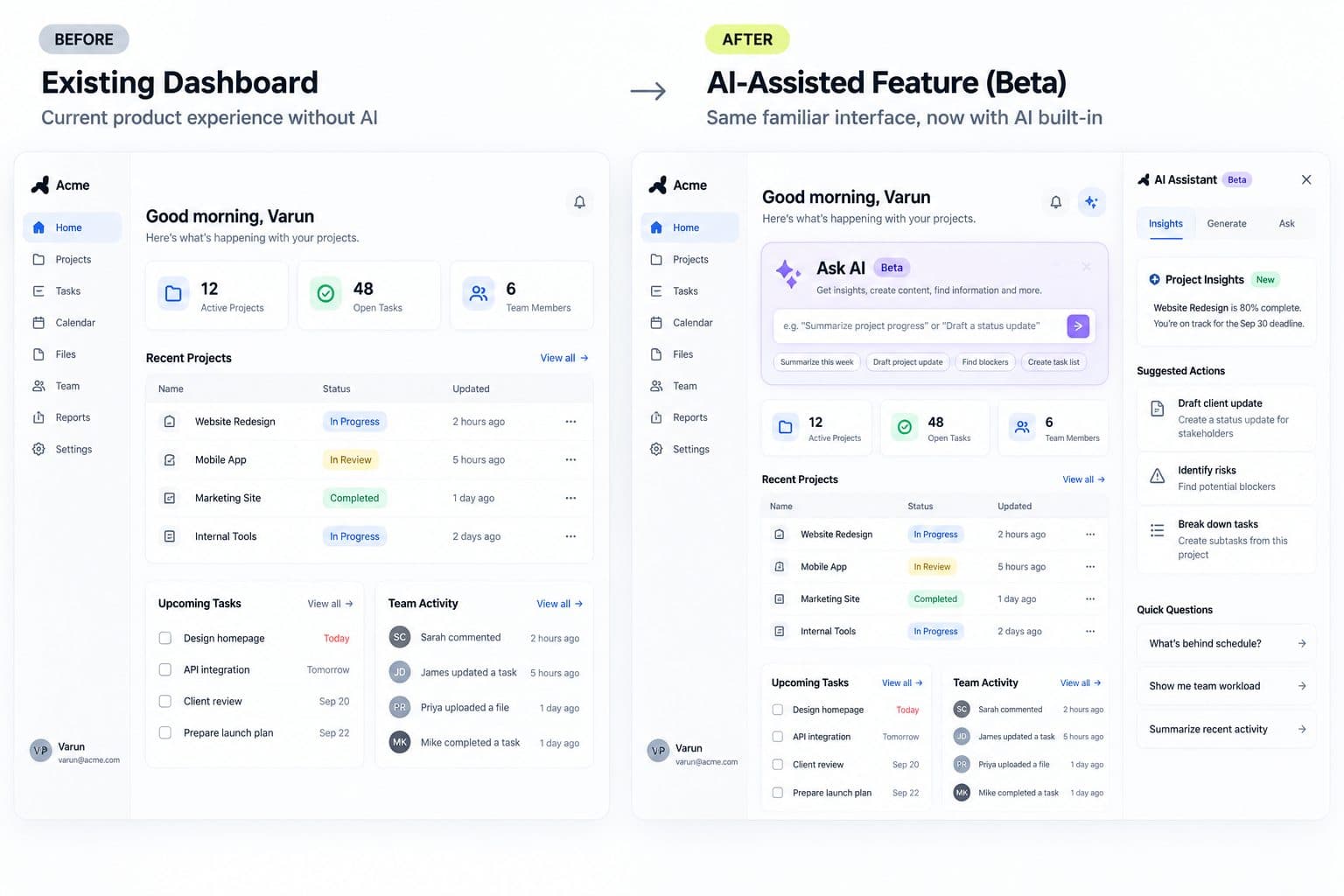
Most "AI integration" work in the market means standing up a brand-new AI product next to your real one: a separate chatbot subdomain, a different auth system, a different data store that has to be kept in sync by hand. That is a reasonable choice when you are launching something genuinely new. It is the wrong choice when what you actually need is your existing product to get smarter, with the AI feature living inside the same session, the same permissions model, and the same release process as everything else you ship.
I think the harder and more valuable engineering here is respecting what already exists: not rewriting your auth, not standing up a parallel data model, not shipping an AI feature that bypasses your existing rate limits or billing tiers because nobody wired it into them. Retrofitting is slower to demo and faster to actually ship safely.
What we build
01
Integration within your existing auth and permissions model.
An AI feature added to your app inherits your current session and role-based access rather than requiring a separate login or exposing data a user's existing permissions would not let them see. If a support rep can only see tickets in their queue today, the AI assistant you add respects that same boundary.
02
Schema extension, not a parallel data store.
Where a feature needs embeddings for semantic search or retrieval, we add a vector column or a linked table in your existing database, typically Postgres with pgvector, rather than standing up a separate vector database your team now has to keep synchronized with the system of record.
03
Feature-flagged rollout.
New AI functionality ships behind a flag so it can be enabled for a pilot group, rolled back instantly if something behaves unexpectedly, and released gradually instead of flipping on for every user the moment it deploys.
04
Cost and rate limiting matched to your existing tiers.
If your product already has usage tiers or billing plans, LLM calls get metered against them from day one, so an AI feature does not become an unbudgeted cost center that shows up as a surprise on next month's API bill.
05
UI that matches your existing design system.
The feature ships in your component library and your existing interaction patterns, not a generic chat bubble that visibly comes from a different toolkit than the rest of your product.
06
Legacy stack accommodation.
Older Rails, Django, or PHP monoliths can absolutely get an AI feature added without a framework migration. We scope the integration around what your stack can support directly, and flag honestly anywhere the existing architecture genuinely limits what is possible without a larger change.
Recently shipped
Built for an existing B2B product first. We added an AI-assisted search feature to a client's legacy Django application without a framework rewrite: embeddings stored in a new vector column on their existing Postgres database, Claude API wired into their current auth and permissions model, and the feature shipped behind a flag to a pilot group of 50 users before a broader rollout. The integration touched their real data schema, not a parallel system, and rolled back cleanly when one edge case surfaced during pilot. Retrofitting, not rebuilding.
Built on a modern, connected stack
Claude API and OpenAI are the models we integrate most, backed by Postgres with pgvector when a feature needs retrieval, and self-hosted n8n when part of the feature needs an asynchronous workflow rather than a synchronous API call blocking your UI. Where your product already talks to a CRM or helpdesk; HubSpot, Zoho, Salesforce, Zendesk, Freshdesk, or Intercom; an AI feature we add can read from and write back to that same system instead of creating a second source of truth. If the feature needs a real tool layer between the LLM and your data, an MCP server we build slots directly into the same architecture.
Who this is for
01
SaaS companies with a mature, shipped product
who want AI capability added into what customers already use, not a separate AI-branded product launched alongside it.
02
Companies whose product predates the current wave of AI features
and need a retrofit rather than a rebuild to stay competitive.
03
Teams on an older stack
who assumed AI integration meant a framework migration and have been putting it off because of that assumption.
04
Agencies
wanting a white-label technical partner to add AI capability into a client's existing product without touching the client relationship or roadmap ownership.
Why Flowagenz
Code you own outright, integrated into what you already own.
Full ownership of every line added to your codebase on completion. No separate AI platform license, no vendor lock-in on top of a system you already control.
Based in Salem, Tamil Nadu.
Western-grade engineering at a rate structure offshore delivery makes possible.
Real overlap, not vague promises.
Async-first communication with working hours that overlap US Eastern mornings, UK afternoons, and Australian business hours on the same day.
We work inside your architecture, not around it.
A feature that ignores your existing auth, data model, or deploy pipeline is faster to build and genuinely more dangerous to ship. We take the slower, more careful path because it is the one that survives contact with your actual production traffic.
Process
How it works
01
01
Codebase and architecture review.
We get read access to your repository and review the auth model, data schema, and deploy pipeline the new feature needs to respect.
02
02
Feature scoping.
We define exactly what the AI feature does, which existing permissions and rate limits it inherits, and where in the data model it needs to read from or write to.
03
03
Build behind a feature flag.
Implementation ships gated, tested against your staging environment, with a clear rollback path if anything behaves unexpectedly once real users touch it.
04
04
Pilot rollout and handover.
A staged rollout to a pilot group, cost and usage monitored against your existing billing tiers, followed by full documentation for your own team. Typical integrations run 2 to 5 weeks depending on how much the existing architecture needs accommodating.
What you get on handover
Every AI integration ships with the following:
Full source code for every line added to your existing repository
Auth and permissions integration documented, showing exactly which existing roles and sessions the feature respects
Data schema changes documented, including any new vector columns, linked tables, or indexes added for retrieval
Feature flag configuration with rollout, rollback, and kill-switch instructions
Rate limiting and cost metering wired to your existing billing tiers or usage plans
UI components built in your existing design system, not a generic external widget
Staging and production testing notes documenting what was validated and where edge cases were found
API key and environment variable list with secure storage guidance
Documentation for your own team to extend, monitor, or remove the feature without our involvement
30-day post-launch support for edge cases, performance tuning, and rollout adjustments
Zero dependency on Flowagenz infrastructure; everything lives in your codebase, your database, your control
FAQ
Frequently Asked Questions
Everything you need to know about our process and digital systems.
Usually not. The point of this service is adding AI capability without a rewrite. Where your existing architecture genuinely cannot support what you want without a larger change, we will say so plainly at the scoping stage rather than discovering it mid-build.
Book your AI integration scoping call
Tell us what you want your product to be able to do and give us a look at the codebase it needs to live in. We scope the integration, the architecture changes, and the build cost on a short call. No generic pitch.