Your spreadsheet has twelve tabs and four people in it at once, or your legacy system needs a specialist for every small change. You get a custom web app built around how you work, and you own it outright.
Custom web apps for teams outgrowing spreadsheets
The problem, reframed
Most teams think the choice is binary. Force the business into off-the-shelf SaaS that fits maybe 70% of how you work, or keep the spreadsheet alive one more quarter.
There's a third option, and it's the one that compounds: software shaped around your workflow instead of the other way around.
Because the real cost of off-the-shelf isn't the subscription. It's the 30% of your process you quietly bend to fit the tool, every day, forever.
What we build
Here's what a build actually involves. The finished app feels obvious and fast to the people using it, and reads as clean, documented code to whoever picks it up next.
1. Legacy modernization, on your timeline
Big-bang rewrites are where most modernization budgets quietly disappear, so that's not how this goes. Your old system keeps running while its replacement gets built one module at a time, behind a stable facade, until the new version has earned your trust.
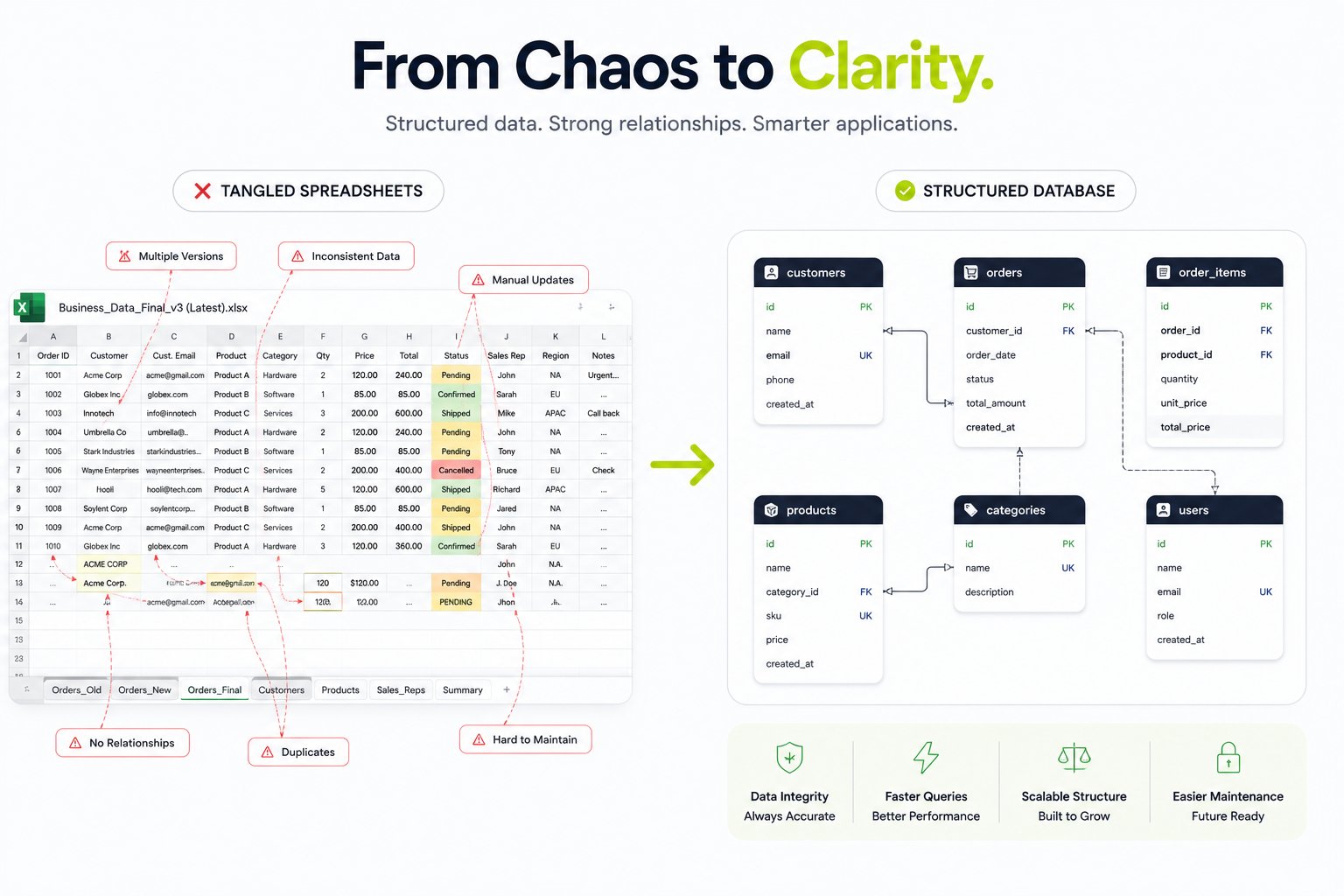
Your data comes out of legacy SQL, Access, or a stack of spreadsheets and into a clean, normalized schema, validated and reconciled so the numbers match before you rely on them. Old and new run side by side through the switch, so there's always a fallback.
2. Databases that stay fast as they fill
A schema is cheap to get right on day one and expensive to get wrong by year two, so it's designed for year two from the start.
Normalized where integrity matters, denormalized read models where speed matters more, so reports stay quick as the tables grow.
Indexes, foreign keys, and versioned migrations, so a schema change ships without a late-night incident.
Postgres features used on purpose: JSONB for genuinely flexible fields, materialized views for the heavy reports that would otherwise crawl.
Most "the framework is slow" complaints turn out to be one unindexed query against a table that outgrew its original design.
3. APIs other systems can actually use
Your app has to talk to everything else you run, and that's where most builds turn brittle. So the API is versioned and documented from day one. Authentication is real, OAuth2 or JWT, with role-based access so finance and the warehouse never land on the same screens. Writes are idempotent, which just means a double-click never charges a card twice or books the same slot twice. And it ships with an OpenAPI spec, so your next developer reads the interface instead of booking a call with us.
4. Integrations that hold
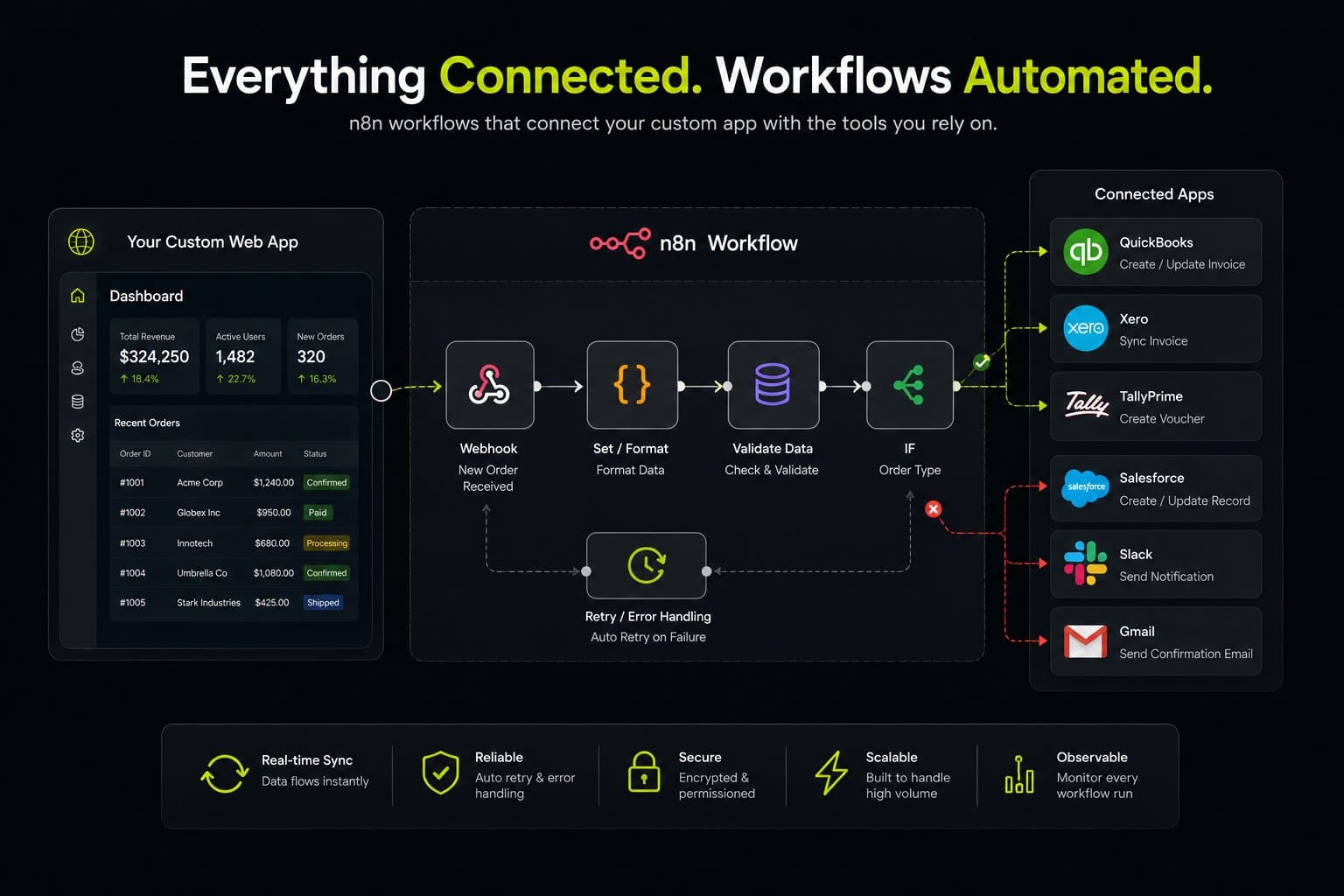
Your tools should share data on their own, and keep doing it when something upstream changes. Most "the integration broke" stories are really a one-off script with no retries and no logging behind it.
Yours connect to the systems you already run, Xero, QuickBooks, Tally, your CRM or ERP, over their real APIs, with n8n and webhook automation handling the orchestration in between. When a sync fails, it queues and retries itself instead of dropping a record and going quiet.
5. From spreadsheet to system
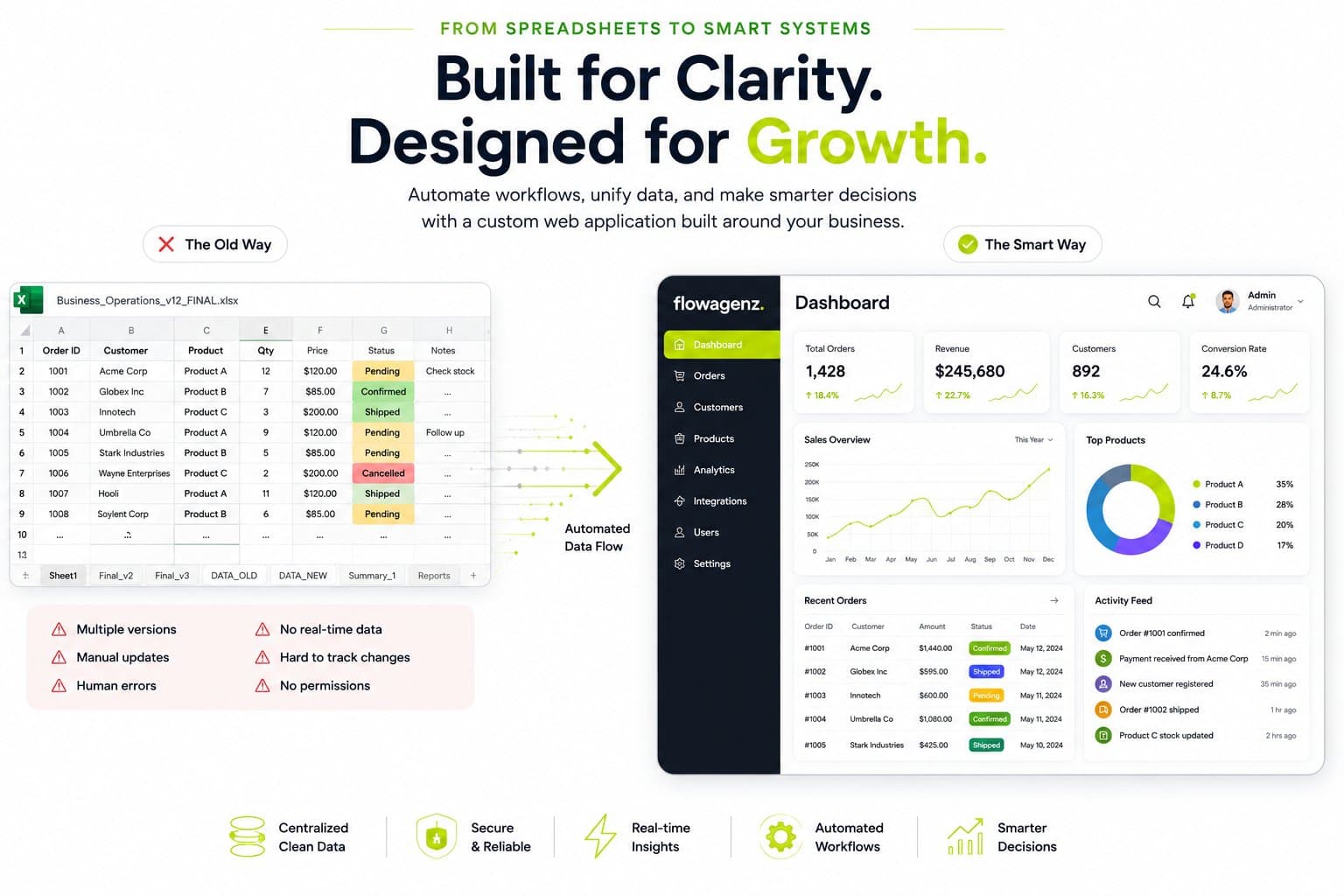
A shared sheet is a database with none of the guardrails. Same workflow, real home:
Validation that stops bad data at the door.
Several people editing at once, no overwritten cells.
Permissions and a full change log, so who-changed-what is never a mystery.
Everything your team already knows how to do. Far fewer ways for it to go sideways.
Built on a modern, future-proof stack
It's built for your next stage of growth, not ten stages past it, so you're not paying for capacity you won't touch this year.
React or Next.js on the front end, server-rendered where speed matters, so screens stay quick as the data grows.
A typed, tested Node or Python API with background queues, so a bulk import or a heavy report never freezes the interface.
PostgreSQL with deliberate indexing, plus Redis for caching and queues when the load calls for it.
n8n for orchestration between systems, and webhook automation for the real-time events.
Nothing exotic. Just the proven pieces, assembled well.
Who custom web application engineering is for
A few different starting points, one common thread: a process important enough to deserve software built around it.
You're a growing SMB running the whole operation on spreadsheets that have hit their ceiling.
You're on older software that needs modernizing carefully, without downtime or a risky rewrite.
Your tools don't talk to each other, and you need an API layer that actually holds.
You've inherited a half-built app, and you need someone to take it over and finish it properly.
Why Flowagenz
You own everything, on completion
When the build's done, all of it is yours: the code, the database, the infrastructure access. No proprietary runtime you can only license through us, and no renewal quietly holding the system hostage. It's a line in the contract, not a nice-sounding promise.
Salem rates, Western-grade engineering
We're based in Salem, Tamil Nadu. In practice that means the engineering standard you'd expect from a US or UK shop, at a number that makes a custom build a sensible decision instead of the enterprise quote you were bracing for.
Real overlap with US, UK, and Australia
Your mornings line up with our afternoons if you're on US Eastern, and if you're in the UK or Australia we share most of the working day. Between calls, updates land in writing, detailed enough that you're never chasing us for status.
Process
How it works
No surprises, no scope creep. The sequence:
01
01
Scoping call.
Map the workflow, the data, what needs to integrate, and what "done" actually means for you.
02
02
Architecture and a fixed quote.
You get a data model, an integration plan, and a fixed number, all before anyone writes production code.
03
03
Build in phases.
You review real progress on staging at each milestone. Legacy modules get swapped out one at a time.
04
04
Migration and cutover.
Data gets migrated, validated, and reconciled, then the switch is rehearsed before going live.
05
05
Handover.
Code, database, and infrastructure access come to you, with a support window for anything that surfaces early.
A focused build usually runs 4 to 10 weeks, depending on how many systems it touches and how much data has to move.
FAQ
Frequently Asked Questions
Everything you need to know about our process and digital systems.
Scope drives it. The big levers are how many systems it integrates with, how much legacy data has to move and reconcile, and how deep the schema goes. As a rough range, a focused build runs ₹1,50,000 to ₹8,00,000 ($1,800 to $9,500), with larger legacy modernizations scoped on their own. Either way, you get a fixed number before development starts.
Let's scope your build
Outgrown your spreadsheets, or sitting on a legacy system that needs modernizing? One call, and you leave with a fixed quote and a clear plan. No obligation.