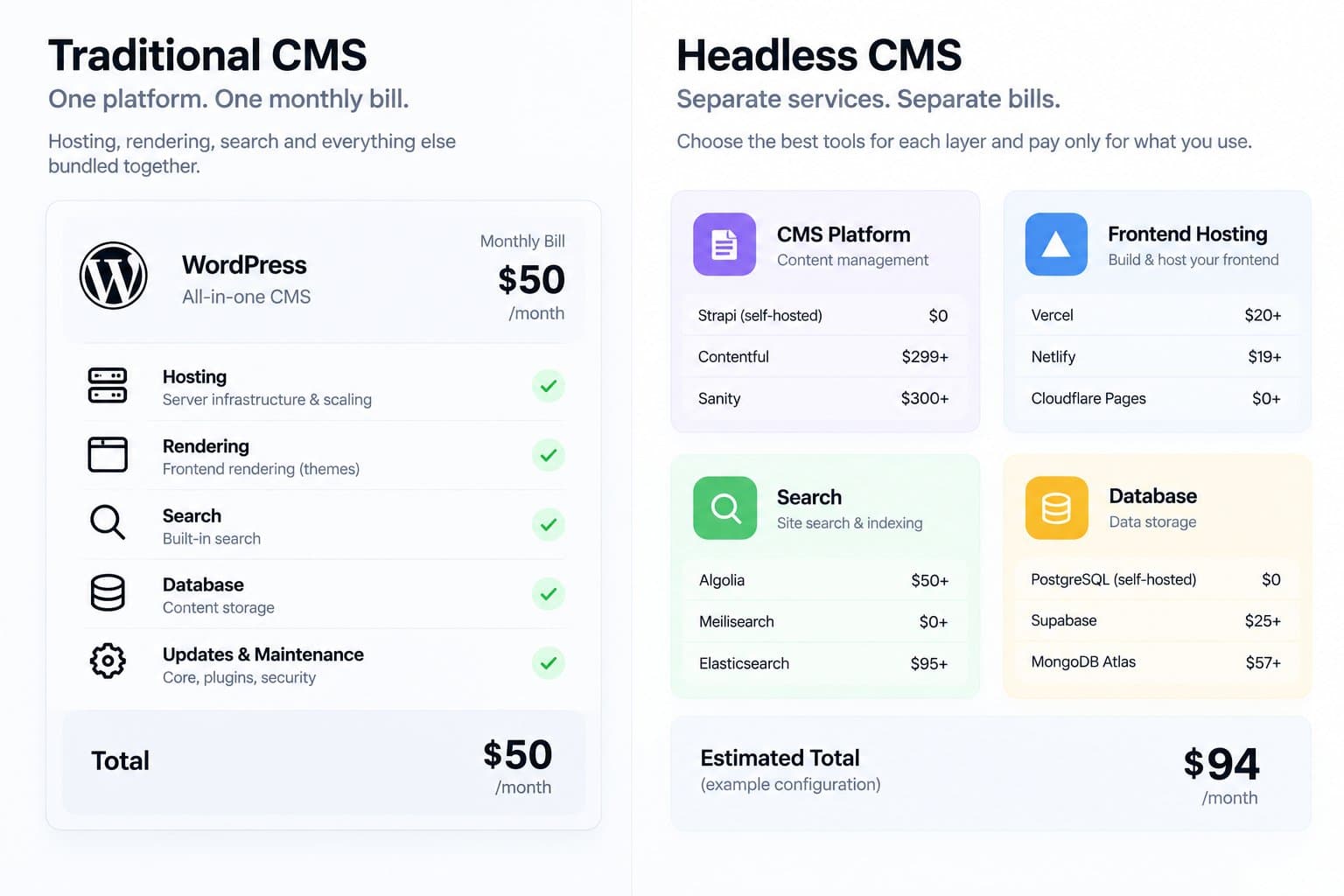
For high-traffic enterprise sites, front-end hosting alone can cost as much as the CMS license itself. That's the sentence most headless CMS pricing pages never lead with, because a traditional CMS bundles hosting, rendering, and search into one number, and a headless CMS unbundles all of it into separate bills you have to assemble yourself: the CMS platform, the frontend host, search, and often a database, each billed independently, each with its own overage structure most teams don't discover until the first real traffic spike.
None of this makes headless the wrong choice, it usually isn't. It makes "how much does headless CMS hosting cost" a genuinely more complicated question than "what's the monthly plan price," and the gap between those two numbers is exactly what this post covers.
The honest framing on all of this: for a real production build, hosting is usually not the biggest line item, the build itself, $10,000 to $150,000-plus depending on complexity, dwarfs hosting cost at any real traffic level. But hosting is the line item most quotes underprice or omit entirely, which is why it's worth understanding on its own before signing off on a budget.
Why headless hosting costs surprise people specifically
A traditional CMS like WordPress bundles content management, rendering, and hosting into a single system, one hosting bill covers everything. A headless CMS deliberately separates content management from presentation, which means the CMS platform's price tag was never meant to be the whole picture, you're also paying for wherever the frontend actually runs (Vercel, Netlify, Cloudflare Pages, or your own infrastructure), and often for search and a database on top of that. Most published headless CMS pricing pages quote the platform cost clearly and leave the rest to be discovered later, not out of dishonesty, but because the unbundled architecture genuinely doesn't have a single number to quote.
Bandwidth: the cost that scales with your success
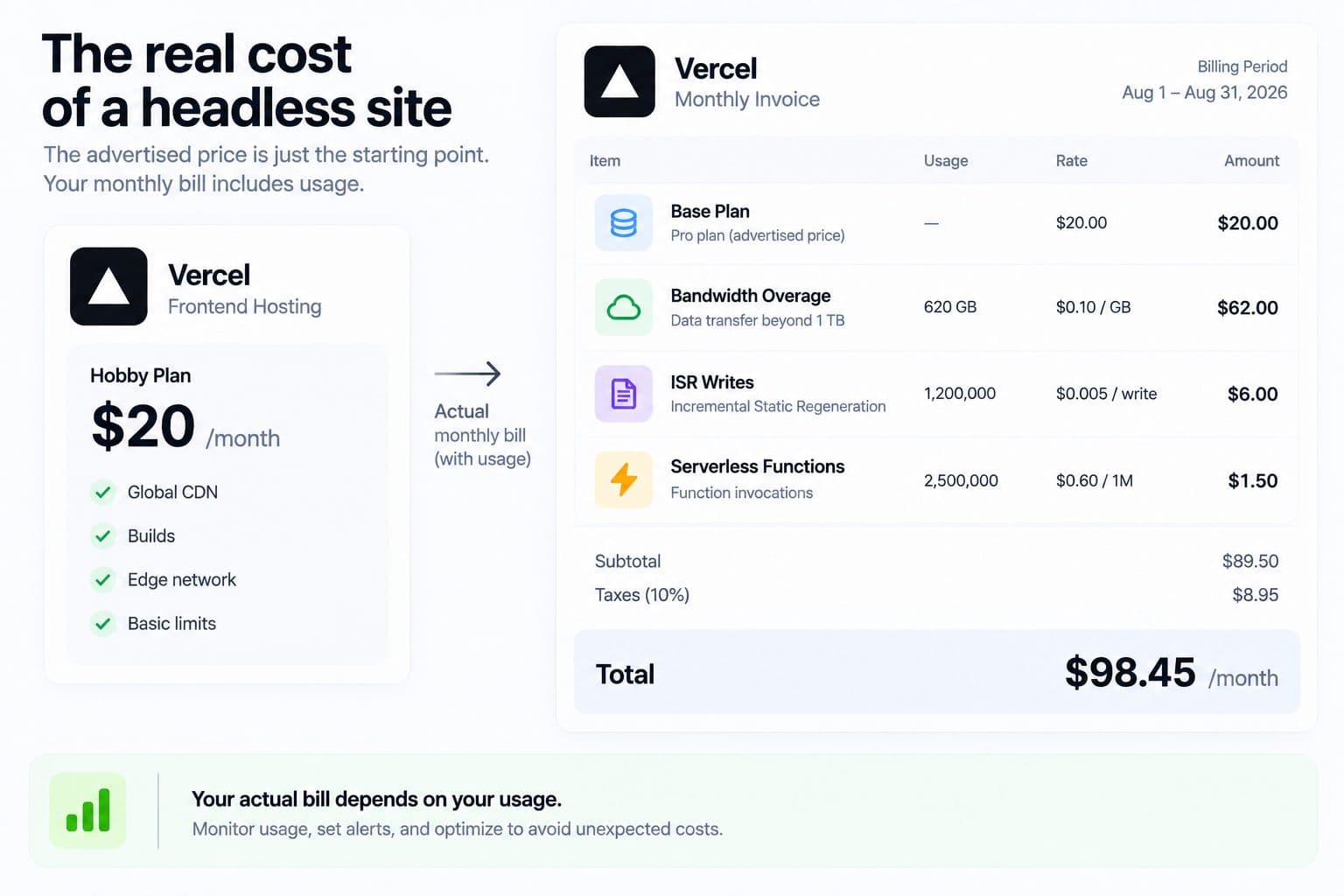
This is the most common surprise, and it hits hardest exactly when a site is doing well, more traffic means more bandwidth, and bandwidth overages are where free and entry-tier hosting plans make their real margin. Current 2026 rates: Vercel bills bandwidth overages in the range of $0.15 to $0.40 per GB depending on plan tier, Netlify runs close to $0.55 per GB over its included allowance. On a media-heavy or genuinely high-traffic site, this adds up fast, one detailed teardown found a Vercel Pro account (1TB included) hitting real overage charges once traffic pushed past that allowance by even a modest margin.
Cloudflare Pages stands out here specifically: it offers unlimited free bandwidth for static assets, no per-GB overage at all, a real structural cost advantage for a static or largely static headless frontend. The trade-off is less framework-specific convenience than Vercel offers for Next.js projects specifically, worth weighing against the bandwidth savings for any site expecting genuinely high or unpredictable traffic.
My read: the platforms above are all metered in some way, free tier plus per-GB overage. A VPS is the third option that changes the shape of the bill entirely: providers like Hostinger sell VPS plans with a large bandwidth allowance bundled into a flat monthly price rather than a metered one, so a traffic spike doesn't automatically turn into a surprise line item the way it can on Vercel or Netlify. It's not the right call for every team, see the FAQ below for the trade-off.
Search: the feature traditional CMS gives you for free
This is the hidden cost category most people don't think about until they need it. Traditional CMS platforms typically ship with reasonable built-in search. Headless architectures have no such thing by default, search has to be added as its own service: Algolia (roughly $1 to $10,000-plus a month depending on scale), Coveo ($50,000 to $200,000-plus a year at enterprise scale), or a self-managed Elasticsearch instance, which trades subscription cost for real infrastructure and maintenance overhead instead. For a small site with a handful of pages, this might be genuinely unnecessary, simple client-side filtering can suffice. For any content-heavy site where search is a real user-facing feature, this is a cost category worth budgeting explicitly rather than assuming it's covered somewhere else.
ISR, serverless functions, and other usage-based traps
Modern frontend hosting platforms bill several dimensions most teams don't think to ask about upfront. Incremental Static Regeneration, a Next.js feature that lets pages update without a full rebuild, bills per write on some platforms, a real, easy-to-miss cost on a site that updates content frequently. Serverless function invocations, used for anything from API routes to on-demand image processing, are billed per execution and can scale unpredictably with traffic in a way a flat hosting fee never would. None of these show up as a line item on a pricing page's headline number, they show up on the actual invoice once the site is live and being used the way it was built to be used.
Database hosting: the cost self-hosted CMS platforms don't mention
If the CMS itself is self-hosted, Strapi being the common example, it needs a database, and that database needs its own hosting, separate from both the CMS and the frontend. This is easy to overlook specifically because SaaS headless CMS platforms (Contentful, Sanity, Storyblok) don't have this line item at all, their pricing already includes data storage, so a cost comparison between a SaaS CMS and a self-hosted one that doesn't account for database hosting is comparing incomplete numbers. Budget a real, if modest, monthly cost here rather than assuming it's folded into the CMS or frontend hosting bill.
Debatable: if you're already self-hosting Strapi on a VPS, running the database on the same box (or a second VPS instance) instead of a separate managed database service is a legitimate way to keep this line item close to zero. It works well at moderate scale; a genuinely high-write, high-availability workload eventually outgrows it and needs its own managed database.
Preview environments and staging, the quietly multiplying cost
Content teams need to preview unpublished changes before they go live, and most modern hosting platforms handle this through preview deployments, a real, separate environment spun up per branch or per content change. This is usually included in reasonable volume on standard plans, but at scale, with multiple content editors working simultaneously across a large site, preview environment usage can push into territory that requires a higher plan tier, another cost that doesn't show up until real editorial workflow volume reveals it.
The honest reframe: hosting usually isn't the biggest number
All of the above is real and worth understanding, and it's also true that for a genuine production build, the development cost dwarfs hosting cost at nearly any realistic traffic level. A production headless build commonly runs $10,000 to $150,000-plus as a one-time cost, against hosting that might run $20 to $1,500 a month even for a fairly high-traffic site, a rounding error by comparison once real revenue or business value is attached to the site. The point of this post isn't that hosting costs will bankrupt a project, it's that hosting is the specific line item most quotes and comparisons leave vague or absent entirely, and an unbudgeted surprise, even a comparatively small one, is a worse experience than a larger cost that was planned for from the start.
The bottom line
Headless CMS hosting costs surprise people because the architecture is fundamentally unbundled, and most published pricing only shows one piece of a bill that actually has several. Bandwidth overages, search, ISR and function costs, database hosting, and preview environments are all real, separately billed line items that a headline platform price doesn't capture. None of this changes the calculus that development cost usually dwarfs hosting for a real production build, but budgeting hosting properly from the start, including whether a flat-cost VPS setup fits your traffic better than a metered managed platform, avoids the specific kind of surprise that erodes trust in a project's numbers, even when the actual dollar amount is comparatively small.
If you're budgeting a headless CMS build and want the hosting costs modeled realistically against your actual traffic and content needs, including whether a Hostinger VPS setup makes more financial sense than a managed platform for your case, Flowagenz builds these estimates from real usage patterns, not headline pricing. Happy to walk through your specific numbers on a short call.
Let's create something together
Get in touch with us today.