Several independent Shopify Plus agencies, the businesses whose incentive would normally be to sell more expensive headless builds, are on record talking the majority of their own prospective clients out of going headless. One agency reports steering roughly 75 percent of interested brands back to native Shopify Plus. Another explicitly states they take on headless projects selectively and default most merchants toward a well-built standard theme instead. When the businesses that profit from headless work are this consistently cautious about recommending it, that's a real signal worth taking seriously before assuming headless is the more sophisticated, more correct choice by default.
There's also a genuinely new factor changing this calculus in 2026 that most existing headless content hasn't caught up to yet: Shopify's Universal Commerce Protocol and Storefront MCP servers, which reached general availability in June 2026, mean AI shopping agents querying ChatGPT, Gemini, or Copilot for a product don't browse your storefront at all, headless or Liquid. They query a structured data endpoint directly. Your frontend, however beautifully built, is invisible to that specific and rapidly growing channel.
Headless wins decisively on raw performance ceiling and design freedom. Standard Shopify wins on cost, app compatibility, and time to launch. The AI shopping agent shift affects neither side's case for or against headless specifically, since MCP-based agent queries bypass the frontend layer entirely regardless of which one you built.
What headless Shopify actually is
Headless commerce decouples the customer-facing storefront from Shopify's commerce backend, products, cart, checkout, payments, fulfillment, all keep running on Shopify exactly as before, while a custom frontend, most commonly built with Shopify's own Hydrogen framework and deployed on Oxygen (their edge hosting), pulls data through the Storefront API instead of rendering through Shopify's Liquid templating system. This is a real, significant shift in how much control and complexity you're taking on, not just a different-looking theme.
A genuinely important 2026 update: Hydrogen was rebuilt this spring to run on any stack, including Next.js, not locked exclusively to Oxygen hosting the way it was originally positioned. This changes the practical calculus, a team can now choose Hydrogen specifically for its tight, low-maintenance Shopify integration, or choose Next.js instead when the project needs heavy content routing, deep integration with non-Shopify systems, or an existing team's framework of choice, without being forced into Oxygen as the only hosting option either way.
The real performance case for headless
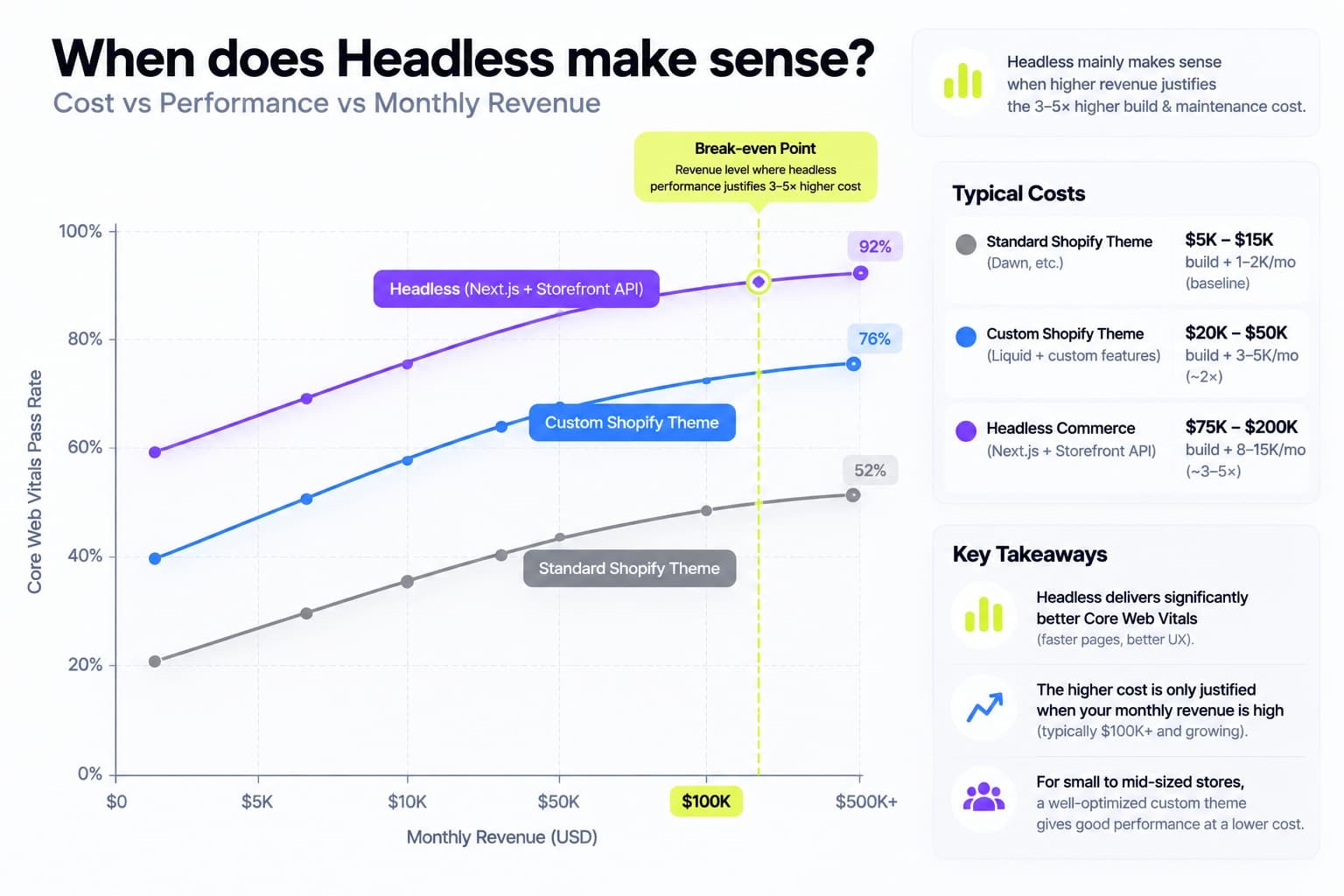
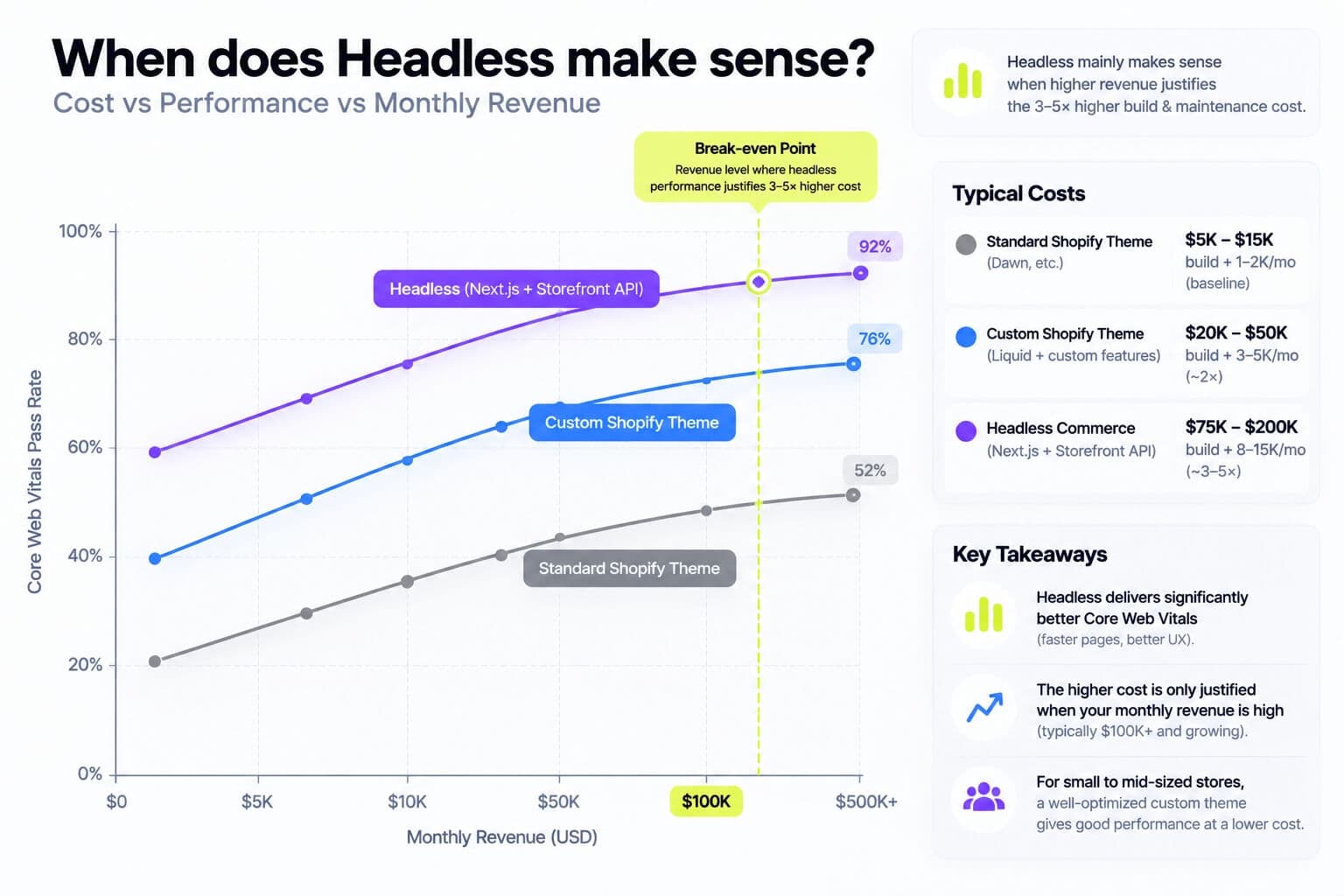
This part of the case is genuinely strong, not marketing exaggeration. Headless Shopify storefronts built on Hydrogen report a median Largest Contentful Paint of 1.4 seconds against 2.0 seconds for a well-optimized traditional theme, and a Core Web Vitals pass rate of 78 percent compared to 58 percent for traditional stores doing everything right within Liquid's constraints. Real brands report real results: one apparel brand's move to Hydrogen delivered roughly 30 percent faster load speeds; a brand migrating off Salesforce Commerce Cloud to headless Shopify reported tripling its site speed; another running a complex 100-plus product configurator across four languages hit an 80-plus Lighthouse score on the headless build, difficult to achieve on that level of interactive complexity within a standard theme.
Where this comes from mechanically: a standard Shopify theme loads the entire Liquid rendering pipeline for every page. Hydrogen lets you control exactly what renders, when, and how it's cached at the edge, real architectural control a theme-based approach structurally can't offer, regardless of how well the theme is optimized.
The real cost case against headless
This is where most headless enthusiasm runs into a wall that a lot of content glosses over. A full headless build runs $50,000 to $250,000 depending on scope, and ongoing operational overhead, hosting, maintenance, the React development team needed to make any change at all, commonly lands in the $8,000 to $40,000 a month range. That's not a one-time cost premium, it's a recurring, structural increase in what it costs to run the store, month over month, for as long as the headless architecture is in place.
The app ecosystem cost is real too and often underestimated: backend-integrated apps, payment providers, fulfillment, inventory, ERP connections, keep working fine, since they operate through Shopify's backend regardless of frontend architecture. Frontend-facing apps, review widgets, popups, chat overlays, loyalty program displays, generally need to be rebuilt or replaced entirely as part of the headless frontend, since they were built assuming a Liquid theme to inject into. This is real, uncounted development work that a straightforward cost comparison against a standard theme easily misses.
A concrete decision checklist
Multiple agencies converge on a similar, genuinely useful set of disqualifying criteria, worth checking against your own store honestly before pursuing headless:
Is monthly revenue below roughly $1 million? Standard Shopify Plus with a well-built theme is very likely sufficient, headless's performance ceiling is overkill relative to what a store at this scale needs to convert well.
Is there an in-house React development team, or a reliable, ongoing agency relationship for one? Every meaningful change to a headless storefront needs a developer, there's no theme editor or Liquid workaround to fall back on for a quick fix.
Does the store sell through a single channel? Headless's real strategic advantage includes multi-channel flexibility, serving the same commerce backend to web, app, and other surfaces, a benefit a single-channel store isn't actually using.
Does the marketing team need self-service control over the storefront? Standard Shopify's theme editor gives marketing real autonomy; headless removes that, every change routes through a developer.
Answering yes to any of these is a real signal to stay on standard Shopify. The businesses answering no to all four are the ones where a real, well-scoped headless build genuinely pays for itself.
The AI shopping agent shift nobody's factored in yet
Shopify's Universal Commerce Protocol, developed with Google and backed by Amazon, Meta, Microsoft, Salesforce, Stripe, Etsy, Target, and Wayfair, reached general availability in June 2026, alongside Storefront MCP servers now deployed to every Shopify store. The practical effect: when a customer asks an AI assistant to find a product, that assistant queries the store's structured MCP data endpoint directly, it does not render or browse the storefront, headless or Liquid, at all.
This has a real, underdiscussed implication for the build-vs-headless decision specifically: the frontend investment that headless buys you, faster loads, richer interaction, custom design, is entirely invisible to this specific and rapidly growing discovery channel. It doesn't argue against headless, a beautifully built storefront still matters enormously for the customers who do browse directly, but it does mean the case for headless has to rest on real, human-facing conversion and brand experience gains, not on any assumption that frontend quality affects AI-agent-driven discovery or purchasing. Structured product data quality, feeding that MCP endpoint correctly, matters for that channel regardless of which frontend architecture sits behind it.
The bottom line
Headless Shopify delivers a real, measurable performance and design-freedom advantage, and it costs three to five times more to build and maintain than a well-built standard theme, a gap that only makes sense to close for stores with the revenue, technical team, and genuine brand-experience requirement to justify it. The consistent pattern across agencies actually doing this work, recommending most merchants stay standard, is a stronger signal than any single case study of a brand that went headless successfully. And the 2026 shift toward AI shopping agents querying structured data directly means the frontend decision, headless or not, matters less for that specific channel than it did even a year ago, worth factoring in before assuming headless is where ecommerce is inevitably heading.
Let's create something together
If you're deciding whether your store's traffic and team actually justify going headless, Flowagenz can walk through your real numbers against this checklist before recommending a build. Happy to talk it through on a short call.