Shopify vs WordPress vs custom: choosing an ecommerce platform
WooCommerce runs roughly 36 to 38 percent of ecommerce sites globally, more than any other platform, while Shopify holds around 27 to 28 percent and generates meaningfully higher average revenue per merchant. Those two numbers together tell you the real story: market share and revenue per store aren't measuring the same thing, and neither platform is objectively "winning." They're winning different kinds of businesses.
The honest version of this decision has three real options, not two. Shopify and WooCommerce get compared constantly. Custom development, a platform built specifically around your product, checkout, and operations, gets mentioned less often because it's the most expensive and slowest option, but for a specific kind of business it's the only one that actually fits. This post covers what each one costs in 2026, not what their marketing pages claim.
I default to Shopify for a business that wants to sell online this month and doesn't have a developer on staff. I default to WooCommerce specifically when a business already runs WordPress and content or SEO is a real growth channel, not just a nice-to-have. I only recommend custom when there's a specific, named reason neither platform can accommodate, not because custom sounds more serious.
What each one actually is
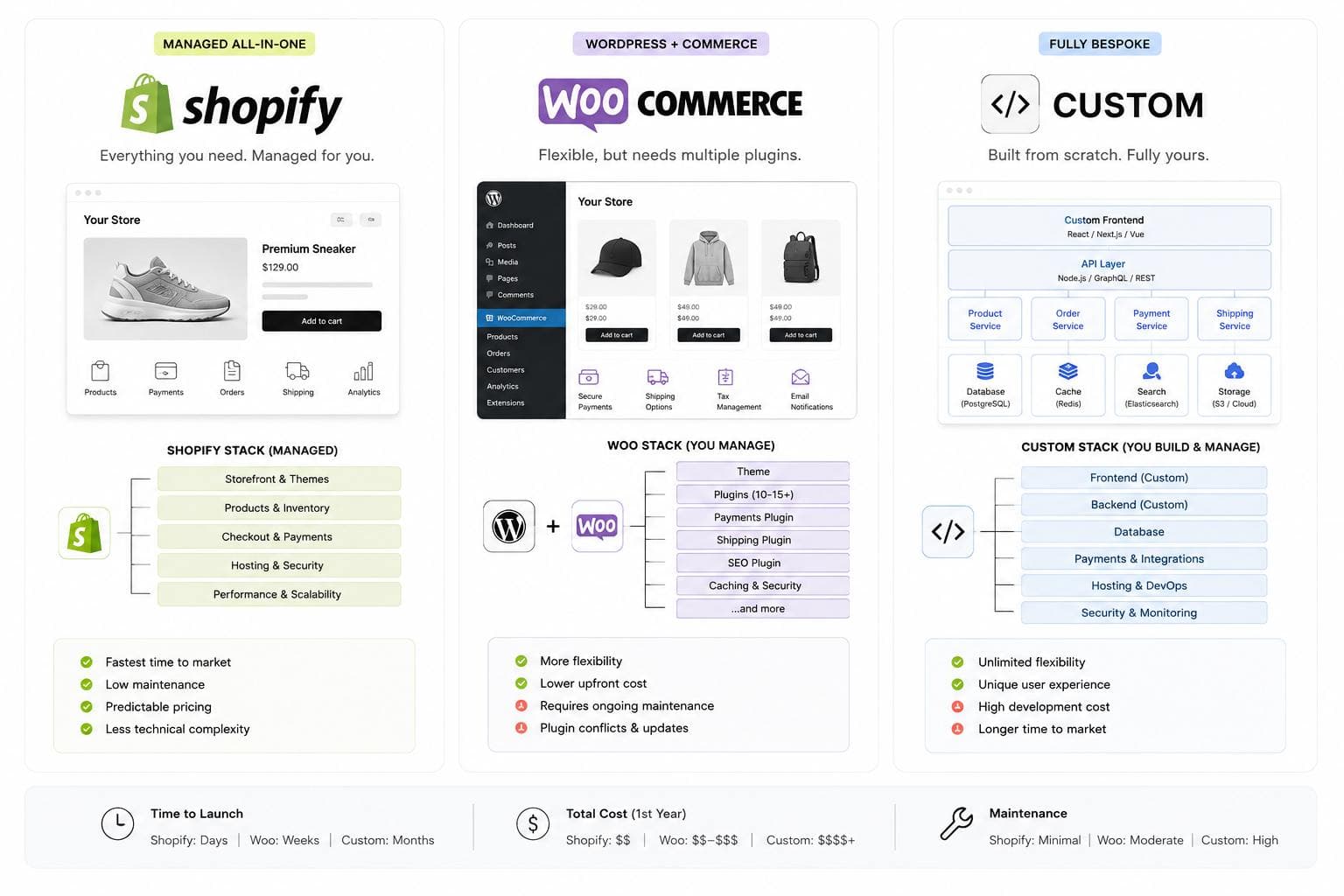
Shopify is a fully managed, hosted ecommerce platform. Infrastructure, security, PCI compliance, and uptime are Shopify's problem, not yours, and a non-technical owner can have a store accepting payments within a day. That simplicity has a real, often underestimated cost: the average Shopify merchant spends $120 to $300 a month on apps for functionality that isn't in the base plan, and most active Shopify stores run at least five to ten third-party apps once they're established. Checkout customization beyond the default is locked behind Shopify Plus, which starts around $2,300 a month.
WooCommerce is a free, open-source plugin that turns a WordPress site into a store. The plugin itself costs nothing, and that's where the free part ends: managed WordPress hosting, a real theme, extensions for subscriptions or bookings or advanced shipping, and developer time for setup and ongoing maintenance are all real, separate costs. What you get in exchange is full code access and WordPress's two decades of content and SEO tooling, which matters a lot if organic content is genuinely part of the growth strategy.
Custom development means a platform built from scratch around your specific product, checkout flow, and operational logic, no inherited constraints from a platform's opinions about how commerce should work. This is the right call when the business logic itself is genuinely non-standard, not as a default choice for a business that could function fine on an existing platform.
Setup time and initial cost
Shopify wins decisively here. A basic store can launch in a matter of hours, with pricing that's predictable from day one. WooCommerce takes real setup time, 20 to 80 hours depending on complexity, and a competitive small business store realistically costs $1,200 to $1,600 in year one once hosting, plugins, and payment processing are accounted for, not the "$150 a year" figure sometimes used in marketing comparisons. Custom development starts past $15,000 and runs months, which rules it out immediately for a business that needs to be selling soon.
Total cost of ownership over time
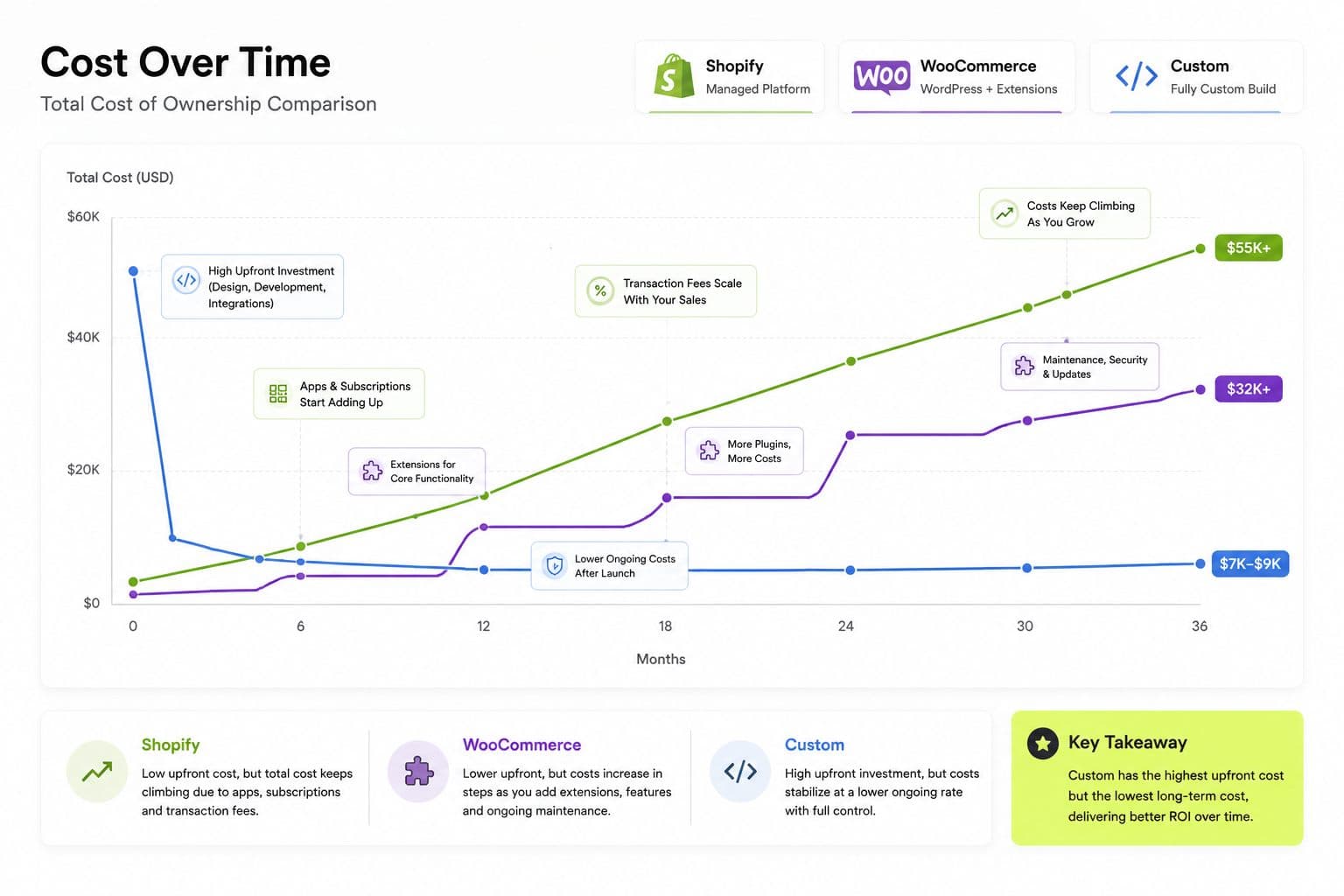
This is where the comparison gets less obvious. Shopify's costs are predictable but compound through apps and transaction fees, at $10,000 in monthly revenue, realistic total costs land around $240 to $520 a month in fees alone. WooCommerce starts cheaper and scales in complexity rather than in a clean linear cost curve, key extensions alone (subscriptions, bookings, memberships) commonly run $200 to $250 a year each, and developer maintenance adds $500 to $2,400 a year on top. Custom development has the highest upfront cost but no platform tax, no per-transaction fee, no forced app subscriptions, which can make it the cheaper option at real scale, if the business has the volume and technical team to justify it in the first place.
Customization and control
WooCommerce and custom both win over standard Shopify here, for different reasons. WooCommerce gives full code access on top of WordPress, so nearly anything is buildable given enough developer time. Custom removes even the constraints WooCommerce inherits from being a plugin layered on a CMS. Standard Shopify sits in between, extensive through its app ecosystem, but genuinely walled off from certain changes (checkout being the clearest example) unless you're paying for Shopify Plus.
SEO and content
WooCommerce has historically been the stronger platform here, built on WordPress's mature blogging and content tooling, plugins like Yoast and Rank Math giving granular control over meta tags, schema, and site structure. Shopify has closed a meaningful part of that gap through 2025 and 2026 with custom meta fields, automatic sitemaps, and structured data support, and it compensates with genuinely faster default page loads, a real ranking factor. For a business where long-form content and organic search are core growth channels, WooCommerce still has the edge. For a store where content is secondary to product and conversion, Shopify's SEO capability is no longer a real gap.
Maintenance and reliability
Shopify wins clearly. Shopify handles infrastructure, security patching, and uptime, which removes an entire category of operational risk. WooCommerce's biggest real-world reliability issue is plugin conflicts, WordPress core, PHP, themes, and every installed plugin update on their own schedules, and version collisions are the dominant cause of checkout failures and downtime in the WooCommerce ecosystem. That's a genuine, recurring maintenance cost, either learned and handled in-house or paid to a developer on retainer.
The bottom line
Shopify wins on speed and predictability, WooCommerce wins on content-driven SEO and platform ownership, and custom wins only when a business's actual requirements exceed what either platform can flex to accommodate. The mistake is picking based on which sounds more professional rather than matching the platform to your actual technical capacity, growth channel, and realistic budget over the first two to three years, not just the first month.
If you're deciding between these three for your next store, Flowagenz has built on all three and can assess which one your actual product, content strategy, and team capacity justify. Happy to walk through your specific requirements on a short call.
Let's create something together
Get in touch with us today.