Tool-calling agents vs RAG chatbots: pick the right architecture
RAG and tool calling get discussed as if they're competing approaches to the same problem, and they're not. RAG retrieves information, it answers "what does our policy say about this." Tool calling takes action on a live system, it answers "what is this customer's order status right now" or "actually process this refund." A RAG chatbot bolted onto a task that needs tool calling will confidently generate a plausible-sounding answer about something it has no way to actually check. A tool-calling agent with no RAG layer will have perfect access to live systems and no grounded understanding of your actual policies, documentation, or past conversations to reason from. Most real production systems need both, used for what each is actually good at, not one standing in for the other.
The architectural difference matters because of where the probabilistic behavior lives. RAG's output is inherently approximate, retrieval returns the most similar chunks, not a guaranteed correct answer, and the model generates from them. Tool calling, when built correctly, moves the actual action out of the model's generation step entirely: the model decides which function to call and with what parameters, but the function itself executes deterministically against a real system. That's not a small distinction. A support agent that hallucinates a wrong fact in a RAG answer is embarrassing. A support agent that calls the wrong tool, or calls the right tool with the wrong parameters, refunds the wrong order.
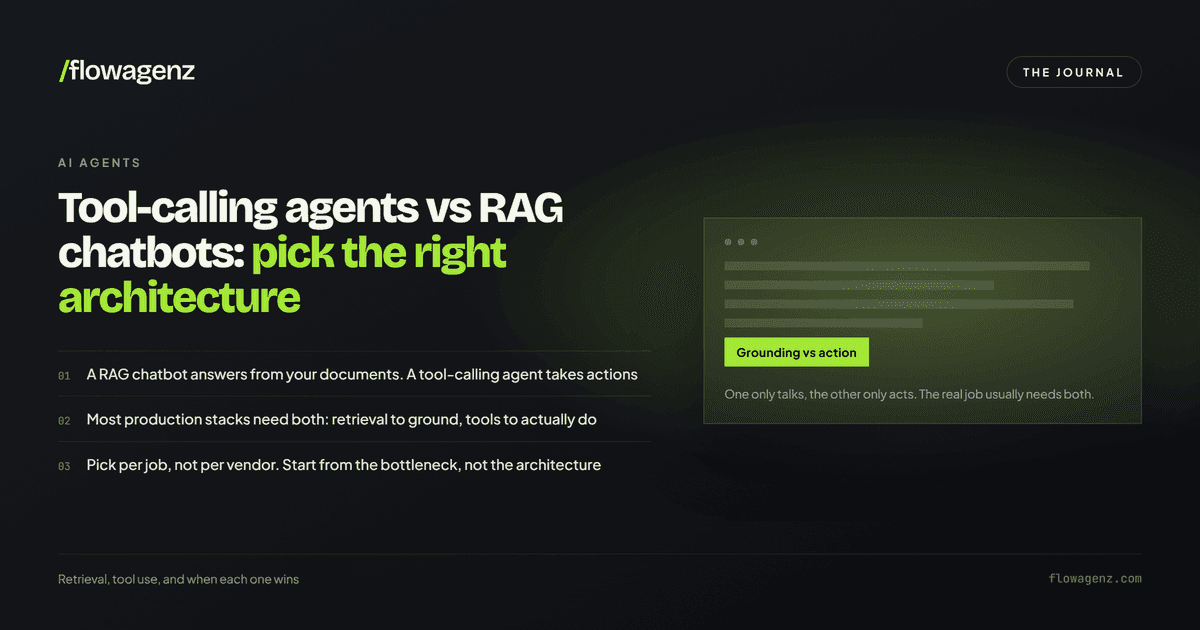
If the question is "what does it say somewhere," reach for RAG. If the question is "what is it right now" or "make this happen," reach for tool calling. Most agents serving real customers need both, routed to the right one per query, not a single architecture doing everything by default.
What each one is actually built for
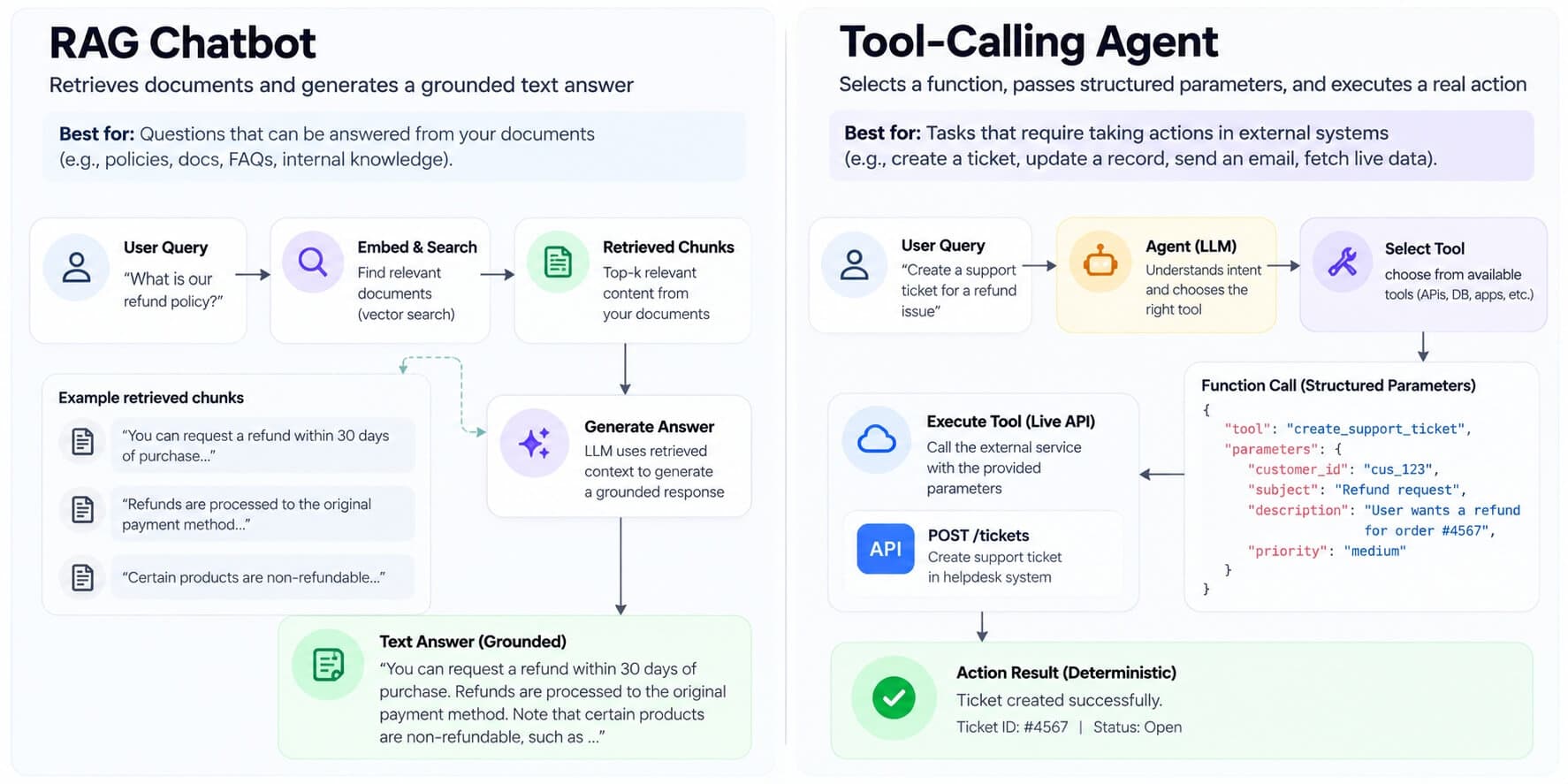
RAG (retrieval-augmented generation) indexes a knowledge base, documents, policies, past tickets, product specs, and retrieves the most relevant pieces at query time to ground the model's generated answer. It's fundamentally a read-only, approximate-match architecture: the retriever finds what's semantically closest to the query, not what's definitionally correct, and the model writes an answer from what it found. This is exactly right for questions whose answer lives in text somewhere and doesn't change minute to minute, a return policy, a product spec, how a feature works.
Tool calling (function calling) gives the model a defined set of callable functions, each with a name, a description, and a structured parameter schema, and lets it decide which to call and with what arguments based on the conversation. The function itself, checking an order status via an API, processing a payment, updating a CRM record, executes as regular, deterministic code once the model has decided to call it. The model's job is choosing the right tool and filling in the right parameters, not generating the actual result, which is precisely why tool calling is the right architecture for anything that needs to be current or needs to actually change something. Moving deterministic logic out of the language model and into real function execution is also a direct, structural way to reduce the kind of hallucination that comes from a model trying to generate a fact it should instead be looking up live.
The real architectural distinction: read vs read-and-write
This is the cleanest way to decide between them for a specific task, more useful than thinking in terms of "simple vs advanced." RAG is a read path: it surfaces existing, already-written content. Tool calling is both a read and a write path: a tool can fetch live data (reading a current account balance) or perform an action (writing a refund, booking a slot, updating a ticket). Anything that's a write, anything that changes a real system's state, has to go through tool calling, there's no safe way to let a generated RAG answer modify a live system directly. Anything that's a read against slow-changing, already-written content is a legitimate RAG case. Anything that's a read against fast-changing, live data, inventory, account status, today's schedule, is a read that RAG structurally can't serve well, since a vector index is only as current as its last sync, and belongs in tool calling instead.
Why the security risk profile is different for each
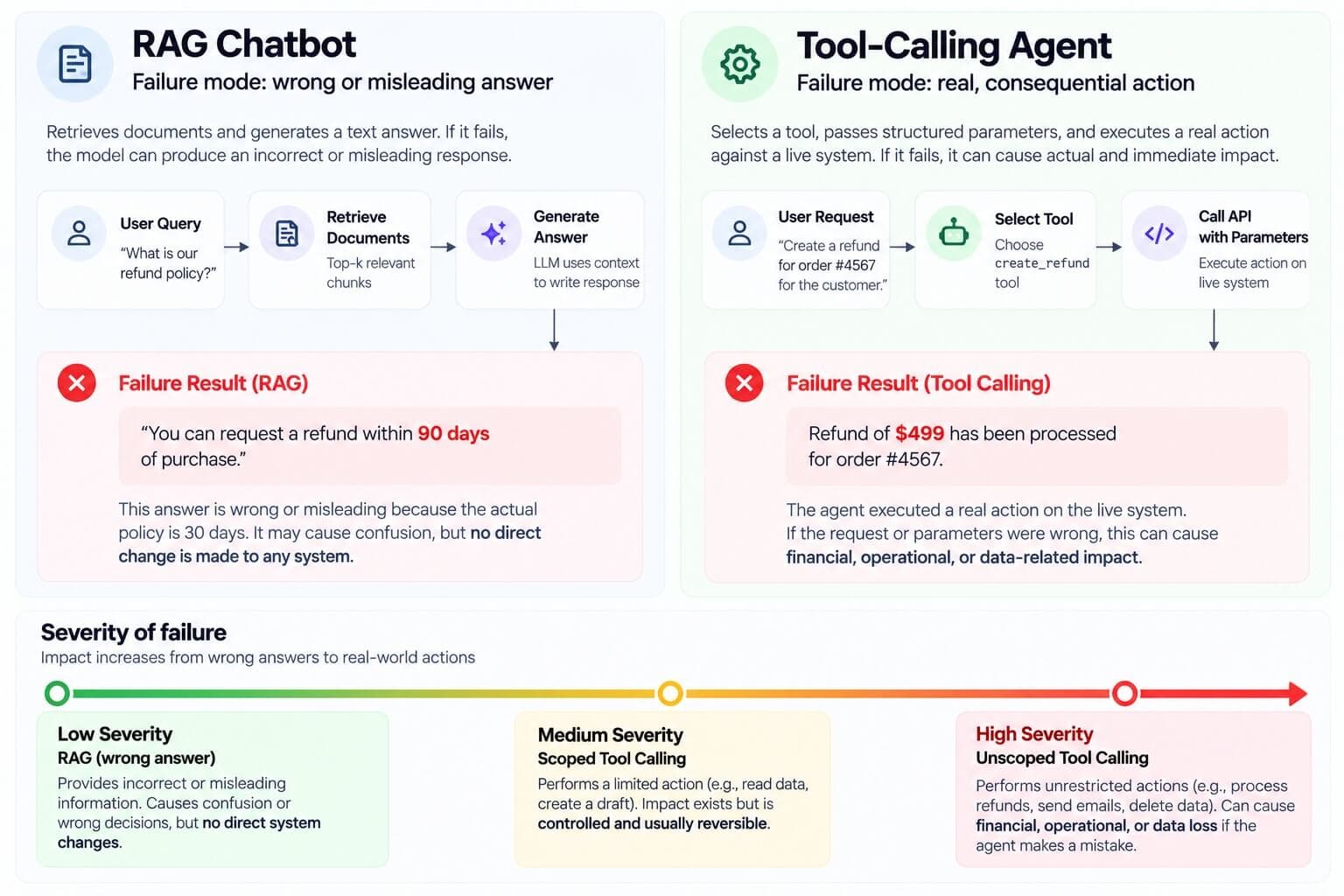
RAG's primary risk is a knowledge problem: retrieving and generating from the wrong or outdated content, covered in depth in our piece on RAG chatbot hallucination. The blast radius of a RAG failure is usually a wrong or misleading answer, bad, but typically recoverable.
Tool calling's primary risk is an action problem: selecting the wrong tool, passing the wrong parameters, or being manipulated through a prompt injection into calling a tool it shouldn't. The blast radius here is a real action taken against a real system, a wrong refund issued, the wrong customer's data modified, a booking made for the wrong date. This is exactly why the guidance in our AI agent security best practices post, least-privilege tool scoping, human approval gates on high-risk or irreversible actions, matters more for tool-calling architectures than for a read-only RAG chatbot. A RAG system that answers wrong is a quality problem. A tool-calling system that acts wrong is an operational and sometimes legal problem.
When you genuinely need both
This is the common case for anything beyond a narrow FAQ bot, and it's also where the architecture gets harder to build correctly. A support agent handling "what's your return policy for electronics" needs RAG. The same agent handling "what's the status of my order" needs a live tool call. The same agent handling "please process my return" needs a tool call that actually executes the return, likely gated behind confirmation logic. A single conversation can legitimately need all three in sequence.
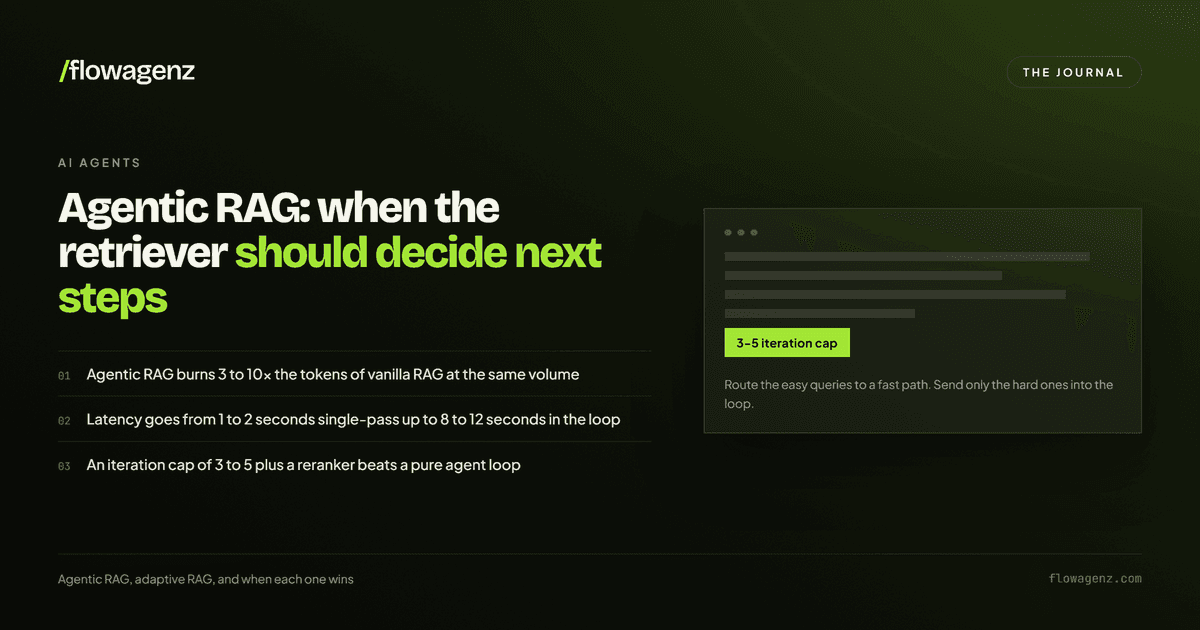
The practical pattern, covered in more depth in our guide to agentic RAG, is giving the agent both a retrieval tool and action tools, and letting it decide per-query which one, or which combination, the question actually requires, rather than hardcoding a fixed sequence. Our n8n AI node guide covers the concrete building blocks for this in n8n specifically: a Vector Store Tool for the RAG side, HTTP Request or Call Workflow tools for the action side, both exposed to the same AI Agent node, which chooses between them per turn.
The "agent-washing" problem worth knowing about
A real, fair criticism circulating in 2026 vendor and practitioner discussion: a lot of products marketed as "AI agents" are RAG chatbots with no actual tool-calling or write capability at all, they search documents and generate answers, but can't actually do anything on a customer's behalf. This framing comes partly from vendors selling genuine agent platforms with a commercial interest in drawing that line sharply, worth reading with that in mind, but the underlying technical distinction is real and worth checking directly: ask whether a given "agent" can actually call tools that change system state, or whether it only retrieves and generates text. A system that only does the latter is a RAG chatbot regardless of what it's marketed as, and evaluating it as an agent capable of taking real action will lead to the wrong expectations.
Decision framework
Build RAG if: the task is answering questions from documentation, policies, or internal knowledge that changes slowly, and no live data lookup or system action is actually required.
Build tool calling if: the task needs current, live data (anything that changes faster than your knowledge base syncs) or needs to actually perform an action on a real system.
Build both, with the agent choosing per query, if: the use case spans both knowledge questions and live data or actions in the same conversation, the common case for any real customer-facing support or sales agent handling more than narrow FAQ traffic.
Add explicit guardrails specifically around tool calling, not RAG, since that's where the higher-consequence failure mode lives: least-privilege scoping per tool, confirmation gates on anything irreversible, and logging every tool call, not just the final response.
The bottom line
RAG and tool calling solve different problems and carry different risk profiles, treating them as competing architectures to pick one from is the wrong frame. RAG is the right tool for grounding an answer in existing knowledge. Tool calling is the right tool for anything live or anything that needs to actually happen. Most real agents serving real customers need both, with the agent itself deciding per query which one the question actually requires, and tool calling specifically needs the tighter permission scoping and approval gates its higher-consequence failure mode demands.
Book a short call to walk through your specific use case.
If you're scoping an agent that needs to answer questions and take real action, Flowagenz builds both the RAG and tool-calling layers, scoped and permissioned correctly from the start.