Get your site built so ChatGPT, Perplexity, and Google AI Overviews can actually read and cite it. Not a content strategy retainer with a new acronym, an implementation pass on the technical layer that decides whether AI crawlers can reach your pages.
AI search optimization, done as engineering
The problem, reframed
Generative engine optimization and answer engine optimization are genuinely new disciplines, and most of what gets sold under those names right now is repackaged content advice with an AI label on it. The terminology is barely a year old and the expertise claims in the space are running well ahead of the evidence.
I think the honest position is that nobody has "AI search mastery" figured out yet, because the platforms themselves keep changing how they crawl, rank, and cite. What is solvable right now with real engineering: whether your site is crawlable by GPTBot, ClaudeBot, and PerplexityBot in the first place, whether your structured data gives a model something concrete to extract, and whether your content is structured so an answer engine can lift a clean, correct passage out of it. That is a technical implementation problem, and it is the part of GEO Flowagenz actually builds.
What we build
01
01
AI crawler access audit and fix.
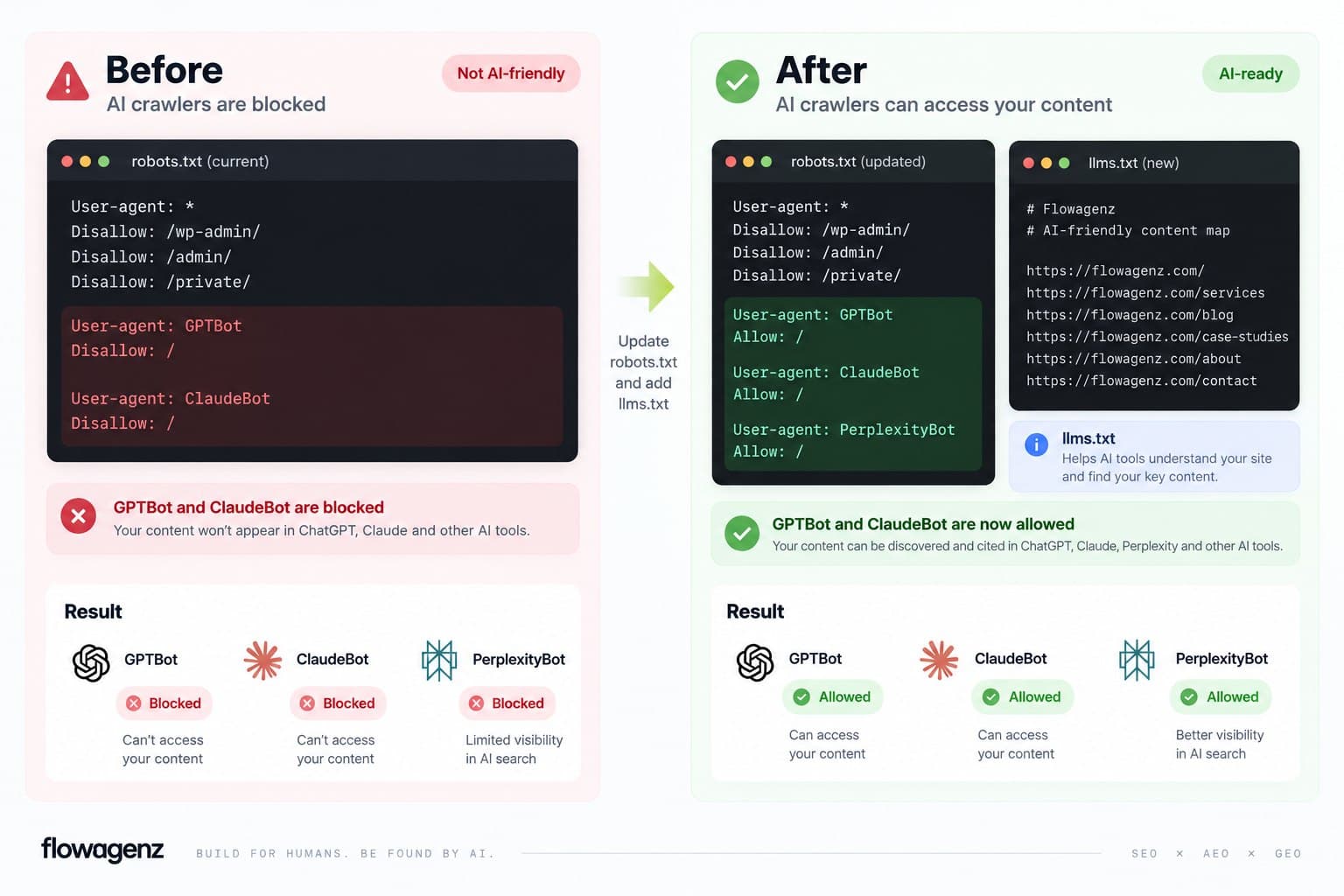
We check your robots.txt and server logs against the current crawler user agents (GPTBot, ClaudeBot, PerplexityBot, Google-Extended, and others), fix accidental blocks left over from a defensive robots.txt someone copied years ago, and confirm your CDN or WAF isn't silently rate-limiting or challenging these crawlers with a bot-detection rule that was never meant to catch them.
02
02
llms.txt implementation.
We write and deploy an llms.txt file that gives models a clean, structured entry point to your most important pages, distinct from the sitemap built for traditional search engines. This is a young, still-evolving convention, not a guaranteed ranking signal, and we say so rather than overselling it.
03
03
Structured data built for extraction, not just SEO checkboxes.
Organization, Service, FAQPage, and Breadcrumb schema implemented as valid JSON-LD, tested against Google's Rich Results and schema.org validators, not copy-pasted boilerplate with placeholder fields nobody filled in. This is the same schema work already in our technical SEO practice, applied deliberately for AI extraction rather than as an afterthought.
04
04
Content structure that survives extraction.
Definition-led opening paragraphs, direct question-and-answer blocks, and comparison tables where a comparison is the actual content, because these are the structures that get lifted cleanly into an AI-generated answer instead of paraphrased badly. We restructure existing pages rather than rewriting your voice from scratch.
05
05
Core Web Vitals and render path.
If your primary content only appears after client-side JavaScript execution, some AI crawlers render it and some do not consistently. We check what a non-JS crawl actually sees and fix the gap between rendered and source HTML where it matters for extraction.
Recently implemented
Built on our own site first. We deployed llms.txt and AI-crawler-optimized schema on flowagenz.com before offering this to clients. Our MCP server development and AI search optimization services both ship with the same technical rigor we apply to our own infrastructure: valid JSON-LD, server-rendered content, and confirmed crawler access in server logs. Dogfooding, not theory.
Built on a modern, connected stack
Where this overlaps our other work: Next.js and headless WordPress sites we build already ship with server-rendered content and clean JSON-LD, so the AI-crawlability work is often a smaller lift than on a legacy theme-heavy WordPress install with client-rendered widgets stacked on top. For sites we did not build, the audit tells you honestly how much restructuring is actually needed before we quote it.
Who this is for
B2B SaaS and service companies who want their product or service showing up when a buyer asks ChatGPT or Perplexity a comparison question, not just when they type a keyword into Google.
Agencies who want a technical AI-search implementation partner to execute the engineering half of a GEO engagement they are running for a client.
Growing businesses with an existing site that already ranks reasonably in classic search but has never been checked against AI crawler access or structured data quality.
Startups building their first real content and marketing site who want the crawlability and schema foundation in place from day one instead of retrofitting it later.
This is a technical implementation service, not a content strategy or PR retainer. If what you need is a content calendar and messaging strategy for AI search, we are the wrong shop; if you need the site itself built so AI systems can actually read and cite it, that is exactly what we do.
Why Flowagenz
Code and configuration you own outright.
Full ownership of the robots.txt, llms.txt, and schema implementation on completion. Nothing depends on an ongoing Flowagenz retainer to keep working.
Based in Salem, Tamil Nadu.
Western-grade technical execution at a rate structure offshore delivery makes possible. We work with US, UK, and Australian clients as standard practice.
Real overlap, not vague promises.
Async-first communication with working hours that overlap US Eastern mornings, UK afternoons, and Australian business hours on the same day.
We tell you what is unproven.
Because this field is genuinely new, we separate the parts backed by verifiable technical fact (crawler access, valid schema, render path) from the parts that are still industry speculation (exactly how much llms.txt or any single tactic moves citation frequency). You get engineering you can verify yourself, not a black-box promise of AI visibility.
Process
How it works
01
01
Crawler and structured data audit
We check current AI crawler access against your robots.txt and server configuration, validate any existing schema, and review whether your key pages render fully without client-side JavaScript.
02
02
Findings review.
You get a plain report: what is blocking crawlers, what schema is missing or needs correction, and which pages would benefit most from restructuring for extraction, prioritized by effort versus likely impact.
03
03
Implementation.
We fix crawler access rules, deploy llms.txt, implement or repair Organization, Service, and FAQPage schema, and restructure the highest-priority content blocks.
04
04
Verification.
We confirm the fixes with Google's Rich Results validator, a schema.org validation pass, and a check of server logs for crawler activity after deployment. Typical engagements run 1 to 3 weeks depending on site size and how much restructuring the audit surfaces.
What the audit fixes
Every AI search optimization engagement ships with the following:
robots.txt audit and correction for GPTBot, ClaudeBot, PerplexityBot, and Google-Extended
llms.txt deployed with your priority pages in a model-readable format
Organization, Service, and FAQPage schema implemented as valid JSON-LD and tested
Core Web Vitals and render path check to confirm non-JS crawlers see your content
Server log verification that AI crawlers can reach and parse your pages post-deployment
Written findings report with a prioritized fix list and effort estimate
30-day post-deployment support for any crawler or schema issues
Zero dependency on Flowagenz infrastructure; all changes live in your codebase and CMS
FAQ
Frequently Asked Questions
Everything you need to know about our process and digital systems.
A typical AI search audit and implementation pass runs INR 75,000 to 2,00,000 ($900 to $2,400) depending on site size and how much schema restructuring is needed. A small site with clean crawl access and existing schema sits at the lower end. A legacy site with blocked crawlers, no structured data, and client-rendered content that needs real engineering work sits at the upper end. We quote precisely after the audit, not blind, because quoting a flat number before seeing your robots.txt, server configuration, and render path means either overcharging simple sites or undercharging complex ones. The range above is honest for planning; your actual quote comes after the audit findings.
Get the audit before you spend on GEO content
Book your AI search audit. Send us your domain. We check crawler access and schema quality before the call, so our first conversation is already about your actual site, not a generic pitch.