We build custom AI agents that own one repetitive cognitive process at a time, scoped to a real bottleneck and shipped with guardrails, without the demo-grade prototypes that impress in a meeting and fall over on production data. One agent that reliably clears a queue, measured against the manual work it replaces.
Custom AI agent development for operations-heavy teams
The Problem, Reframed
The interesting question is not "can an AI agent do this task." Most can, in a sandbox. The question is whether it holds up across the messy long tail of real inputs, integrates with the tools your team actually uses, and stays inside a cost and accuracy budget you can defend to a CFO.
We treat agent work as an operations problem first and an AI problem second. You bring a process that consumes hours of skilled attention (support triage, data reconciliation, research synthesis, real-time monitoring). We build the agent that owns the predictable 80% and hands the genuinely ambiguous 20% back to a human with full context attached.
My Read: The agencies selling "autonomous everything" are optimizing for the demo, not your P&L. A narrow agent that reliably clears one queue is worth more than a general one that constantly needs a babysitter.
What We Build
Each block below is a deployable unit of work. We scope one before we promise five.
1. Custom AI Agents on a Hardened Scaffold
We build your business logic on top of an internal agent scaffold we maintain: the agent loop, tool-calling layer, retry and fallback handling, structured-output validation, and tracing are already solved and tested. Your budget goes to the part that is actually yours—the reasoning and the integrations—not to reinventing the loop.
Fact: This is the credible version of a "reusable codebase." You get a custom agent; we do not rebuild the plumbing on your dime every time.
2. Model Context Protocol (MCP) Integration
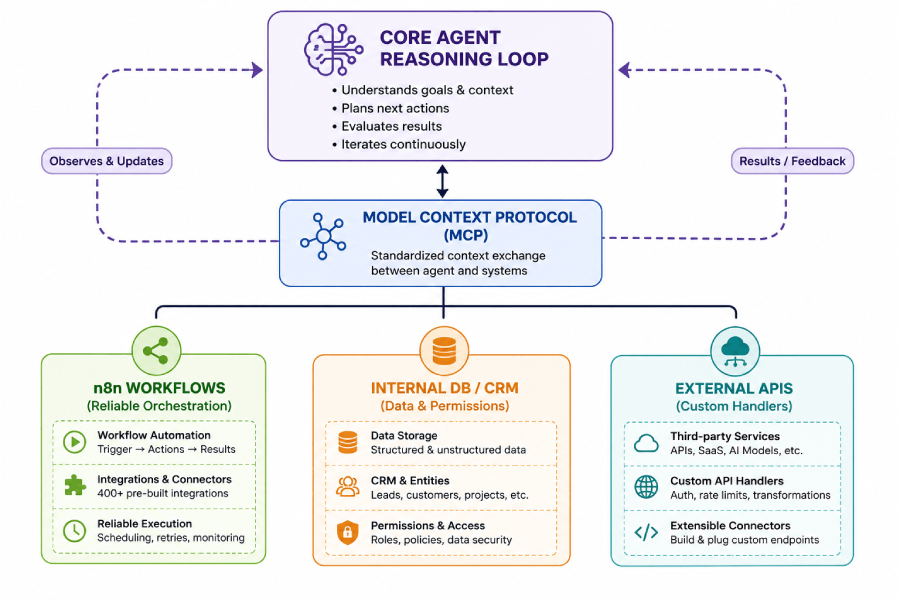
We connect agents to your real tools and data through MCP servers rather than brittle one-off API glue. Fact: Model Context Protocol is an open standard for exposing tools, resources, and data to an LLM through a consistent server interface. In practice, that means your CRM, your database, your internal services, and platforms like n8n become callable capabilities the agent can use, with permissions and audit trails you control.
The payoff is durability. When you swap a downstream tool, you update one MCP server, not every prompt in the system.
3. Token and Context-Window Optimization
Inference cost is a line item, not a footnote, so we engineer for it from day one:
Context Handling over Context Stuffing: We retrieve and scope only the context a step needs, then compact running history into summaries rather than dragging the full transcript through every call.
Model Routing: A small, cheap model triages and classifies; the expensive reasoning model is invoked only when the task earns it.
Prompt Caching: Stable instructions and reference context are cached so repeated calls bill at the reduced cache-read rate instead of full input price.
Structured Outputs: Schema-validated responses cut the retry loops that quietly double your token spend.
My Read: On a high-volume agent, disciplined context and routing work is usually the difference between unit economics that close and ones that do not. This is where most "it works but it is too expensive" projects are won or lost.
Bounded Autonomy with Guardrails
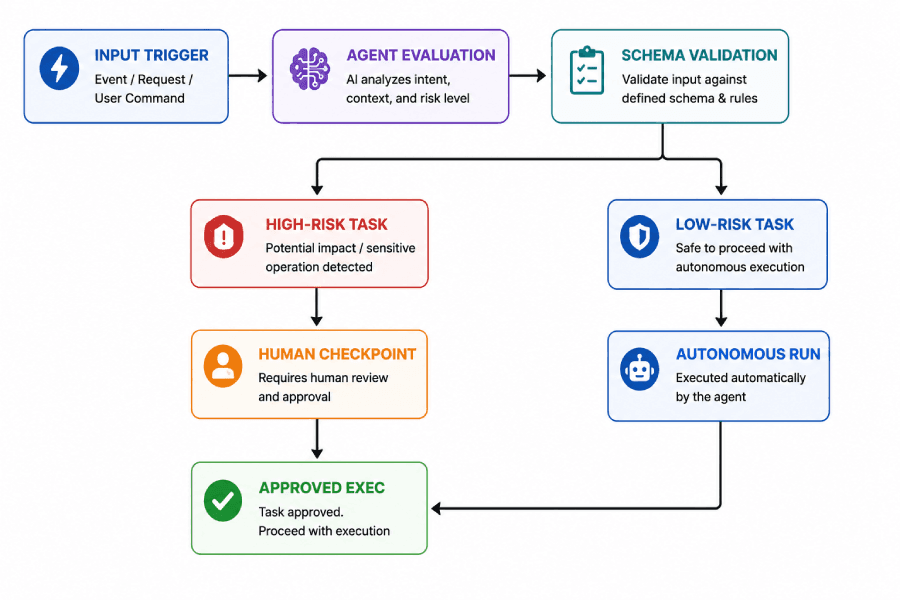
Autonomy is a dial we turn up per workflow once it has earned trust, not a switch we flip on day one. Read-only and low-stakes actions can run unattended; anything that spends money, sends external communication, or touches production records sits behind validation, rate limits, and a human checkpoint until the eval data says otherwise.
Debatable: How much autonomy is "enough" is a per-process risk call, not a universal answer. We make that call with you, against real failure data, not vibes.
Built on a Modern, Future-Proof Stack
We are not married to one model vendor or one framework, and your system should not be either.
01
MCP as the Integration Layer
Tools and data sources are swappable without rewrites.
02
Provider-Flexible Model Routing
Built across the major LLM families, so you are never locked to a single vendor's pricing or roadmap.
03
n8n & Webhooks
For the deterministic orchestration around the agent—the parts that should be a plainly reliable workflow rather than an unpredictable model call.
04
Agentic Retrieval (RAG)
Where the task needs grounded, current knowledge instead of a fixed prompt.
Who This Is For
This page filters by operational profile, not revenue. The right fit is a team with enough repetitive cognitive volume that automating it frees real capacity.
Operations-heavy businesses with a queue of skilled-but-repetitive work (triage, classification, reconciliation, research) that scales with headcount today.
High-growth companies hitting the point where adding people no longer fixes throughput, and process needs to get smarter, not just bigger.
Support and revenue teams that want agent logic handling tier-one volume and routing the rest with full context, not a scripted chatbot that frustrates customers.
Data and analytics functions needing real-time monitoring or synthesis that runs continuously, instead of a report someone builds by hand each morning.
The filter, stated plainly: If you cannot point to a process that currently burns meaningful skilled hours every week, an agent is a solution looking for a problem, and we will tell you so on the first call.
Why Flowagenz
Full Code Ownership, No Vendor Lock-in
On completion, you own the agent code, the prompts, the eval sets, and the infrastructure access outright. The provider-flexible design means you are not locked to us or to a single model vendor either.
Salem-Based, Western-Grade Execution
We are a boutique technical studio in Salem, Tamil Nadu, India. That is the engine behind senior-level engineering at rates a US or UK in-house build cannot match, and we state it openly because it is an advantage, not something to hide.
Real Timezone Overlap
We hold committed overlapping hours with US, UK, and Australia teams and run tight async communication around them, so an agent in production is never waiting hours for a human on the build side.
Depth You Can Interrogate
Ask us about context compaction, MCP server permissions, or how we contain a runaway tool loop, and you get a straight engineering answer, not a sales deflection.
How we
actually work.
01
01
Bottleneck Audit
We map the candidate process, the inputs, the failure modes, and the cost of the current manual path. If an agent is not the right tool, you hear it here.
02
02
Scoped Pilot
We build one agent against one workflow, wired to your real tools through MCP, with an eval harness from the start.
03
03
Hardening and Guardrails
We tune accuracy, set the autonomy boundaries, add monitoring, and validate against real cases until the numbers hold.
04
04
Production Rollout
We ship behind the agreed human checkpoints, watch the live cost and accuracy data, and turn the autonomy dial up only as the evidence supports it.
Related articles
FAQ
Frequently Asked Questions
Everything you need to know about our process and digital systems.
Scope drives it, so we quote against your specific workflow rather than a fake "starting at" number. As an indicative guide, a scoped single-agent pilot typically runs around 2,50,000 to 7,00,000 INR ($3,000 to $8,500), and a production multi-step system with several MCP integrations, an eval harness, and monitoring usually lands around 8,00,000 to 30,00,000 INR ($9,500 to $36,000) and up. (These ranges are indicative and confirmed on scoping.) What pushes a quote up is integration count, accuracy requirements, and how much autonomy the workflow demands.
Start with one task worth improving
Bring us the one repetitive process that drains your team’s hours. We’ll tell you within a week whether an AI agent can reliably own it, what it will cost to build, and exactly how we will contain it with guardrails. No slide decks, no pressure.