Your support queue has a shape: the same twenty questions on repeat, plus the handful that need real judgment. An AI agent grounded in your own help center handles the first group end to end, and routes the second one cleanly to your team.
An AI agent that actually resolves tickets
The problem, reframed
Most "AI support agent" tools ship as a chat widget bolted onto your site with a generic prompt behind it and no visibility into why it said what it said. It answers from whatever it was trained on rather than your help center, your order data, or your actual escalation rules, and that gets you a bot your team distrusts within a week.
The better question is not "can AI answer support tickets." It is "which fraction of your ticket volume is genuinely repetitive, and can we prove the agent answers that fraction correctly before it ever talks to a customer." Scope it around a measurable slice of your queue and it earns trust fast. Scope it as "handle everything" and it stalls in the pilot the way most support AI projects do.
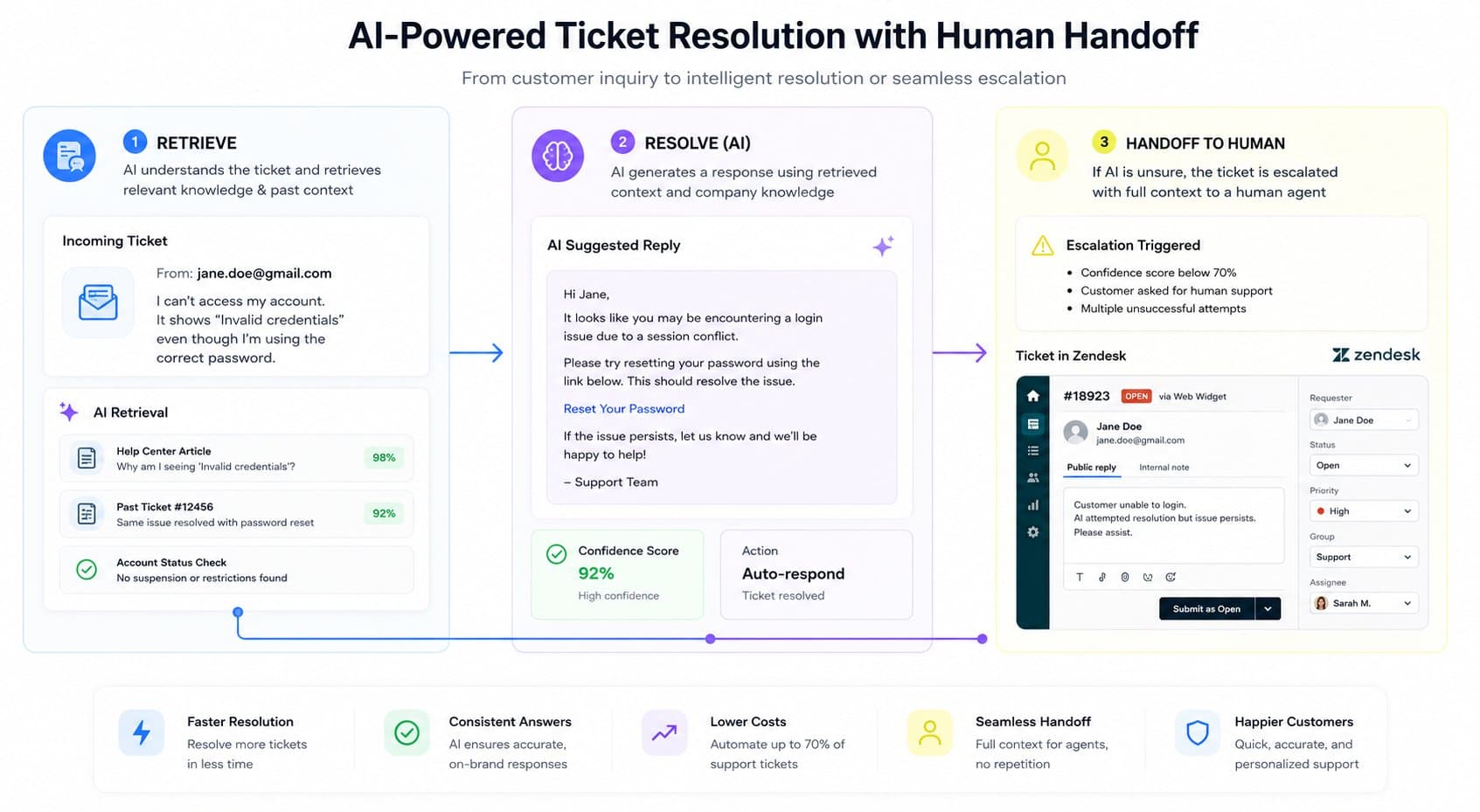
What we build
01
Retrieval grounded in your actual help center and policies.
Your knowledge base, order history, and account data get chunked and indexed in Postgres with pgvector (or your existing vector store), so the agent answers from what is actually true for your business, not from general training data.
02
Confidence-scored responses with a defined escalation path.
Every answer carries a retrieval confidence score. Below a threshold you set, the ticket routes to a human with the retrieved context attached, so your agent is not starting from zero.
03
Multichannel coverage.
The same retrieval and routing logic runs across your website chat widget, email inbox, and WhatsApp Business, so a customer gets a consistent answer regardless of channel.
04
Native integration with the helpdesk you already run.
Ticket creation, tagging, and status updates happen inside Zendesk, Freshdesk, or Intercom through their APIs, not in a separate dashboard your team has to check.
05
An evaluation set before launch, not after.
A held-out set of real historical tickets gets run against the agent before it goes live, so you see resolution accuracy on your actual support history, not a demo script.
Built on a modern, auditable stack
n8n orchestrates the workflow between your helpdesk, your data sources, and the model, so every step is a visible node you can inspect and edit, not a proprietary black box. The Claude API handles response generation and reasoning over retrieved context. Postgres with pgvector holds the embeddings, which means your data stays in infrastructure you control and can migrate off at any point. For teams already running internal tools on Ollama or vLLM for cost or data-residency reasons, the same retrieval layer plugs into a self-hosted model instead.
Who this is for
Support teams with a documented but underused knowledge base. You already have help center articles or a policy doc. The agent gets far more mileage out of that content than your customers currently do.
Businesses with real tool sprawl across support channels. Chat, email, and WhatsApp are handled by different tools or different people right now, and nobody has a single view of resolution quality across them.
White-label agency partners who need support automation capacity to offer their own clients without building the retrieval and integration layer themselves.
Growing SMBs past the point where a shared inbox works, where ticket volume has outpaced what founders or a two-person support team can answer by hand, regardless of current revenue size.
Why Flowagenz
I build the retrieval and evaluation layer myself, which is why the page above talks about confidence thresholds and held-out test sets instead of "smart AI that understands your customers." That is the difference between a system you can trust with real tickets and a demo that looks good in a sales call.
We are based in Salem, Tamil Nadu, which means senior engineering time at a fraction of US or UK agency rates, not a discount on quality. We keep working hours that overlap with US, UK, and Australian business days, and async communication fills the rest, so a question raised at your end of day gets an answer waiting when you start the next one.
No vendor lock-in. On completion, you get full ownership of the codebase, the n8n workflows, and the hosting access. If you want to bring the work in-house or hand it to another developer later, nothing here holds you back.
Process
How it works
01
01
Scoping call.
We look at a sample of your actual ticket history to find the genuinely repetitive slice worth automating first, and agree on the channels and helpdesk integration in scope.
02
02
Retrieval build.
Your knowledge base and relevant data sources get indexed, chunked, and tuned for your content type.
03
03
Evaluation pass.
The agent runs against a held-out set of real historical tickets before it ever sees a live customer, and we review the misses together.
04
04
Integration and escalation wiring.
The agent connects to your helpdesk and channels, with the confidence-based handoff rules you approved.
05
05
Launch and monitoring window.
A defined period of close monitoring after go-live, with threshold adjustments based on real traffic.
Custom scoping happens on a call once we have seen your actual ticket volume and channel mix. That is a deliberate choice over a generic "starting at" price, since a single-channel FAQ bot and a three-channel agent with helpdesk integration are genuinely different builds.
FAQ
Frequently Asked Questions
Everything you need to know about our process and digital systems.
Scope drives the number. A single-channel agent answering from one knowledge base sits at a different price point than a three-channel build with helpdesk integration and custom escalation logic. Once we have seen a sample of your ticket volume and channel mix on a scoping call, we give a fixed quote in INR and USD, not a moving hourly estimate.
Related articles
Ready to see if your ticket volume is a fit
If a meaningful share of your support queue is the same handful of questions on repeat, that is worth a scoping call. Bring a rough sense of your monthly ticket volume and the channels you support on, and we will tell you plainly whether an AI support agent is worth building for your case or whether your queue is better served by simpler fixes first.