Two tactics became the default deliverables of AI search optimization over the last year: publish an llms.txt file, and wrap your FAQs in FAQPage schema. Both are cheap, both are easy to sell, and both now have enough published data behind them to judge. The short version is uncomfortable for anyone who sold them as the fix. llms.txt shows no measurable effect on AI citations in any large study so far, and the FAQ rich result that made FAQ schema worth doing in the first place was switched off by Google on May 7, 2026. The markup itself is a murkier story, and it is worth getting right rather than repeating whichever claim your favorite SEO newsletter ran with.
One caveat before the details. This post synthesizes published studies, it is not a controlled test run on Flowagenz's own sites, and almost every study cited here measures citations or bot fetches, not revenue-grade traffic. That gap matters, and the section on calibrating expectations returns to it. Where sources disagree, the post says so and names the source type, because a vendor selling a GEO tool and an independent crawler study are not the same kind of evidence.
If you only have time for one thing, check that AI search crawlers can actually reach your pages. Everything else is optimization on top of access you may not have.
llms.txt: what the data says
llms.txt is a Markdown file at a site's root that lists key pages for AI systems, proposed in 2024 as a kind of sitemap for models. Adoption took off anyway: Ahrefs found roughly 28% of 137,000 analyzed domains had published a valid one. Then the measurement arrived.
Almost nobody reads it. In the same Ahrefs dataset, about 97% of llms.txt files received zero requests from AI bots in May 2026. A separate analysis of more than 500 million bot events found requests to the file were a statistically negligible share of what GPTBot, ClaudeBot, and PerplexityBot actually fetch.
It does not correlate with being cited. SE Ranking tested nearly 300,000 domains and found no statistically significant relationship between having llms.txt and being cited in AI answers. In their model, dropping the llms.txt variable made predictions slightly more accurate, meaning it was adding noise, not signal. A separate review of 94,614 cited URLs found exactly one that was an llms.txt page. A May 2026 correlation study from Zyppy, as summarized by third parties, ranked it as the lowest-scoring factor on its list.
The platforms have not endorsed it. Google has said it does not use the file, and its AI search guidance says no special files or schema are required. OpenAI, Anthropic, and Perplexity do not document it as a citation signal or visibility requirement. One 2026 analysis reports that Google added an llms.txt check to Lighthouse in May under a new agentic browsing category, which is best read as a small technical acknowledgment, not an endorsement that the file improves rankings.
Two honest limits on all of this. The studies use different methods, server log analysis in one case and correlation modeling in the other, and none of them demonstrates a causal effect in either direction. And no large study yet isolates whether llms.txt helps with something narrower, like entity disambiguation, so "no measurable citation lift" is the accurate claim, not "provably useless."
Practical read: adding one takes under an hour and breaks nothing, so there is no reason to fight a client who wants it. There is every reason not to bill it as an AI visibility strategy.
FAQ schema: the rich result died, the argument did not
The timeline matters here because the claims people repeat mix up two different things.
Google restricted FAQ rich results to government and health sites in August 2023, then ended the feature entirely on May 7, 2026. That is the visual dropdown under a search result, and it is gone. What Google did not do, according to the documentation notice, is declare FAQPage markup invalid. Google says it continues to use FAQ structured data to understand pages, and that leaving unused structured data in place causes no problems.
So should you remove it? Not unless the FAQ section itself was filler. The more interesting question is whether it helps AI citations, and this is where sources split.
The bullish claim. Several GEO-focused sites report that pages with FAQPage markup are cited in Google AI Overviews about 3.2 times as often as pages without structured data (13.6% against 4.2% in one index), and that structured data generally correlates with more citations across ChatGPT, Perplexity, and AI Overviews. Treat this carefully: the figure is repeated across many vendor and agency posts that trace back to the same small set of sources, and it is a correlation between pages that have markup and pages that do not.
The cautious claim. Google's May 2026 guidance for generative AI search says structured data is not required, and there is no special schema to add. One 2026 analysis puts it plainly: there is no confirmed evidence that FAQPage markup itself wins citations. It points to AirOps data showing that content with clean heading and question-and-answer structure earns citations at roughly 2.8 times the rate of unstructured prose, then notes that this is correlation, because well-structured pages tend to be stronger in every other way too.
What the larger models say. Semrush's January 2026 content study found clarity and summarization, E-E-A-T signals, and Q&A format among the strongest positive correlations with citations, with structured data correlating too but lower on the list. A regression-style analysis from AuthorityTech found schema's independent effect to be small once domain strength was controlled for.
The honest read: the format is doing the work, not the markup. Writing a real question, answering it directly in the first sentence or two, and keeping answers self-contained is what correlates with citations. FAQPage JSON-LD is a cheap way to label that content, and it costs nothing to keep. It is not a traffic lever you can pull, and anyone promising a multiple on it is extrapolating from correlation.
What the evidence says does move citations
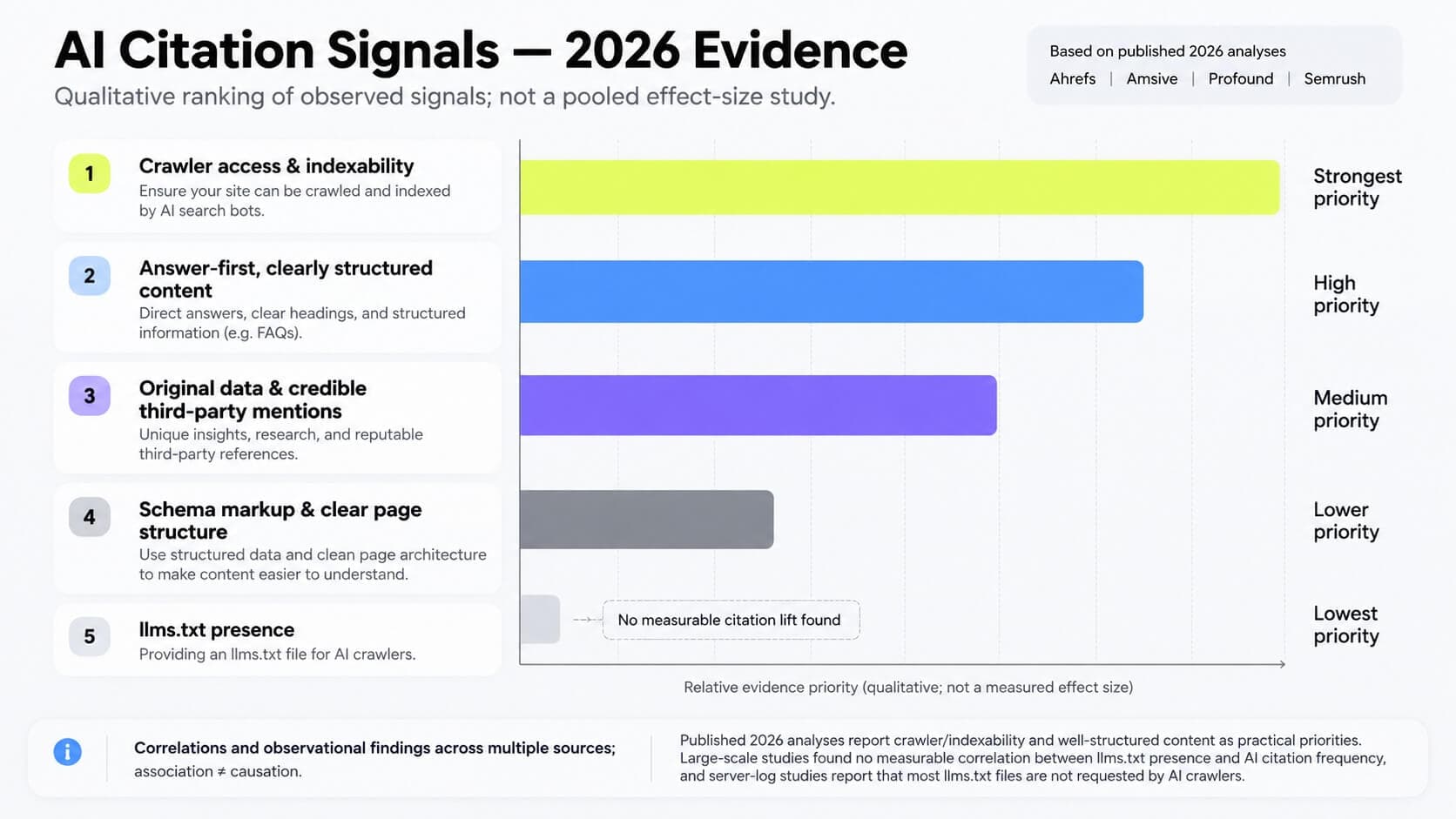
When you read across the larger datasets instead of the single-tactic posts, a consistent, unglamorous picture appears.
Crawler access comes first
AI answer engines cannot cite a page they cannot fetch. This is the least exciting finding and the highest-impact one. The distinction that trips people up is that AI crawlers do very different jobs. Cloudflare Radar data for mid-2026 shows training crawls make up about 44.5% of AI crawler requests and send no referral traffic, while search-purpose crawling (11.57% in July) and user-triggered fetches (2.66%) together, about 14%, come from bots that can put your page in front of a person.
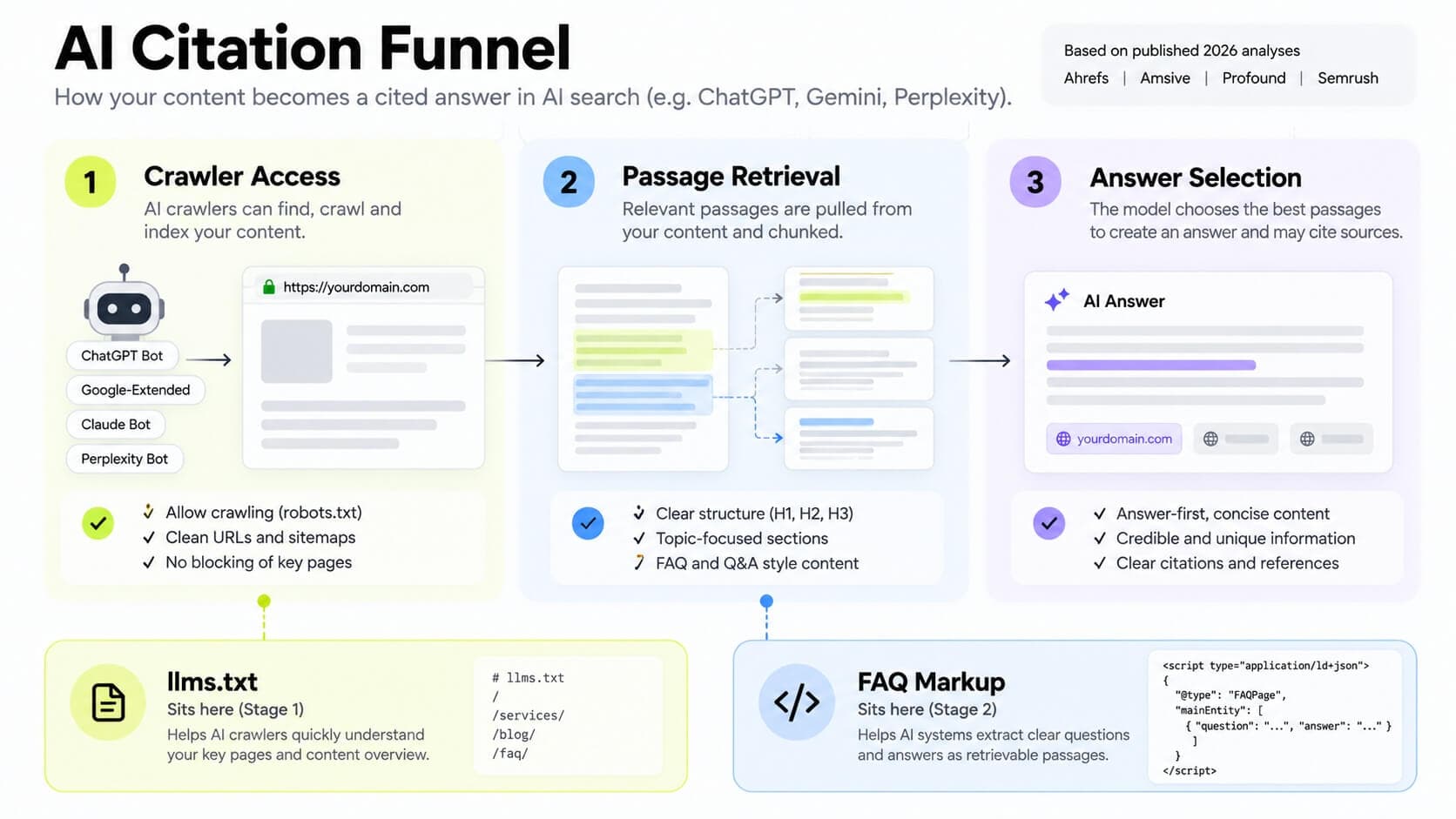
In practice, that means the bots that matter for citations are the live-retrieval ones: OAI-SearchBot and ChatGPT-User for OpenAI, PerplexityBot, and Claude-SearchBot and Claude-User for Anthropic. Blocking OAI-SearchBot removes you from ChatGPT search answers, and blocking Claude-SearchBot and Claude-User does the same for Claude. Training bots like GPTBot, ClaudeBot, and CCBot are a separate policy decision about whether your content trains models, and you can make it independently of whether you want to be cited. Whether to allow training is a business and legal call, not a technical one.
The less obvious failure is at the network layer. One vendor audit found around 27% of B2B sites accidentally blocking AI bots at the CDN or firewall even with a clean robots.txt, which a robots.txt fix cannot repair. Take that number as directional, since it comes from a company selling this kind of audit, but the failure mode is real and cheap to check in your server logs.
Answer position and query match
Two page-level findings recur. Citations skew toward the top of a document, with one analysis finding about 44% of AI references come from the first 30% of a page. And semantic closeness between the page and the exact question being asked shows up as one of the strongest page-level signals in the regression work, with Discovered Labs' analysis of roughly 2 million citations finding prompt-to-content alignment about three times larger than the next page-level signal.
The practical translation: answer the question in the opening lines of the section that is supposed to answer it, using the phrasing a real person would type. This is the same retrieval logic behind chunking strategies for RAG, since answer engines pull passages, not whole pages, and a passage that needs the paragraph above it to make sense is a weaker candidate.
Authority and earned mentions
The same Discovered Labs analysis found domain-level authority roughly six times as influential as the strongest individual page feature. Muck Rack's analysis of more than 25 million links cited by ChatGPT, Claude, and Gemini found 84% were earned media, with paid or advertorial content at 0.3%. Ahrefs data summarized elsewhere shows only 38% of AI Overview citations now come from pages in Google's top 10, down from 76% in mid-2025, which means classic ranking matters less than it did, but brand mentions across the web matter more.
This is the slow lever, and for a small agency or business it is the one that cannot be shortcut with a file.
Speed and clean HTML
A vendor study reports pages with a First Contentful Paint under 0.4 seconds averaged about 6.7 ChatGPT citations against 2.1 for pages over 1.13 seconds. It is a single-source number from a company in this space, so use it as a nudge, not a benchmark. The reasoning behind it is sound regardless: fast, server-rendered, clean HTML is easier for any crawler to read, which is the same case made in our guide to migrating WordPress to Next.js and Strapi without losing SEO, where server-rendered content and JSON-LD are treated as requirements, not extras.
Calibrate expectations: AI referral traffic is still small
This is the part that rarely makes the headline. Previsible analyzed 1.96 million LLM-driven sessions from November 2024 through November 2025 and found AI-referred traffic averaged just 0.13% of total sessions, concentrated on higher-intent pages such as industry, tools, blog, and pricing pages. Other analyses show AI-referred sessions growing fast in percentage terms, but from a small base.
That changes how to read "what moved traffic." For most sites in 2026, AI search is a small, high-intent channel next to classic search and direct, and none of the tactics above has been shown to move it by an amount worth attributing to a single file or tag. The right framing is that crawler access and answer-first content improve both classic and AI visibility at the same time, which is why they are worth doing even if the AI channel stays small. It also fits how commerce is changing, as covered in Shopify vs headless commerce, where AI shopping agents increasingly query structured product data directly and skip the frontend entirely.
How to test this on your own site
Published studies tell you what correlates across thousands of sites. They cannot tell you what moves yours. A lightweight way to find out:
Read your server or CDN logs for AI user agents over 30 days. Confirm OAI-SearchBot, PerplexityBot, and the Claude bots actually receive 200 responses, not 403s or challenge pages.
Segment AI referrals in analytics. Referrals from chatgpt.com, perplexity.ai, gemini.google.com, copilot.microsoft.com, and claude.ai can be isolated into one channel group so changes are visible instead of buried in "referral."
Change one thing at a time. Rewrite the opening of your ten highest-intent pages to answer directly, or fix a crawler block, not both in the same week.
Allow several weeks. Reports on crawler-side fixes describe lift appearing over roughly three weeks as bots re-crawl, so a week-one readout is noise.
Track a fixed set of 20 to 30 real queries manually in each engine monthly, recording whether you are cited. It is tedious, and it is the only direct measurement of the thing you care about.
Where to spend the effort
Do first: confirm AI search and user-triggered crawlers can reach your pages at the robots.txt, CDN, and rendering layers. Make sure core content is in server-rendered HTML.
Do next: restructure your highest-intent pages so each section opens with a direct answer in natural query phrasing, and keep FAQ sections genuine, with self-contained answers.
Do cheaply, expect nothing: keep FAQPage JSON-LD on real FAQs, and add llms.txt if a client wants it. Both are harmless. Neither deserves a line item promising results.
Invest slowly: original data, expert content, and earned mentions. This is the largest lever in the biggest datasets, and it compounds.
Skip: paying anyone for an AI visibility package whose main deliverables are llms.txt and schema.